In short, similes for small things help you compare tiny objects, ideas, or details to something familiar by using words like “as” or “like.” They make your writing more vivid, memorable, and fun to read. Keep reading to discover examples, tips, and activities you can use in school and creative writing.
[IMAGE: A student writing creative similes about tiny objects in a notebook]
What Are Similes for Small Things? (And Why They Matter)
Have you ever been writing a story when your teacher asked you to describe something tiny, but all you could think of was “very small”? You are not alone. Many students want to make their writing more interesting but struggle to find the right comparison.
Similes for small things compare something tiny to another small or delicate object using the words “like” or “as.” Instead of saying something is simply “small,” you create a picture in your reader’s mind.
For example, instead of writing, “The bug was small,” you could write, “The bug was as small as a grain of sand.” Your reader instantly imagines its tiny size.
Language arts researchers and literacy educators encourage students to practice similes because they improve descriptive writing, reading comprehension, and creative thinking. Once you learn how to use them, you can make your stories, poems, and essays much more engaging.
Now that you know what they are, let’s explore some of the best examples you can use right away.
The Best Examples of Similes for Small Things
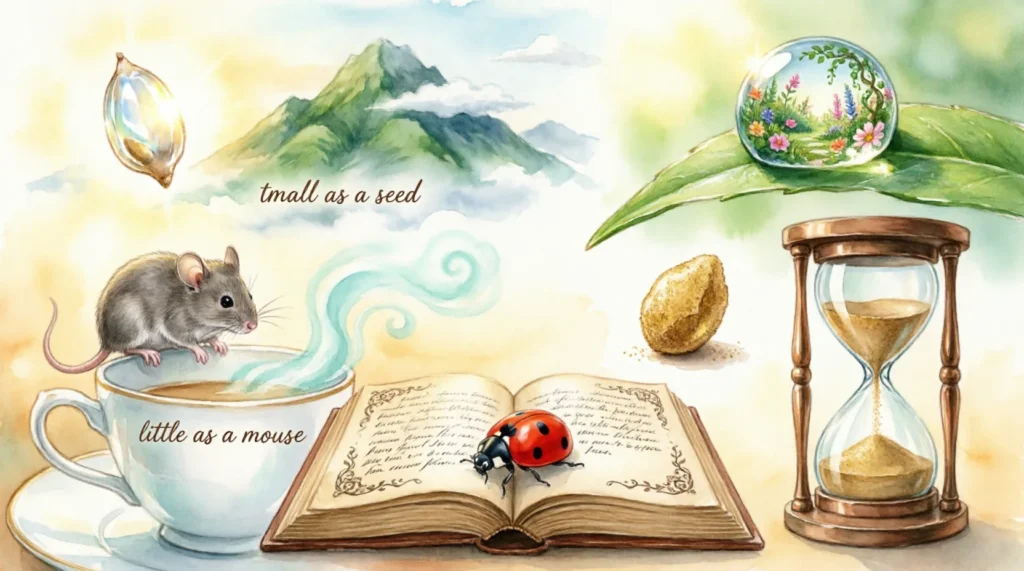
As small as a grain of sand.
As tiny as an ant.
Like a single raindrop on a leaf.
As little as a ladybug.
Like a tiny pebble beside a mountain.
As small as a sesame seed.
Like a speck of dust floating in sunlight.
As tiny as a snowflake.
Like a drop of dew on grass.
As small as a pinhead.
Like a single grain of rice.
As tiny as a baby’s fingernail.
Like a bead hidden in the carpet.
As little as a marble.
Like a crumb on the kitchen table.
As small as a coin.
Like a tiny star in the night sky.
As tiny as a mouse’s footprint.
Like a seed waiting to grow.
As little as a feather drifting through the air.
Like a bubble floating across a pond.
As small as a button.
Like a sparkle on a diamond.
As tiny as a drop of paint.
Like a tiny shell on the beach.
As little as a paper clip.
Like a firefly in the distance.
As small as a puzzle piece.
Like a leaf caught in the wind.
As tiny as a grain of sugar.
Like a bead of water on a spider web.
As little as a cherry pit.
Like a tiny bell hanging from a branch.
As small as a pencil eraser.
Like a miniature toy car.
As tiny as a flower petal.
Like a snowflake landing on your sleeve.
As little as a popcorn kernel.
Like a single stitch in a quilt.
As small as a teardrop.
Like a tiny pearl in an oyster.
As little as a blueberry.
Like a tiny candle flame in the dark.
As small as a leaf bud in spring.
Like a butterfly resting on a fingertip.
These examples work well because they create clear mental pictures. Many also connect to everyday experiences, making them easy for you to understand and remember.
When you choose comparisons your readers recognize, your writing feels more vivid, emotional, and believable. Next, let’s learn how you can create your own.
How to Use Similes for Small Things in Your Writing
You do not need to memorize dozens of similes. Instead, follow these simple steps whenever you write.
Think about exactly how small the object is. Is it the size of a seed, a pebble, or a grain of salt? The more precise you are, the stronger your simile becomes.
Choose something your readers already know. Comparing a tiny insect to an ant works better than comparing it to something unfamiliar.
Match the mood of your writing. A funny story might compare something to a popcorn kernel, while a poem could compare it to a snowflake.
Read your sentence aloud. If it sounds natural and creates a clear picture, you have probably chosen a good simile.
Example:
“The lost earring was as small as a grain of rice, so Maya searched the floor for nearly an hour.”
With a little practice, you will begin creating your own original comparisons without much effort.
Similes for Small Things in Poems and Stories
Creative writing becomes more memorable when you include colorful comparisons.
Aisha wrote:
“The hope inside her heart Was as tiny as a seed, Yet it waited patiently To become a mighty tree.”
Miguel described his adventure:
“The hidden key was as small as a button, tucked beneath the old flowerpot where no one expected to find it.”
Priya wrote:
“A tiny star blinked above the trees, like a silver bead sewn into the sky.”
Poets and authors use similes for small things because tiny details often carry big emotions. A small object can represent hope, mystery, kindness, or even courage when described with vivid imagery.
As you read books and poems, you will notice many writers using simple comparisons to make ordinary moments unforgettable.
Common Mistakes Students Make With Similes for Small Things
Choosing comparisons that are not actually small. Sometimes students compare tiny objects to large ones, which confuses readers. Make sure both parts of your comparison match.
Using too many similes in one paragraph. Every sentence does not need a simile. A few well-chosen comparisons usually have a stronger effect.
Picking unclear comparisons. If your readers have never seen the object you mention, they may not understand the image. Choose familiar examples whenever possible.
Forgetting the words “like” or “as.” A simile normally uses one of these words. Without them, you may accidentally write a metaphor instead.
Comparing everything to the same object. It is easy to write “as small as an ant” repeatedly. Challenge yourself to discover fresh comparisons that fit the situation.
Learning from these common mistakes will help you write with greater confidence.
Fun Activities to Practice Similes for Small Things
Tiny Treasure Hunt: Grab a pencil and find ten tiny objects around your home or classroom. Write a unique simile for each one.
Picture Challenge: Look at a nature photo and create five similes describing the smallest details you can spot.
Story Swap: Play with a friend by writing short stories that each include three different similes for small things. Read them aloud and guess which similes are your favorite.
Draw and Describe: Sketch a tiny object like a ladybug or a pebble, then write three creative similes underneath your drawing.
Reading Detective: While reading a novel or poem, search for similes that describe small objects. Notice how they help you imagine the scene.
Worksheet Race: Create a worksheet with unfinished similes, such as “As tiny as _______.” Challenge yourself or your classmates to complete them with original ideas.
The more you practice in different ways, the easier descriptive writing becomes.
What NOT to Do With Similes for Small Things
Do not assume every tiny object needs the same comparison. Different situations call for different images, so try to match your simile to the scene.
Do not choose comparisons that distract the reader. If your simile is too unusual or confusing, it may take attention away from your writing.
Do not force a simile into every sentence. Strong writing mixes simple descriptions with figurative language instead of relying on one style.
Do not believe there is only one “correct” simile. One of the best parts of creative writing is that you can invent fresh comparisons as long as they are clear and meaningful.
Now that you know what to avoid, you are ready to answer some common questions students often ask.
Frequently Asked Questions About Similes for Small Things
What is a simile for something very small?
A classic example is “as small as a grain of sand.” You can also use comparisons like “as tiny as an ant” or “like a speck of dust” depending on the situation.
How do you use similes for small things in a sentence?
Use “like” or “as” to compare something tiny with another familiar object. For example: “The baby turtle was as small as my palm.”
What is the difference between a simile and a metaphor for small things?
A simile uses the words “like” or “as” to make a comparison. A metaphor says one thing is another without using those comparison words.
Are similes for small things suitable for elementary and middle school students?
Yes. These similes are easy for younger students to understand while still giving older students plenty of room to write creatively. Creative writing teachers often recommend starting with familiar objects before inventing original comparisons.
Why do writers use similes for small things?
Writers use them to help readers picture tiny details more clearly. Small objects often become more interesting and meaningful when described with vivid comparisons.
Final Thoughts on Similes for Small Things
Learning similes for small things is a simple way to make your writing more colorful and expressive. Whether you are describing a tiny insect, a hidden treasure, or a delicate flower, the right comparison helps your reader see exactly what you imagine.
You have explored dozens of examples, learned practical writing strategies, discovered common mistakes, and practiced fun classroom activities. These skills will help you write stronger stories, poems, and school assignments.
Literacy researchers and language arts educators agree that descriptive writing grows through regular practice. Every new simile you create builds your confidence and expands your vocabulary.
Keep observing the tiny details around you, keep experimenting with new comparisons, and remember that every great writer starts with small steps. Happy writing!
Liam Nguyen is a passionate educator and writer with a deep love for figurative language. He holds a master’s degree in Creative Writing and has spent eight years teaching at various educational settings, focusing on language enrichment programs for children from grades 2-6. His expertise in crafting metaphorical language and similes into captivating content stems from his belief that storytelling is the heartbeat of learning. Liam’s contributions to SimilePedia span from emotion-driven examples to color-inspired narrative tools. He is committed to fostering a creative environment where students can explore and find joy in their unique expressions.