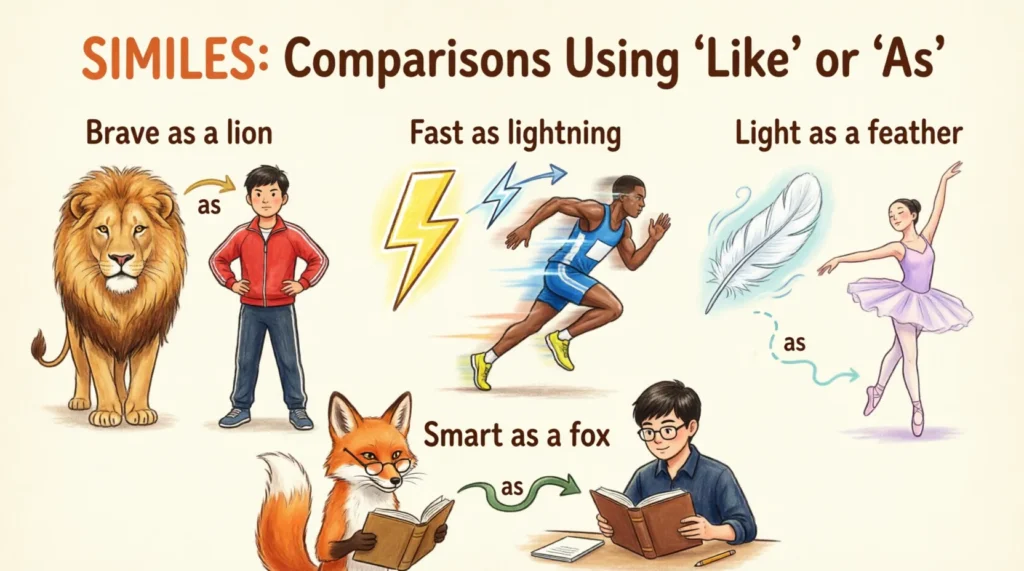
In short, similes for comparison help you describe people, places, feelings, and ideas by comparing one thing to another using the words “like” or “as.” They make your writing more colorful, easier to picture, and more enjoyable to read. Keep reading to discover examples, writing tips, and fun ways to practice using them with confidence.
What Are the Similes for Comparison? (And Why They Matter)
Have you ever stared at a blank page because you knew what you wanted to say but couldn’t find the right words? Maybe your teacher asked you to make your writing more descriptive, and you weren’t sure how to do it. If that sounds familiar, you’re not alone.
Similes for comparison are figures of speech that compare two different things using the words “like” or “as.” They help readers imagine what something looks, sounds, feels, or acts like by connecting it to something familiar.
For example, instead of writing “The runner was fast,” you could say, “The runner was as quick as lightning.” That simple comparison creates a much stronger picture in your reader’s mind.
Language arts researchers and literacy educators often encourage students to use similes because they improve descriptive writing, reading comprehension, storytelling, and creative thinking. Once you understand how they work, you’ll notice them everywhere—from books and poems to songs and everyday conversations.
[IMAGE: Student writing colorful similes in a notebook]
The Best Examples of Similes for Comparison
Here are some vivid and creative similes for comparison that you can use or adapt in your own writing.
As brave as a lion.
As quiet as a mouse.
As bright as the morning sun.
Like a feather floating through the air.
As busy as a bee.
As gentle as a spring breeze.
Like a rocket shooting into space.
As cool as fresh snow.
As cheerful as a bird at sunrise.
Like a rainbow after the rain.
As sharp as a razor.
Like a candle shining in the darkness.
As calm as a peaceful lake.
Like popcorn popping in a hot pan.
As strong as an oak tree.
Like a fish swimming through clear water.
As soft as a fluffy cloud.
Like thunder rolling across the sky.
As happy as a child on a birthday.
Like a puzzle finally coming together.
As smooth as polished glass.
Like leaves dancing in the wind.
As colorful as a box of crayons.
Like stars sparkling in the night sky.
As steady as a mountain.
These examples work well because they create clear mental pictures. They also connect everyday experiences with new ideas, making your writing more memorable. When you choose comparisons that your readers can easily imagine, your descriptions become stronger and more meaningful.
Now that you’ve seen plenty of examples, let’s explore how you can create your own.
How to Use Similes for Comparison in Your Writing
You don’t need to be an expert writer to use similes for comparison effectively. Follow these simple steps whenever you write.
Think about what you want to describe. Ask yourself what quality stands out the most. Is it fast, bright, loud, soft, or something else?
Find something that shares that quality. Think of objects, animals, nature, or everyday experiences your readers already know.
Connect them with “like” or “as.” This creates a clear simile that readers can understand immediately.
Read your sentence aloud. If it sounds natural and creates a clear picture, you’ve probably chosen a good comparison.
Example:
“The basketball flew like a shooting star, leaving everyone amazed.”
As you practice, you’ll find that creating your own comparisons becomes easier and much more fun.
Similes for Comparison in Poems and Stories
Poets and authors often use similes for comparison because they add emotion, rhythm, and vivid imagery. They help readers feel as if they are inside the story.
Maya whispered, “Hope spread through me like sunlight through morning clouds.”
Ayaan sprinted across the playground like the wind chasing autumn leaves. Everyone cheered before he even crossed the finish line.
Sofia smiled as brightly as the first flower blooming in spring. Her kindness made every classroom feel warmer.
Whether you’re writing a poem, a short story, or even a school assignment, thoughtful comparisons can make your ideas much more engaging. Creative writing teachers often encourage students to experiment with different comparisons until they discover the one that fits best.
Let’s also look at some common mistakes so you can avoid them.
Common Mistakes Students Make With Similes for Comparison
Choosing confusing comparisons. If your reader cannot imagine the comparison, try using something more familiar.
Using too many similes in one paragraph. A few strong comparisons usually work better than filling every sentence with them.
Mixing different ideas together. Stay focused on one quality at a time instead of comparing many unrelated things.
Using overused comparisons without adding variety. “As busy as a bee” is fine, but you can also create fresh comparisons that match your own style.
Forgetting the words “like” or “as.” Remember that similes use these comparison words. Without them, you may accidentally create a metaphor instead.
Making these mistakes is completely normal. Every writer improves by practicing and revising.
Fun Activities to Practice Similes for Comparison
Grab a pencil and create a “Comparison Challenge.” Choose five everyday objects and write a new simile for each one.
Play a classroom guessing game. One student reads a simile while everyone else guesses what is being described.
Draw and write. Sketch an object, animal, or scene, then write three creative similes that match your drawing.
Read a favorite story. Highlight every simile you find and discuss why the author chose that comparison.
Make your own worksheet. Write simple sentences, then improve each one by adding a creative simile.
Try a family writing contest. Everyone writes five original similes, then votes for the funniest, most imaginative, and most descriptive one.
These activities help you notice comparisons in everyday life while making writing feel more like play than homework.
What NOT to Do With Similes for Comparison
Don’t think every sentence needs a simile. Strong writing uses comparisons when they add meaning, not just to fill space.
Don’t compare things that have nothing in common. A comparison should help readers understand your description instead of confusing them.
Don’t copy every common simile you find online. Original comparisons often make your writing more interesting and memorable.
Don’t assume longer similes are always better. Sometimes the simplest comparison creates the strongest image.
Frequently Asked Questions About Similes for Comparison
What are similes for comparison?
Similes for comparison describe one thing by comparing it to another using “like” or “as.” They help readers picture ideas more clearly and make writing more engaging.
How do you use similes for comparison in a sentence?
Start with what you want to describe, then compare it to something familiar. For example: “Her laughter was like music filling the room.”
What is the difference between similes for comparison and metaphors?
A simile uses “like” or “as” to compare two things. A metaphor says one thing is another without using those comparison words.
Are similes for comparison good for school writing?
Yes. They are excellent for stories, poems, personal narratives, and descriptive paragraphs. They also help you develop stronger vocabulary and more expressive writing.
Why do writers use similes for comparison?
Writers use them to create vivid images, express emotions, and help readers connect with ideas more easily. A well-chosen simile can make an ordinary sentence unforgettable.
Final Thoughts on Similes for Comparison
Learning similes for comparison is one of the easiest ways to make your writing more colorful and expressive. Whether you’re writing a poem, a story, or a classroom assignment, good comparisons help your readers see exactly what you imagine.
You’ve explored dozens of examples, learned how to create your own comparisons, discovered common mistakes to avoid, and found fun activities to build your skills. Each time you practice, your confidence will grow.
Remember that the best similes come from careful observation. Look around your world, notice interesting details, and think about what they remind you of.
With practice, you’ll find that using similes becomes natural, and your writing will become clearer, more creative, and more enjoyable to read. Keep experimenting, keep imagining, and enjoy every step of your writing journey.
Jamal Rodriguez is a poet and author who has been writing professionally for over a decade. With a Bachelor’s degree in Creative Writing, Jamal’s expertise lies in the use of vivid imagery and emotional depth in poetic language. Fascinated by the limitless possibilities of similes and metaphors, he joined SimilePedia to share his knowledge with budding writers. Jamal focuses on creating content for creative writers and poets, helping them understand the emotional resonance that figurative language can evoke. Through his work, he aims to inspire others to explore their own creative boundaries and embrace the beauty of language as an art form. His contributions include a range of exercises that stimulate imagination across all grade levels.