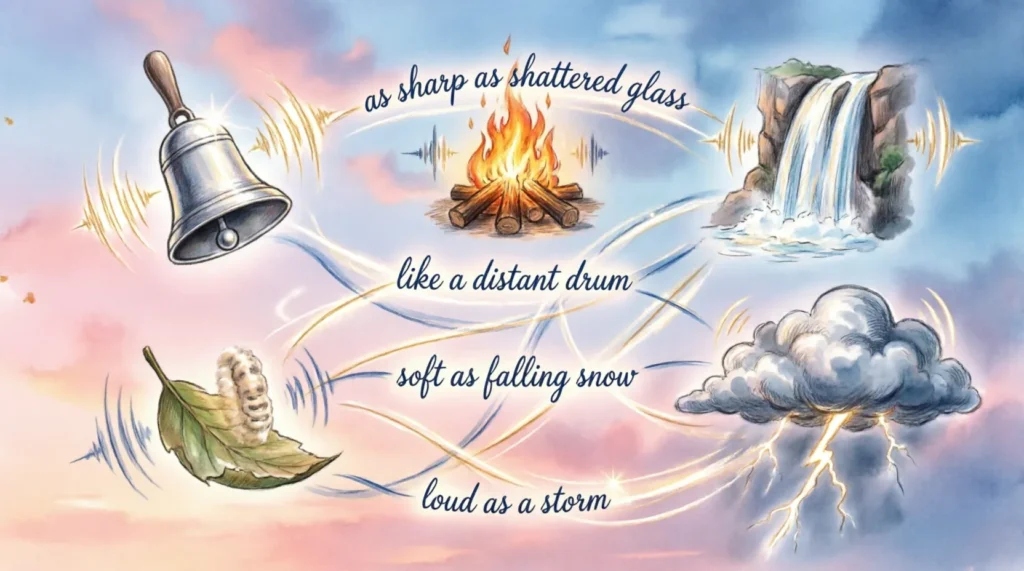
In short, similes for sounds are comparisons that help you describe noises in a vivid and interesting way. They usually use the words “like” or “as” to compare one sound to something familiar. In this guide, you’ll discover creative examples, writing tips, common mistakes, and fun activities that can make your descriptions sound more alive and exciting.
What Are Similes for Sounds? (And Why They Matter)
Picture this: you’re writing a story for school, and your teacher says, “Describe the thunder.” You know it was loud, but suddenly your mind goes blank. Was it booming? Crashing? Roaring?
That’s where similes for sounds can help you.
A simile compares one thing to another using words such as “like” or “as.” When you describe sounds with similes, you help your reader hear the moment in their imagination.
For example:
“The thunder rumbled like a giant rolling a drum across the sky.”
“Her laugh sounded like bells ringing in the wind.”
These comparisons matter because they make your writing stronger, clearer, and more emotional. Literacy educators often encourage students to use sensory details because readers remember writing that helps them see, hear, and feel a scene.
Whether you are writing poems, stories, essays, or even song lyrics, similes can help your words stand out. Once you start noticing sounds around you, you’ll find inspiration almost everywhere.
The Best Examples of Similes for Sounds
[IMAGE: A student listening to rain and writing similes in a notebook]
Here are some vivid and creative examples of similes for sounds that you can use in your own writing:
The thunder crashed like a thousand drums beating at once.
Her laughter rang like tiny silver bells.
The leaves rustled like whispers in a library.
The car engine growled like an angry bear.
The rain tapped the roof like fingers on a table.
His voice was as smooth as soft jazz music.
The alarm screamed like a frightened cat.
The crowd roared like ocean waves during a storm.
The bee buzzed like a tiny electric motor.
The wind howled like wolves in the dark.
The teacher’s chalk squeaked like a mouse trapped in a corner.
The fireworks exploded like popcorn bursting in a pan.
Her sneakers squeaked like rubber ducks on the gym floor.
The clock ticked like tiny footsteps in an empty hallway.
The baby cried like a siren in the night.
The bird sang like a flute floating through the trees.
The computer hummed like a sleepy robot.
The door creaked like an old pirate ship.
The river rushed like applause after a concert.
His whisper floated like smoke through the room.
The train rattled like loose coins in a jar.
The ice cracked like breaking glass.
The guitar echoed like waves rolling onto a beach.
The classroom chatter buzzed like a busy beehive.
The popcorn machine popped like tiny fireworks.
The dog barked like a warning trumpet.
The sneakers slapped the pavement like wet towels.
The kettle whistled like a high-pitched bird call.
The vacuum cleaner roared like a jet engine.
The typing sounded like rain falling on metal.
These examples work well because they create strong imagery and sensory detail. Instead of simply saying a sound was “loud” or “quiet,” you paint a picture in the reader’s mind.
Creative writing teachers often remind students that the best similes connect sounds to things people already recognize. When your reader can imagine the comparison easily, your writing feels more powerful and memorable.
Now that you’ve seen great examples, let’s look at how you can create your own.
How to Use Similes for Sounds in Your Writing
Using similes for sounds becomes easier when you break the process into simple steps.
Listen carefully to the sound.
Before you write, pause and really notice the noise around you. Is it sharp, soft, scratchy, booming, cheerful, or scary? Your ears are your best writing tool here.
Think of something familiar.
Ask yourself: “What else sounds like this?” Maybe thunder sounds like drums, or whispering sounds like leaves moving in the wind.
Use “like” or “as.”
This is what turns your comparison into a simile.
Example: “The rain hit the windows like pebbles tossed against glass.”
Keep your comparison clear.
You do not need fancy words to make a strong simile. In fact, simple comparisons are often the most effective.
Language arts researchers say students improve faster when they practice sensory writing regularly. The more you listen to everyday sounds, the easier these comparisons become.
Once you understand the basics, you can start using sound similes naturally in stories and poems.
Similes for Sounds in Poems and Stories
[IMAGE: A child reading a poem while rain falls outside the window]
Writers use similes for sounds to create mood, rhythm, and emotion. Poems often rely on sound imagery because readers can almost “hear” the scene while reading.
Here are a few short examples:
“Amina heard the rain tapping like dancers on the roof. The thunder rolled like giant bowling balls in the sky.”
“Ethan’s laughter burst through the room like fireworks on New Year’s Eve. Even the shy students smiled.”
“The violin cried like wind drifting through winter trees, soft and lonely in the silent hall.”
Poets and storytellers use sound similes because they make scenes feel alive. Instead of telling readers a moment is scary, joyful, or peaceful, they help readers experience it for themselves.
You can also use these similes in personal narratives, school essays, fantasy stories, or even dialogue between characters.
More similes for sounds by Tone and Context
🌿 Natural & Descriptive
“Like leaves whispering in the wind” — Captures a soft, gentle sound that works well in nature descriptions and peaceful scenes.
“As steady as rain on a rooftop” — Describes a calm, repeating sound that creates a relaxing mood.
“Like waves brushing the shore” — Suggests a smooth, rhythmic sound perfect for descriptive essays about beaches or lakes.
“As clear as birds greeting the sunrise” — Highlights bright, cheerful sounds that bring outdoor scenes to life.
“Like pebbles rolling down a hill” — Describes light, scattered sounds that add movement to a setting.
💛 Warm & Emotional
“Like a friend’s comforting laugh” — Expresses warmth and happiness in personal stories.
“As gentle as a mother’s lullaby” — Shows kindness, care, and peaceful emotions.
“Like happy voices around a dinner table” — Brings out feelings of family, togetherness, and joy.
“As soothing as a quiet bedtime story” — Works well when describing relaxing or reassuring sounds.
“Like a welcome home greeting” — Suggests sounds filled with excitement, love, and belonging.
✨ Poetic & Romantic
“Like moonlight singing across the water” — Creates a dreamy, magical feeling for poems and lyrical writing.
“As soft as stars whispering at midnight” — Adds mystery and gentle beauty to romantic descriptions.
“Like a violin speaking to the heart” — Describes emotional, expressive sounds in poetry.
“As graceful as petals falling through the breeze” — Gives sounds an elegant and delicate quality.
“Like echoes dancing through the evening air” — Paints a vivid image of lingering, beautiful sounds.
😄 Playful & Fun
“Like popcorn popping at movie night” — Describes quick, cheerful bursts of sound.
“As bouncy as a rubber ball on the floor” — Works well for energetic and lively sounds.
“Like monkeys chatting in the trees” — Adds humor and excitement to noisy scenes.
“As silly as a chorus of squeaky toys” — Perfect for funny stories and playful descriptions.
“Like a room full of giggles” — Captures joyful, contagious laughter in a lighthearted way.
These tone-grouped similes for sounds give you options for every kind of writing — whether you need something soft and poetic or bold and fun. Try picking one from each group and using them in a short paragraph to see how different the same keyword can feel.
Using similes for sounds in Real Writing Contexts
In a Descriptive Essay
When writing a descriptive essay, you can use similes for sounds to help readers imagine exactly what they would hear. A good simile turns ordinary details into vivid experiences. The stream flowed through the forest, its sound like leaves whispering in the wind.
In a Poem
Similes for sounds can shape the mood of a poem by making quiet moments feel peaceful or loud moments feel dramatic. They also help readers connect emotions with what they hear. Your voice was as soft as stars whispering at midnight, filling the silence with hope.
In a Story or Creative Scene
In stories, similes for sounds help readers picture the setting or understand a character’s feelings. They make scenes feel more alive and memorable. As Mia stepped into the old house, every creak echoed like pebbles rolling down a hill, making her heart race.
In a Social Media Caption or Message
A short simile can make a caption or message more fun and expressive. It gives simple updates extra personality without using many words. Today’s playlist hit like a friend’s comforting laugh—it made the whole day brighter.
The more you practice placing similes for sounds into real sentences, the more natural your writing will sound — and the more your reader will feel exactly what you want them to feel.
Common Mistakes Students Make With Similes for Sounds
Everyone makes mistakes while learning figurative language. The good news is that most of these problems are easy to fix once you notice them.
Using comparisons that don’t match the sound
Sometimes students compare a sound to something unrelated. For example, saying “The thunder sounded like cotton candy” confuses readers because cotton candy has no sound.
Making similes too long
A simile should help the reader quickly imagine the sound. If your comparison takes five lines to explain, it may lose its impact.
Repeating the same similes over and over
Phrases like “quiet as a mouse” are common because they work, but using only familiar comparisons can make your writing feel less original.
Forgetting sensory detail
Some students write very general descriptions like “The sound was nice.” Try adding more detail about volume, rhythm, or emotion.
Using too many sound similes in one paragraph
This is especially common in descriptive writing. If every sentence contains a simile, your writing can feel crowded instead of smooth.
Creative writing teachers often encourage students to read their work aloud. If a simile sounds awkward when spoken, it probably needs revision.
Now let’s make practice more fun and interactive.
Fun Activities to Practice Similes for Sounds
[IMAGE: Students playing a classroom writing game with sound cards]
Sound Safari
Grab a pencil and sit quietly for five minutes. Write down every sound you hear, then create a simile for each one.
Mystery Sound Challenge
Play different sounds for your classmates or family members. Try sounds like rain, footsteps, or animals. Everyone writes a simile, and then you compare answers.
Draw and Describe
Draw a noisy scene like a carnival, storm, or playground. Then write 5–10 sound similes based on your picture.
Simile Swap Game
Write one sound simile on paper and pass it to another person. That person improves or changes the comparison to make it even more vivid.
Poem Builder
Choose three sounds from your day and build a short poem around them. Challenge yourself to use at least two strong similes.
Reading Detective
While reading a novel or poem, search for similes related to sound. Highlight them and discuss why they work so well.
Activities like these help you notice sounds in the world around you. The more you practice, the more naturally similes will appear in your writing.
What NOT to Do With Similes for Sounds
Don’t force a comparison just to sound fancy
A simple simile that makes sense is much better than a confusing one packed with difficult words.
Don’t compare sounds to silent objects
Readers may struggle to understand comparisons like “The bell rang like a pillow.” Choose things people can actually hear.
Don’t copy every simile from the internet
Using examples for inspiration is fine, but your own ideas will sound fresher and more personal.
Don’t forget the mood of the scene
A funny simile might not fit a serious or emotional moment. Match the sound comparison to the feeling of your writing.
Understanding what to avoid can help your descriptions feel smoother and more believable.
Frequently Asked Questions About Similes for Sounds
What is a simile for loud sounds?
A simile for a loud sound could be “The thunder roared like a crashing waterfall.” Loud sound similes often compare noises to storms, drums, explosions, or engines because readers can easily imagine their power.
How do you use similes for sounds in a sentence?
You can place the simile directly into a description. For example: “The crowd cheered like waves crashing against rocks.” This helps your reader hear the excitement more clearly.
What is the difference between a sound simile and a metaphor?
A simile uses “like” or “as” to compare sounds, while a metaphor makes the comparison directly. For example, “Her voice was like honey” is a simile, but “Her voice was honey” is a metaphor.
Are similes for sounds good for school writing?
Yes, they are excellent for creative writing, descriptive paragraphs, poems, and narratives. Language arts educators often encourage students to use sensory details because they make writing more engaging.
Why do authors use similes for sounds?
Authors use them to create emotion and help readers imagine scenes more vividly. A strong sound simile can make a quiet forest feel peaceful or a thunderstorm feel terrifying.
Final Thoughts on Similes for Sounds
Learning how to use similes for sounds can completely change the way your writing feels. Instead of plain descriptions, you create scenes your readers can almost hear in their minds.
You explored dozens of examples, learned how to build your own comparisons, and discovered fun ways to practice. You also saw common mistakes that many students make and how you can avoid them.
The best part is that sound similes are everywhere around you. Every laugh, whisper, storm, bell, and buzzing insect can inspire a new idea for your writing.
Keep listening closely to the world around you, keep experimenting with comparisons, and remember that strong creative writing is a skill you build step by step. Your words can become more vivid, expressive, and unforgettable with practice.
Frequently Asked Questions
What are similes for sounds and why are they important in writing?▼
Similes for sounds are comparisons that describe noises using ‘like’ or ‘as’ to connect them to something familiar. They are important because they enhance the vividness of writing, allowing readers to better imagine and experience the sounds being described.
Can you provide some creative examples of similes for sounds?▼
Absolutely! Some examples include ‘The thunder crashed like a thousand drums beating at once’ and ‘Her laughter rang like tiny silver bells.’ These comparisons create strong imagery and help readers hear the sounds more clearly.
How can I create my own similes for sounds?▼
To create your own similes, start by identifying a sound you want to describe and think of something familiar to compare it to. For example, if you want to describe a loud alarm, you might say, ‘The alarm screamed like a frightened cat.’ This technique helps make your writing more relatable and impactful.
What common mistakes should I avoid when using similes for sounds?▼
One common mistake is being too vague or using clichés that do not provide a fresh perspective. It’s important to choose comparisons that are vivid and evoke strong imagery, ensuring that your readers can easily visualize and hear the sounds you’re describing.
How do similes for sounds enhance the reader's experience?▼
Similes engage the reader’s senses, allowing them to hear and feel the moments you describe. By making sounds relatable and vivid, similes enrich the narrative and create a more immersive reading experience.
In what types of writing can similes for sounds be effectively used?▼
Similes for sounds can be effectively used in various forms of writing, including poems, stories, essays, and even song lyrics. They help to create emotional resonance and vivid imagery, making your writing more engaging across different genres.
How can I practice using similes for sounds in my writing?▼
You can practice by observing the sounds around you and writing down comparisons that come to mind. Additionally, engaging in fun activities like sound journaling or descriptive writing exercises can help you develop your skills in using similes creatively.
Jamal Rodriguez is a poet and author who has been writing professionally for over a decade. With a Bachelor’s degree in Creative Writing, Jamal’s expertise lies in the use of vivid imagery and emotional depth in poetic language. Fascinated by the limitless possibilities of similes and metaphors, he joined SimilePedia to share his knowledge with budding writers. Jamal focuses on creating content for creative writers and poets, helping them understand the emotional resonance that figurative language can evoke. Through his work, he aims to inspire others to explore their own creative boundaries and embrace the beauty of language as an art form. His contributions include a range of exercises that stimulate imagination across all grade levels.