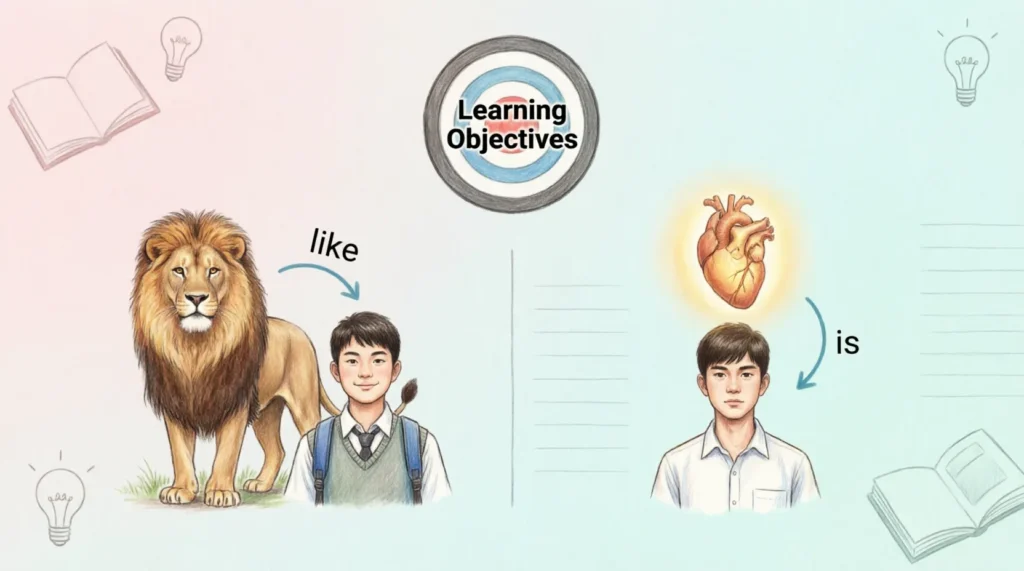
In short, learning objectives for similes and metaphors help students understand how to recognize, explain, and use figurative language in meaningful ways. These objectives guide reading, writing, and classroom activities so you can build stronger creative and analytical skills. Keep reading to discover examples, activities, and practical ways to make figurative language easier and more fun.
What Are Learning Objectives for Similes and Metaphors? (And Why They Matter)
You’re sitting in class staring at a blank paper. Your teacher says, “Write a metaphor about fear,” and suddenly your mind goes completely empty. Or maybe you know what a simile is, but you’re not sure how to use one naturally in your writing.
That’s where learning objectives for similes and metaphors come in. They are simple goals that explain what students should understand and be able to do with figurative language. These objectives help you move from confusion to confidence step by step.
A learning objective might focus on identifying similes in a story, explaining how metaphors create emotion, or writing original comparisons in your own paragraph. Instead of guessing what to learn, you have a clear target.
Language arts educators and literacy researchers often explain that students learn figurative language better when objectives are specific and practical. When you know exactly what you’re practicing, your reading comprehension, storytelling, and creative writing improve much faster.
[IMAGE: student writing similes and metaphors in a notebook]
As you explore more examples, you’ll start seeing how strong learning goals can make figurative language feel much less intimidating.
The Best Examples of Learning Objectives for Similes and Metaphors
Below are useful, classroom-friendly examples of learning objectives for similes and metaphors. Some are simple enough for younger students, while others work well for middle school and creative writing lessons.
Students will identify similes in a short poem and explain what is being compared.
Students will create three original metaphors about emotions.
Students will distinguish between literal and figurative language in a paragraph.
Students will explain how similes improve imagery in descriptive writing.
Students will write a personal narrative using at least two metaphors.
Students will compare similes and metaphors using a graphic organizer.
Students will identify clue words such as “like” and “as” in similes.
Students will revise weak comparisons to make them more vivid and meaningful.
Students will analyze how authors use metaphors to show character feelings.
Students will create illustrated similes based on nature scenes.
Students will identify figurative language in song lyrics.
Students will write a short poem containing one simile and one metaphor.
Students will explain the emotional effect of figurative language in a story.
Students will practice turning literal sentences into figurative ones.
Students will work in groups to create metaphor posters.
Students will identify overused similes and replace them with original ideas.
Students will use sensory details alongside similes in descriptive paragraphs.
Students will explain why an author chose a metaphor instead of direct description.
Students will create a classroom “figurative language wall” with examples.
Students will identify metaphors in historical speeches or famous quotes.
Students will use similes to improve dialogue in fictional stories.
Students will write journal entries using figurative comparisons naturally.
Students will explain the difference between comparison and exaggeration.
Students will evaluate whether a simile strengthens or weakens a sentence.
Students will use figurative language to describe a setting creatively.
These examples work well because they focus on clear actions. Instead of vague goals like “learn metaphors,” students know exactly what they are expected to identify, explain, create, or improve.
Creative writing teachers also encourage objectives that connect figurative language to emotion and imagery. When you practice comparisons with real feelings and sensory details, your writing becomes much more memorable.
How to Use Learning Objectives for Similes and Metaphors in Your Writing
Once you understand the goals behind figurative language, you can start applying them in your own work more confidently. Here are some easy ways to do that.
Start With Simple Comparisons
Before writing a long story, practice small comparisons first. Think about how something feels, sounds, or looks.
Example: “The classroom buzzed like a beehive before the test.”
Focus on One Emotion or Image
Strong similes and metaphors usually center around one clear feeling. If you try to compare too many ideas at once, your sentence may feel confusing.
Choose one mood first, such as excitement, loneliness, or fear.
Replace Boring Descriptions
When you revise your writing, look for plain sentences that could become more vivid.
Instead of writing “The rain was heavy,” you could write, “The rain hammered the roof like drums.”
Read Your Sentence Out Loud
Good figurative language sounds natural. If your simile or metaphor feels awkward when spoken aloud, try simplifying it.
Many literacy educators recommend reading your writing slowly to hear rhythm and clarity more easily.
As you practice, you’ll notice that learning objectives for similes and metaphors are not just classroom goals — they actually help you become a more expressive writer.
Learning Objectives for Similes and Metaphors in Poems and Stories
Poets and authors use figurative language because it creates emotion, imagery, and rhythm. A simple comparison can make a scene feel alive in your imagination.
Here are a few short creative examples that show how similes and metaphors appear naturally in writing.
Aisha wrote in her poem:
“The moon floated like a silver balloon, quiet above the sleeping town.”
Mateo described a soccer game this way:
“The crowd was a thunderstorm shaking the stadium walls.”
In Priya’s short story, she wrote:
“Fear wrapped around her like icy chains as she stepped onto the dark stage.”
These examples work because they connect feelings to images readers already understand. Instead of simply saying “the crowd was loud,” the metaphor creates stronger energy and excitement.
Creative writing teachers often encourage students to read poetry and fiction closely because figurative language appears everywhere once you start noticing it.
Common Mistakes Students Make With Learning Objectives for Similes and Metaphors
Everyone struggles with figurative language sometimes. These mistakes are completely normal, especially when you’re still learning how comparisons work.
Confusing similes and metaphors
A simile uses words like “like” or “as,” while a metaphor compares things directly. Students often mix them up at first, but practice makes the difference clearer.
Using comparisons that don’t make sense
Sometimes students create comparisons that sound random or unrelated. Try asking yourself whether the image actually matches the feeling or description.
Overusing figurative language
Too many similes in one paragraph can make writing feel crowded. A few strong comparisons are usually more effective than ten weak ones.
Copying overused examples
Phrases like “busy as a bee” or “cold as ice” are familiar, but they may not feel original anymore. Try creating fresh comparisons from your own experiences.
Forgetting the learning objective
Sometimes students focus so much on sounding creative that they forget the actual goal. If your objective is to explain imagery, make sure your writing clearly creates a picture in the reader’s mind.
Once you recognize these common problems, it becomes much easier to improve your figurative language naturally.
Fun Activities to Practice Learning Objectives for Similes and Metaphors
Practice becomes much more enjoyable when you turn figurative language into games and creative challenges. Here are some fun activities you can try at school or at home.
Simile Drawing Challenge
Grab a pencil and draw a simile literally. If someone writes “The clouds were like cotton candy,” sketch the image and explain why the comparison works.
Metaphor Match Game
Write metaphors on one set of cards and meanings on another. Then play a matching game with classmates or family members.
Rewrite the Boring Sentence
Take simple sentences and improve them using figurative language. Turn “The cafeteria was noisy” into something more imaginative.
Poetry Soundtrack Activity
Listen to age-appropriate song lyrics and highlight similes or metaphors you hear. Many students discover figurative language faster through music.
Figurative Language Hunt
While reading a story or novel, challenge yourself to find five similes and five metaphors. Write down how each one affects the mood or imagery.
Story Starter Challenge
Create a short story beginning with a simile or metaphor. For example: “The hallway stretched before him like an endless tunnel.”
Language arts educators often recommend playful activities because students remember concepts more easily when they actively create instead of only memorizing definitions.
More learning objectives for similes and metaphors by Tone and Context
🌿 Natural & Descriptive “As clear as a mountain stream” — Captures the idea of learning goals being easy to understand and works well in essays and explanations. “Like branches reaching toward sunlight” — Suggests steady growth and progress, making it useful for educational writing. “As balanced as a calm lake at sunrise” — Highlights harmony between learning similes and metaphors in a thoughtful way. “Like seeds planted in rich soil” — Shows how learning objectives can encourage future growth and understanding. “As steady as the changing seasons” — Emphasizes consistent learning and gradual improvement over time.
💛 Warm & Emotional “Like a friendly guide on a long journey” — Shows how learning objectives can support and encourage students. “As comforting as a favorite storybook” — Expresses familiarity and confidence in the learning process. “Like a warm light in a quiet room” — Reflects clarity and reassurance when studying figurative language. “As encouraging as a teacher’s smile” — Highlights positive feelings connected to reaching learning goals. “Like a hand helping you climb higher” — Suggests support and progress in understanding similes and metaphors.
✨ Poetic & Romantic “As graceful as a melody drifting through the air” — Creates a soft, artistic image perfect for poetry. “Like stars shining across a midnight sky” — Represents inspiration and creativity in language learning. “As beautiful as colors blending at sunset” — Shows how similes and metaphors work together to create imagery. “Like whispers carried by the evening breeze” — Gives a gentle and imaginative tone to discussions about learning. “As magical as moonlight on silver water” — Adds wonder and elegance to creative writing.
😄 Playful & Fun “Like puzzle pieces snapping into place” — Describes the excitement of finally understanding figurative language. “As cheerful as a puppy chasing bubbles” — Brings energy and happiness to learning goals. “Like popcorn popping in a microwave” — Shows ideas appearing quickly and enthusiastically. “As lively as a game on a sunny afternoon” — Captures the fun side of practicing similes and metaphors. “Like confetti flying at a celebration” — Expresses joy and achievement when learning objectives are met.
These tone-grouped similes for learning objectives for similes and metaphors give you options for every kind of writing — whether you need something soft and poetic or bold and fun. Try picking one from each group and using them in a short paragraph to see how different the same keyword can feel.
Using learning objectives for similes and metaphors in Real Writing Contexts
In a Descriptive Essay Students may explain how learning objectives help them understand figurative language more clearly. A simile can make those goals feel more vivid and memorable. For example: The learning objectives for similes and metaphors were as clear as a mountain stream, making each lesson easy to follow.
In a Poem Similes for learning objectives for similes and metaphors can create a thoughtful or hopeful mood in poetry. They help express the beauty of learning and creativity. Like stars shining across a midnight sky, our learning goals guided every verse we wrote.
In a Story or Creative Scene Similes for learning objectives for similes and metaphors can show a character’s feelings about learning or describe progress in a creative scene. They add imagery and emotion to the moment. As Maya finished her assignment, the learning objectives felt like puzzle pieces snapping into place, and she smiled with pride.
In a Social Media Caption or Message Short similes work well in casual writing because they quickly share excitement and achievement. They make messages feel more creative and fun. Today’s learning objectives for similes and metaphors were like confetti flying at a celebration—everything finally made sense!
The more you practice placing similes for learning objectives for similes and metaphors into real sentences, the more natural your writing will sound — and the more your reader will feel exactly what you want them to feel.
What NOT to Do With Learning Objectives for Similes and Metaphors
There are also a few myths and habits that can make figurative language harder than it needs to be.
Don’t memorize definitions without practicing
You can know the meaning of “metaphor” perfectly and still struggle to use one in writing. Practice matters more than memorization alone.
Don’t force comparisons into every sentence
Some students think every paragraph needs figurative language. Actually, similes and metaphors work best when used naturally and purposefully.
Don’t assume harder comparisons are always better
Complicated metaphors can confuse readers. Clear and vivid imagery is usually stronger than overly complex wording.
Don’t treat learning objectives like boring rules
Learning objectives for similes and metaphors are meant to guide creativity, not limit it. They help you focus your ideas so your writing becomes clearer and more powerful.
Understanding what to avoid can help you use figurative language more confidently and effectively.
Frequently Asked Questions About Learning Objectives for Similes and Metaphors
What are the main learning objectives for similes and metaphors?
Most learning objectives focus on identifying, explaining, comparing, and creating figurative language. Students may also learn how similes and metaphors improve imagery, mood, and emotional expression in writing.
Why are learning objectives for similes and metaphors important?
They give students clear goals instead of vague instructions. When you know exactly what skill you’re practicing, it becomes easier to improve reading comprehension and creative writing.
How do teachers assess similes and metaphors?
Teachers often use writing assignments, worksheets, reading responses, or classroom discussions. Students may be asked to identify figurative language or create their own original examples.
What is the difference between a simile and a metaphor?
A simile compares two things using “like” or “as.” A metaphor compares two things directly without those words. Both help readers imagine ideas more vividly.
Are learning objectives for similes and metaphors suitable for middle school students?
Yes. Middle school is actually one of the best times to practice figurative language because students begin exploring deeper emotions, imagery, and creative expression in their writing.
Final Thoughts on Learning Objectives for Similes and Metaphors
Learning figurative language can feel confusing at first, especially when you’re trying to understand the difference between similes, metaphors, imagery, and symbolism all at once. That’s why strong learning objectives matter so much.
Clear learning objectives for similes and metaphors help you focus on real skills. Instead of simply memorizing definitions, you learn how to identify comparisons, explain meaning, and use figurative language naturally in your own writing.
The best part is that these skills grow with practice. Every poem you read, every story you write, and every creative comparison you try helps you become a stronger communicator.
You do not need to be a perfect writer to use figurative language well. Keep experimenting, keep reading, and keep practicing — your words will become more vivid and powerful over time.
Frequently Asked Questions
What are learning objectives for similes and metaphors?▼
Learning objectives for similes and metaphors are specific goals that guide students in recognizing, explaining, and using figurative language effectively. These objectives help students understand how to create their own comparisons and improve their writing skills.
How can learning objectives improve students' writing skills?▼
By providing clear and practical goals, learning objectives help students focus on specific aspects of figurative language, such as identifying similes or writing original metaphors. This targeted practice enhances their reading comprehension and storytelling abilities.
What types of activities can support learning objectives for figurative language?▼
Activities can include identifying similes in poems, creating metaphor posters, or revising weak comparisons to make them more vivid. Such hands-on tasks reinforce the learning objectives and make the understanding of figurative language more engaging.
Why is it important to have specific learning objectives?▼
Specific learning objectives help reduce confusion for students and provide a clear direction for their learning. When students know exactly what they need to practice, they can progress more confidently and efficiently in their understanding of figurative language.
Can you provide examples of effective learning objectives?▼
Examples of effective learning objectives include students identifying similes and explaining what is being compared, or writing a personal narrative that includes at least two metaphors. These objectives are designed to be actionable and relevant to students’ writing experiences.
How do similes and metaphors enhance emotional expression in writing?▼
Similes and metaphors enrich writing by creating vivid imagery and evoking emotions, allowing readers to connect with the text on a deeper level. Learning objectives that focus on these elements help students understand the impact of figurative language on storytelling.
What role do educators play in teaching figurative language?▼
Educators play a crucial role by setting clear learning objectives and designing activities that help students explore and apply figurative language. Their guidance ensures that students not only learn to recognize similes and metaphors but also understand their significance in effective writing.
Liam Nguyen is a passionate educator and writer with a deep love for figurative language. He holds a master’s degree in Creative Writing and has spent eight years teaching at various educational settings, focusing on language enrichment programs for children from grades 2-6. His expertise in crafting metaphorical language and similes into captivating content stems from his belief that storytelling is the heartbeat of learning. Liam’s contributions to SimilePedia span from emotion-driven examples to color-inspired narrative tools. He is committed to fostering a creative environment where students can explore and find joy in their unique expressions.