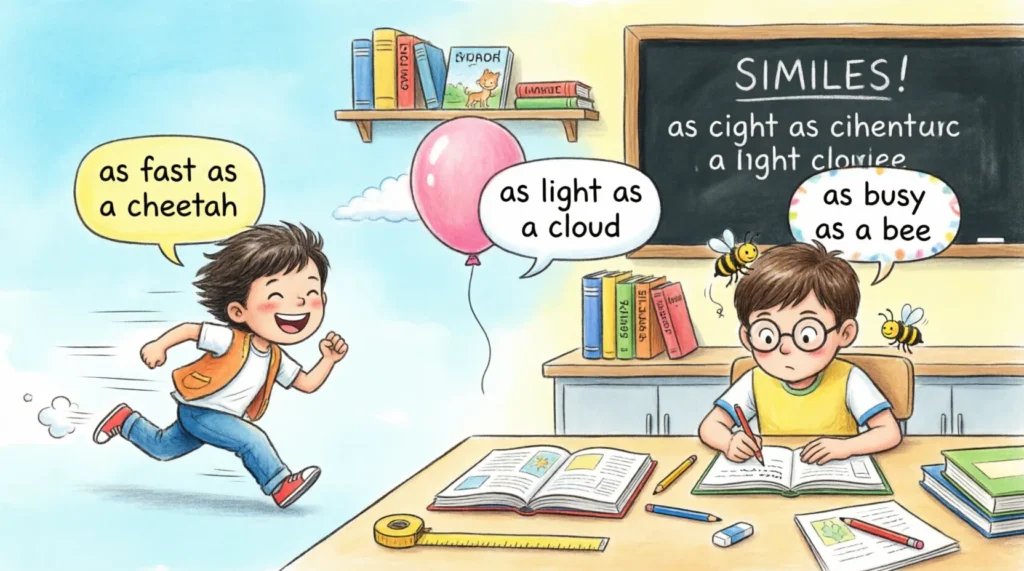
In short, a worksheet on similes for Grade 5 helps students practice comparing two things using words like “as” or “like.” These worksheets make writing more colorful, improve reading skills, and help you describe ideas in creative ways. Keep reading to explore examples, activities, and simple tips that make similes easier and more fun to use.
What Are Worksheet on Similes for Grade 5? (And Why They Matter)
You’re sitting in class, staring at a blank page, and your teacher says, “Write a simile about the weather.” Suddenly, your brain feels completely empty. A good worksheet on similes for Grade 5 can help you move past that stuck feeling and start creating strong, vivid sentences.
A simile is a comparison between two different things using the words “like” or “as.” For example, “The pillow was as soft as a cloud” compares a pillow to a cloud to help readers imagine softness more clearly.
Grade 5 students use similes to make stories, poems, and essays more interesting. Instead of saying something was “fast,” you can say it “ran like the wind.” That small change makes your writing stronger and more exciting to read.
Language arts educators and literacy researchers often explain that figurative language helps students improve creativity, vocabulary, and reading comprehension. When you practice with a worksheet on similes for Grade 5, you also learn how authors create emotion and imagery in books and poems.
[IMAGE: Grade 5 students practicing similes with colorful worksheets]
Once you understand how similes work, it becomes much easier to recognize them in stories and create your own examples confidently.
The Best Examples of Worksheet on Similes for Grade 5
Here are some strong, age-appropriate similes you can use for practice, homework, or creative writing activities:
The baby slept like a peaceful kitten.
Her smile was as bright as the sun.
The classroom was as quiet as a library.
My backpack felt as heavy as a mountain.
The soccer player ran like lightning.
The soup was as hot as lava.
His voice sounded like thunder during the argument.
The puppy jumped around like popcorn in a pan.
The lake sparkled like diamonds in the sunlight.
The student was as nervous as a mouse near a cat.
My little brother eats like a vacuum cleaner.
The old wooden floor creaked like a haunted house door.
The ice cream melted as fast as snow in summer.
Her hair was as soft as silk.
The fireworks exploded like colorful stars in the sky.
The alarm clock rang like a fire truck siren.
The math test felt as long as a road trip.
The cat moved as quietly as a shadow.
The balloons floated like feathers in the wind.
His jokes spread through the class like wildfire.
The cake smelled as sweet as fresh strawberries.
The rain poured down like buckets of water.
My hands were as cold as ice.
The teacher’s instructions were as clear as glass.
The excited kids bounced around like kangaroos.
These examples work well because they create strong mental pictures. You can almost see, hear, or feel what the writer is describing. Creative writing teachers often encourage students to use sensory details because they help readers connect emotionally to the writing.
As you continue practicing with a worksheet on similes for Grade 5, you’ll notice that the best similes feel natural and easy to imagine.
How to Use Worksheet on Similes for Grade 5 in Your Writing
Learning similes becomes easier when you practice them step by step. Here’s a simple way you can start using them in your own writing today.
Think about what you want to describe.
Maybe you want to describe a loud sound, a fast runner, or a scary moment. Pick one clear idea first before adding your comparison.
Ask yourself what it reminds you of.
A loud sound might remind you of thunder. A fast runner might remind you of a cheetah. Your comparison should help readers picture the scene quickly.
Use “like” or “as” naturally.
Try not to force your simile into every sentence. Use it where it makes your writing stronger and more vivid.
Read your sentence out loud.
If the simile sounds strange or confusing, change it. Good similes sound smooth and easy to understand.
Here’s an example of a simile used well in context:
“Amira’s heart beat like a drum as she walked onto the stage for the spelling bee.”
You can practice this skill every time you complete a worksheet on similes for Grade 5 or write a short paragraph for class.
Worksheet on Similes for Grade 5 in Poems and Stories
Similes appear everywhere in creative writing because they make emotions and descriptions stronger. Poets and story writers use them to help readers feel connected to characters and scenes.
Here are a few short examples you might see in poems or classroom stories:
“Ali’s laughter floated through the room Like music dancing in the air.”
“Maya held the tiny bird carefully. Its feathers felt as soft as cotton in her hands.”
“The storm clouds rolled across the sky Like giant ships sailing through darkness.”
Writers use similes because they create rhythm, imagery, and emotion. A simple comparison can turn an ordinary sentence into something memorable.
Creative writing teachers often encourage students to read poems aloud because similes sound more powerful when you hear their rhythm and flow.
More worksheet on similes for grade 5 by Tone and Context
🌿 Natural & Descriptive “As bright as morning dew on fresh grass” — This captures a clear and refreshing feeling and works well in descriptive essays. “Like a gentle stream winding through a meadow” — Use this to show something calm and smooth in nature writing. “As colorful as a garden filled with spring flowers” — This simile adds vivid imagery to creative descriptions. “Like autumn leaves dancing in the wind” — It creates a lively picture and suits seasonal writing. “As steady as a mountain standing against the sky” — This expression shows strength and dependability in essays or stories.
💛 Warm & Emotional “Like a warm blanket on a chilly evening” — This simile expresses comfort and kindness in personal writing. “As welcoming as a smile from an old friend” — It captures feelings of happiness and trust. “Like sunshine breaking through rainy clouds” — Use this to show hope and encouragement in heartfelt pieces. “As gentle as a mother’s lullaby” — This creates a peaceful and caring mood. “Like a handwritten note filled with love” — It highlights thoughtful and meaningful emotions.
✨ Poetic & Romantic “As graceful as moonlight on a quiet lake” — This simile creates a dreamy atmosphere for poems and lyrics. “Like stars sparkling across a midnight sky” — It adds beauty and wonder to romantic writing. “As soft as petals resting in the breeze” — This phrase brings elegance and calm to poetic lines. “Like a melody floating through the night” — Use it to create a musical and emotional feeling. “As timeless as waves meeting the shore” — This simile expresses lasting beauty and deep emotions.
😄 Playful & Fun “Like popcorn popping in a movie theater” — This captures excitement and energy in casual writing. “As cheerful as a puppy chasing its tail” — Use this to show joy and playful behavior. “Like a balloon bouncing at a birthday party” — It creates a lively and happy image. “As silly as a monkey wearing sunglasses” — This simile adds humor and fun to stories or messages. “Like confetti flying through the air” — It gives writing a festive and energetic feeling.
These tone-grouped similes for worksheet on similes for grade 5 give you options for every kind of writing — whether you need something soft and poetic or bold and fun. Try picking one from each group and using them in a short paragraph to see how different the same keyword can feel.
Using the worksheet on similes for grade 5 in Real Writing Contexts
In a Descriptive Essay Students often use a worksheet on similes for grade 5 when learning how to make descriptions more vivid. Adding a simile helps readers picture ideas more clearly and makes writing more interesting. For example, a student might write, “The sunset spread across the sky like orange paint brushed across a giant canvas.”
In a Poem Similes for worksheet on similes for grade 5 can help create mood and make poems sound more expressive. They add colorful images that make readers feel connected to the words. For example, a poem could say, “Your laughter drifted like music through the trees, as sweet as birds singing in the spring.”
In a Story or Creative Scene Writers can use similes to describe a character’s feelings or the setting around them. These comparisons help readers imagine the scene more clearly. As Mia stepped onto the stage, her heart raced like a speeding train, but she smiled and began speaking with confidence.
In a Social Media Caption or Message Short similes work well in messages and captions because they quickly add personality and emotion. They can make even simple posts sound more creative and memorable. For example, a caption might read, “Today was as bright as sunshine after the rain—feeling amazing!”
The more you practice placing similes for worksheet on similes for grade 5 into real sentences, the more natural your writing will sound — and the more your reader will feel exactly what you want them to feel.
Common Mistakes Students Make With Worksheet on Similes for Grade 5
Every student makes mistakes while learning figurative language. That’s completely normal. The important part is learning how to improve.
Forgetting to use “like” or “as”
A simile needs comparison words. Without them, you may accidentally create a metaphor instead.
Using confusing comparisons
Sometimes students compare things that don’t connect clearly. If readers can’t picture the comparison easily, try a simpler idea.
Repeating the same similes too often
Phrases like “as busy as a bee” are common, but using them repeatedly can make your writing feel less original. Challenge yourself to create fresh comparisons.
Adding too many similes in one paragraph
Using similes everywhere can overwhelm readers. A few strong examples usually work better than ten weak ones.
Making the comparison unrealistic
On a worksheet on similes for Grade 5, students sometimes create comparisons that don’t make sense, like “The pencil was like a refrigerator.” Make sure your simile matches the feeling or action you’re describing.
The more you practice, the easier it becomes to spot and fix these mistakes in your own writing.
Fun Activities to Practice Worksheet on Similes for Grade 5
Practicing similes doesn’t have to feel boring. These activities help you learn while staying creative and active.
Simile Match-Up Game
Write objects on one set of cards and descriptions on another. Then try matching them to create funny or vivid similes like “as slippery as a fish.”
Create Your Own Worksheet
Grab a pencil and make your own worksheet on similes for Grade 5. Leave blanks for comparison words or ask a friend to complete your sentences.
Drawing and Writing Challenge
Draw a picture of a storm, animal, or playground scene. Then write three similes describing what you drew.
Simile Hunt While Reading
While reading a story or poem, highlight every simile you find. You’ll start noticing how often authors use figurative language.
Group Classroom Challenge
In small groups, take turns creating similes about random topics like pizza, homework, or rainy days. The funniest or most creative simile wins.
Finish-the-Sentence Activity
Complete sentences like:
“The moon looked like ______.”
“The puppy was as playful as ______.”
“The cafeteria sounded like ______.”
Activities like these help you build confidence while making learning feel more like a game.
What NOT to Do With Worksheet on Similes for Grade 5
Some myths about similes can make writing harder than it needs to be. Here are a few habits you should avoid.
Don’t memorize only old-fashioned similes
Classic comparisons are useful, but your own original ideas can be even stronger and more interesting.
Don’t force a simile into every sentence
Too many comparisons can distract readers. Use similes where they truly improve your writing.
Don’t make comparisons too complicated
A good simile should help readers understand quickly. If your comparison needs a long explanation, simplify it.
Don’t assume worksheets are only for beginners
Many middle school and even high school students still practice figurative language. A worksheet on similes for Grade 5 builds skills you’ll use for years.
Frequently Asked Questions About Worksheet on Similes for Grade 5
What is a simile for Grade 5 students?
A simile is a comparison between two different things using “like” or “as.” Grade 5 students use similes to make writing more descriptive and creative. For example, “The snow was as white as milk” helps readers imagine the scene clearly.
How do you teach similes to Grade 5 students?
The best way is through simple examples, games, and practice worksheets. Students learn faster when they create their own comparisons and read similes in stories or poems.
What are some easy simile examples for kids?
Simple examples include:
“As busy as a bee”
“As light as a feather”
“Runs like the wind”
These work well because kids can picture them easily.
Why are worksheets on similes helpful?
Worksheets give you guided practice and help you recognize patterns in figurative language. They also improve vocabulary, creative thinking, and reading comprehension skills.
What is the difference between a simile and a metaphor?
A simile uses “like” or “as” to compare things. A metaphor compares things directly without those words. For example:
Simile: “Her voice was like music.”
Metaphor: “Her voice was music.”
Final Thoughts on Worksheet on Similes for Grade 5
Learning similes can completely change the way you write. Instead of plain sentences, you start creating descriptions that readers can truly picture and feel.
A strong worksheet on similes for Grade 5 helps you practice comparisons, improve creativity, and become more confident in language arts. The more examples you read, the easier it becomes to invent your own.
Remember that every great writer started by practicing simple skills one step at a time. You do not need perfect similes right away. You just need curiosity, creativity, and a little practice.
Keep experimenting with new comparisons, keep reading stories and poems, and most importantly, keep having fun with your writing journey.
Frequently Asked Questions
What is the purpose of a simile worksheet for Grade 5?▼
A simile worksheet for Grade 5 helps students practice comparing two different things using ‘like’ or ‘as.’ It enhances writing by making it more colorful and engaging while improving reading skills and creativity.
Can you provide examples of similes suitable for Grade 5 students?▼
Yes! Some examples include ‘The baby slept like a peaceful kitten’ and ‘Her smile was as bright as the sun.’ These similes create vivid mental images that help readers connect with the writing.
How do similes benefit students in their writing?▼
Similes enrich students’ writing by making their descriptions more interesting and relatable. By using comparisons, students can convey emotions and imagery more effectively, enhancing their overall storytelling skills.
What activities can be included in a simile worksheet?▼
Activities might include filling in the blanks with appropriate similes, creating original similes based on prompts, or matching similes to their meanings. These activities help reinforce understanding and encourage creative expression.
How can I help my child understand similes better?▼
Encourage your child to practice using similes in everyday conversations or writing assignments. Reading books that feature rich figurative language can also help them recognize and appreciate similes in context.
What are some tips for writing effective similes?▼
To write effective similes, think of familiar objects or experiences that evoke strong imagery. Use sensory details to make comparisons relatable and ensure that the simile enhances the overall meaning of the sentence.
Why are similes important in language arts education?▼
Similes play a crucial role in language arts education as they help improve vocabulary, creativity, and reading comprehension. By exploring figurative language, students learn to express ideas more vividly and emotionally.
Liam is a language enthusiast and lead writer at Similepedia.com, where he focuses on creating clear, creative, and easy-to-use similes for everyday writing. He specializes in turning simple ideas into vivid comparisons that make sentences more engaging, expressive, and memorable.
Instead of overcomplicating language with technical jargon, Liam approaches similes as practical tools for better communication. He breaks down how comparisons work, when to use them, and how to make them sound natural — not forced or awkward.
He pays close attention to tone, context, and clarity, ensuring every simile fits smoothly into real sentences. From fun and playful comparisons to more descriptive and expressive ones, Liam helps readers improve how they write, speak, and express ideas.
At Similepedia.com, his mission is simple: make language more colorful and effective without making it complicated. He doesn’t just list similes — he helps readers understand how to use them confidently in real situations.