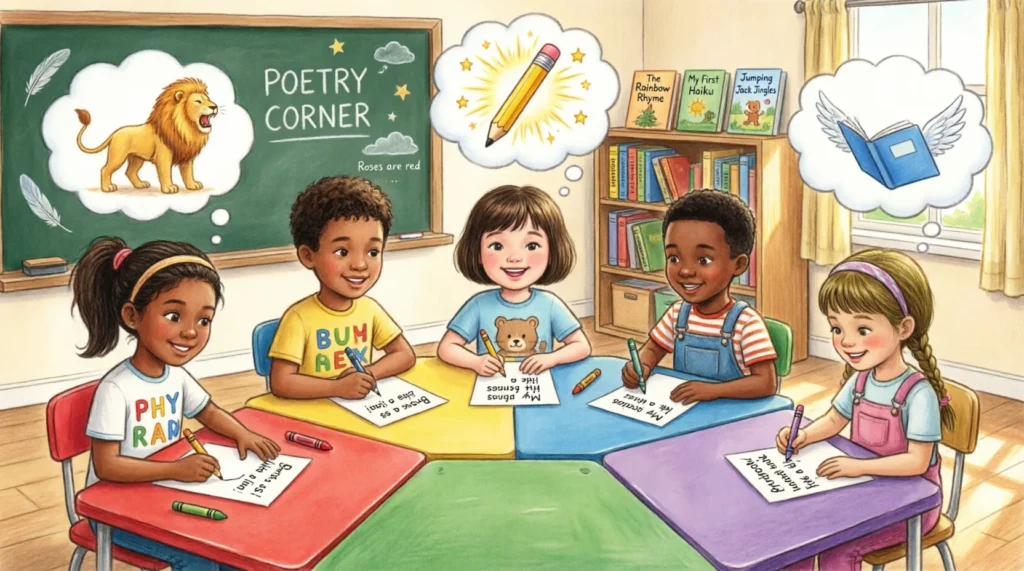
In short, similes in poems for kids are comparisons that use “like” or “as” to help describe feelings, objects, or scenes in a creative and imaginative way. They make poetry more vivid and easier to understand by connecting ideas to familiar things. As you read on, you’ll discover examples, activities, and simple ways to use them in your own writing.
What Are Similes In Poems For Kids? (And Why They Matter)
Imagine you’re staring at a blank page, trying to describe the moon, but all you can think of is “It’s bright.” Your teacher asks for something more creative, and suddenly your mind goes empty. This is exactly where similes in poems for kids become helpful.
A simile is a simple comparison between two things using the words “like” or “as.” In poems, they help you paint pictures with words so readers can see and feel what you mean.
Literacy educators often explain that similes improve reading and writing skills because they build imagination, vocabulary, and emotional understanding. When you use them in poetry, you make your writing more expressive and fun to read.
Similes also matter because they help you connect everyday ideas with creative thinking. Instead of saying something is “cold,” you can say it feels “like ice in your hands,” which makes your poem more powerful.
Now that you understand the basics, let’s explore some exciting examples you can use right away.
The Best Examples of Similes In Poems For Kids
Here are creative and kid-friendly similes in poems for kids that you can learn from and use in your own writing:
The stars shine like tiny diamonds in the night sky.
Her smile is as bright as the morning sun.
The wind howled like a hungry wolf in the forest.
The classroom was as quiet as a sleeping cat.
His heart beat like a fast drum during the race.
The snow fell like soft cotton from the sky.
The river flowed like a silver ribbon through the valley.
The শিশ laughter was like bells ringing in a quiet room.
The thunder sounded like a giant clapping in the clouds.
The grass felt as soft as a fluffy blanket under your feet.
The fireflies glowed like floating stars in the dark garden.
The cake was as sweet as a dream come true.
The pencil scratched the paper like tiny feet running across it.
The waves crashed like loud drums on the shore.
The baby slept like a peaceful angel.
The moon hung in the sky like a glowing lantern.
The teacher’s voice was as calm as a gentle breeze.
The ice cream melted like snow under the sun.
The dog barked like a trumpet in the quiet street.
The forest stood still like a frozen painting.
These examples are powerful because they use clear comparisons and familiar images. They help you turn simple ideas into vivid pictures that readers can easily imagine.
Now let’s see how you can actually use these in your own writing.
How to Use Similes In Poems For Kids in Your Writing
Using similes in poems for kids is easier than you think. You just need to follow a few simple steps:
First, choose something you want to describe, like rain, a feeling, or an object.
Next, think of something similar in quality (soft, fast, loud, bright).
Then connect them using “like” or “as” to form a comparison.
Finally, read it aloud to see if it creates a clear picture in your mind.
For example: “The snow fell like feathers drifting from the sky.”
When you use similes this way, your writing becomes more expressive and enjoyable for readers.
More Similes in Poems for Kids by Tone and Context
🌿 Natural & Descriptive
“As gentle as a stream winding through a meadow” — Captures a calm and peaceful feeling that works well in nature-focused poems.
“Like sunlight dancing across a quiet lake” — Describes beauty and movement in a vivid, visual way.
“As colorful as wildflowers after spring rain” — Highlights brightness and variety in descriptive writing.
“Like a breeze drifting through tall grass” — Suggests softness and smooth motion in a scene.
“As fresh as morning dew on green leaves” — Creates a clean and refreshing image for readers.
💛 Warm & Emotional
“As comforting as a blanket on a chilly evening” — Expresses warmth, safety, and affection.
“Like a smile shared between old friends” — Shows kindness and connection in personal writing.
“As welcoming as an open door after a long trip” — Conveys relief, belonging, and happiness.
“Like a candle glowing in the darkness” — Represents hope and encouragement during difficult moments.
“As cheerful as laughter around a family table” — Brings a sense of joy and togetherness.
✨ Poetic & Romantic
“Like silver moonlight resting on still water” — Creates a dreamy and elegant mood for poetry.
“As graceful as a feather floating through the air” — Emphasizes beauty and delicate movement.
“Like stars whispering across the night sky” — Adds wonder and imagination to poetic lines.
“As timeless as the tide meeting the shore” — Suggests lasting beauty and gentle rhythm.
“Like a melody drifting through the evening” — Gives writing a lyrical and emotional quality.
😄 Playful & Fun
“As bouncy as a ball in a playground game” — Adds energy and excitement to lighthearted writing.
“Like popcorn popping in a hot pan” — Describes quick movement and lively action.
“As wiggly as a worm after the rain” — Creates a funny and memorable image.
“Like a puppy racing after its tail” — Shows enthusiasm and playful behavior.
“As silly as a hat made of pancakes” — Brings humor and creativity into casual writing.
These tone-grouped similes for similes in poems for kids give you options for every kind of writing — whether you need something soft and poetic or bold and fun. Try picking one from each group and using them in a short paragraph to see how different the same topic can feel.
More Similes In Poems For Kids: Fun Examples, Easy Lessons, and Creative Writing Ideas Every Student Will Love (2026) by Tone and Context
“The poem flowed like a quiet stream.” — This simile shows smooth, gentle rhythm and works well when describing peaceful poetry.
“The words sparkled like morning dew.” — Use this to describe fresh, bright language that catches the reader’s attention.
“As colorful as a rainbow after rain.” — This captures the variety of vivid images and emotions found in children’s poems.
“The verses danced like leaves in a light breeze.” — A great choice for showing movement and a playful rhythm in poetry.
“Like sunshine spreading across a field.” — This simile suggests warmth, happiness, and cheerful feelings in a poem.
💛 Warm & Emotional (for personal stories, letters, heartfelt writing)
“The poem felt like a warm hug.” — Use this when a poem brings comfort, kindness, or happy memories.
“As gentle as a parent’s goodnight story.” — This highlights the calm and caring tone of a children’s poem.
“Like a smile shared between friends.” — A wonderful way to describe poems that celebrate friendship and joy.
“As comforting as a favorite blanket.” — This works well for poems that make readers feel safe and relaxed.
“Like laughter filling a family picnic.” — Use this simile to describe poems full of fun, love, and togetherness.
✨ Poetic & Romantic (for poems, song lyrics, love writing)
“The rhyme floated like a feather on the wind.” — This creates a soft, dreamy feeling perfect for lyrical poetry.
“As bright as stars across the night sky.” — Use this to describe beautiful ideas or memorable lines in a poem.
“Like moonlight resting on a quiet lake.” — This simile adds elegance and peaceful imagery to discussions of poetry.
“As graceful as a swan on calm water.” — A strong choice when describing smooth, beautiful verses.
“Like a melody carried through the air.” — This emphasizes the musical quality of a well-written poem.
😄 Playful & Fun (for casual use, social media captions, humor)
“The poem bounced like a rubber ball.” — Great for describing energetic poems with a lively rhythm.
“As silly as a monkey wearing sunglasses.” — Use this for funny poems that make readers laugh.
“Like popcorn popping in a hot pan.” — This captures exciting ideas that appear one after another.
“As cheerful as a puppy chasing butterflies.” — A fun simile for poems filled with happiness and excitement.
“Like confetti flying through the air.” — This works well when describing colorful, joyful poems for kids.
These tone-grouped similes for Similes In Poems For Kids: Fun Examples, Easy Lessons, and Creative Writing Ideas Every Student Will Love (2026) give you options for every kind of writing — whether you need something soft and poetic or bold and fun. Try picking one from each group and using them in a short paragraph to see how different the same keyword can feel.
Using Similes In Poems For Kids: Fun Examples, Easy Lessons, and Creative Writing Ideas Every Student Will Love (2026) in Real Writing Contexts
In a Descriptive Essay
When writing about a favorite poem or explaining why poetry is enjoyable, a simile helps paint a clearer picture for the reader. Instead of simply saying the poem was interesting, compare it to something familiar to make your description more memorable. Example:The poem flowed like a quiet stream, making every line peaceful and easy to imagine.
In a Poem
Similes can create mood, build imagery, and make simple ideas feel more meaningful. They help readers picture emotions and scenes while giving your poem a gentle rhythm. Example:Your words drift like feathers in the breeze, carrying dreams through whispering trees.
In a Story or Creative Scene
A simile can describe how a character experiences or reacts to a poem, making the moment more vivid. It adds emotion without using long explanations. Example:As Mia read the final verse, the words sparkled like morning dew, filling her imagination with bright new ideas.
In a Social Media Caption or Message
Short similes make captions more creative and fun while still being easy to understand. They help your message stand out with colorful language. Example:Today’s classroom poem was like popcorn popping in a hot pan—full of fun surprises from beginning to end!
The more you practice placing similes for Similes In Poems For Kids: Fun Examples, Easy Lessons, and Creative Writing Ideas Every Student Will Love (2026) into real sentences, the more natural your writing will sound — and the more your reader will feel exactly what you want them to feel.
Using Similes in Poems for Kids in Real Writing Contexts
In a Descriptive Essay
Students often use similes to make ordinary descriptions more vivid and interesting. A well-chosen comparison helps readers picture the scene clearly in their minds. For example: The river moved as gentle as a stream winding through a meadow, carrying leaves quietly downstream.
In a Poem
Similes can help create mood and add beauty to a poem. They allow writers to express emotions and images in a creative way. For example: Like silver moonlight resting on still water, your memory lingered through the night.
In a Story or Creative Scene
In stories, similes can reveal how a character feels or help readers imagine a setting. They make scenes more engaging and memorable. For example: As the classroom door opened, Maya felt as welcoming as an open door after a long trip, finally seeing her best friend return.
In a Social Media Caption or Message
Short similes work well in captions and messages because they quickly create a strong image. They can make simple posts feel more creative and expressive. For example: Today felt like popcorn popping in a hot pan—busy, exciting, and full of surprises!
The more you practice placing similes for similes in poems for kids into real sentences, the more natural your writing will sound — and the more your reader will feel exactly what you want them to feel.
Similes In Poems and Stories
Similes in poems in poems for kids often appear in songs, bedtime stories, and even short poems you might read in school. Writers use them to make emotions stronger and images clearer.
[IMAGE: night sky with glowing stars over a calm landscape]
For example:
Amina wrote: “The night was as quiet as a sleeping forest.”
Leo said: “My thoughts were like clouds drifting in the sky.”
Sara added: “The playground rang like a festival of laughter.”
Poets use similes because they add rhythm, emotion, and imagination. They help readers feel the writing, not just read it. That’s why you’ll find them everywhere in children’s poetry and creative stories.
Next, let’s look at common mistakes so you can avoid them.
Common Mistakes Students Make With Similes In Poems For Kids
Using similes without clear comparison Sometimes students write comparisons that don’t make sense, like “as fast as a color.” Always make sure both things are related in a meaningful way.
Overusing the word “like” or “as” It’s normal to rely on them, but too many can make your poem repetitive. Try mixing your sentence style.
Choosing boring comparisons Saying “as big as a house” is common, but not very creative. Try to think of fresh and surprising images.
Forgetting the purpose of the simile A simile should help the reader see or feel something. If it doesn’t add meaning, it may not be useful.
Mixing metaphors and similes incorrectly This happens when students switch between comparison styles without clarity. Keep your comparisons simple and consistent.
Fun Activities to Practice Similes In Poems For Kids
Simile scavenger hunt Walk around your home or classroom and find objects. Try describing each one using a simile.
Finish the sentence game Start with “The sky is like…” and challenge yourself to complete 10 different endings.
Poetry drawing challenge Draw a picture and then write 3 similes to describe it creatively.
Simile storytelling Write a short story and include at least 5 similes to make it more exciting.
Group comparison game In a group, take turns giving objects and creating funny or creative similes together.
Emotion simile journal Each day, describe how you feel using a simile like “I feel as calm as…”
What NOT to Do With Similes In Poems For Kids
Don’t force comparisons that don’t make sense If the connection feels confusing, your reader will struggle to understand your idea.
Don’t copy the same similes repeatedly Repetition makes your writing predictable instead of creative.
Don’t ignore imagery Similes should create pictures in the reader’s mind, not just fill space.
Don’t make them too complex Keep your language simple so your poem stays clear and enjoyable.
Frequently Asked Questions About Similes In Poems For Kids
What are similes in poems for kids?
Similes in poems for kids are simple comparisons that use “like” or “as” to describe something in a creative way. They help make poems more vivid and easier to understand. Kids use them to improve imagination and writing skills.
Why do poets use similes in children’s poetry?
Poets use similes to create strong images and emotions in the reader’s mind. They make poems more engaging and help children connect with ideas more easily. This makes reading more enjoyable and memorable.
Can you give a simple example of a simile in a poem?
Yes, a simple example is: “The moon is like a glowing lantern in the sky.” This helps readers imagine the moon more clearly by comparing it to something familiar.
Are similes in poems in poems for kids hard to learn?
No, they are actually very easy to learn. Once you understand how “like” and “as” work, you can create your own similes quickly with practice.
How can I improve my similes in poetry?
You can improve by reading more poems, practicing daily comparisons, and trying to use unique ideas instead of common phrases. The more you practice, the more creative your writing becomes.
Final Thoughts on Similes In Poems For Kids
Similes in poems in poems for kids are a powerful way to make writing more colorful, emotional, and fun. They help you turn simple ideas into vivid pictures that readers can enjoy and remember.
When you practice regularly, you’ll notice your poems becoming more creative and expressive. You’ll also start seeing the world in a more imaginative way, noticing comparisons everywhere you go.
Keep experimenting, keep writing, and don’t worry about being perfect. With time, your use of similes will become stronger and more natural, and your poetry will truly shine.
Frequently Asked Questions
What are similes and how do they benefit poetry for kids?▼
Similes are comparisons that use ‘like’ or ‘as’ to describe feelings, objects, or scenes. They make poetry more vivid and easier to understand by connecting ideas to familiar things, which enhances kids’ imagination and emotional understanding.
Can you provide examples of similes suitable for children's poems?▼
Sure! Some examples include ‘The stars shine like tiny diamonds in the night sky’ and ‘Her smile is as bright as the morning sun.’ These comparisons help create vivid imagery that children can easily relate to.
How can I use similes in my own writing?▼
To use similes, first choose something you want to describe, then think of a similar quality. Connect them using ‘like’ or ‘as’ to form a comparison, such as ‘The wind howled like a hungry wolf in the forest,’ which helps create a clear picture for readers.
Why are similes important in literacy education for kids?▼
Similes improve reading and writing skills by building vocabulary and enhancing imagination. They make writing more expressive and fun, facilitating a deeper emotional connection with the text.
What are some creative writing ideas involving similes for children?▼
Children can create their own poems using similes by describing everyday objects or feelings. For instance, they might write about the weather, their pets, or their emotions, using similes to paint a vivid picture.
How do similes help in understanding poetry?▼
Similes make the language of poetry more relatable and accessible by linking abstract concepts to concrete images. This connection helps readers visualize and feel the emotions conveyed in the poem.
What steps should I follow to create effective similes in poetry?▼
Start by selecting something to describe, then identify a quality that’s similar. Finally, form a comparison using ‘like’ or ‘as,’ and read it aloud to ensure it creates a strong mental image.
Sara Liu holds a Master’s degree in English Education from the University of Washington and has been an educator for over 15 years. She specializes in curriculum development for elementary and middle school students, with a particular focus on figurative language. Sara’s love for similes and metaphors blossomed when she discovered their power to spark imagination and convey emotion. At SimilePedia, Sara creates engaging worksheets and reference guides that help young learners grasp the nuances of figurative language. Her favorite part of writing content is developing resources that make complex concepts accessible to children. She is passionate about nurturing a love for words and creativity in her students, and her contributions are shaped by this commitment.