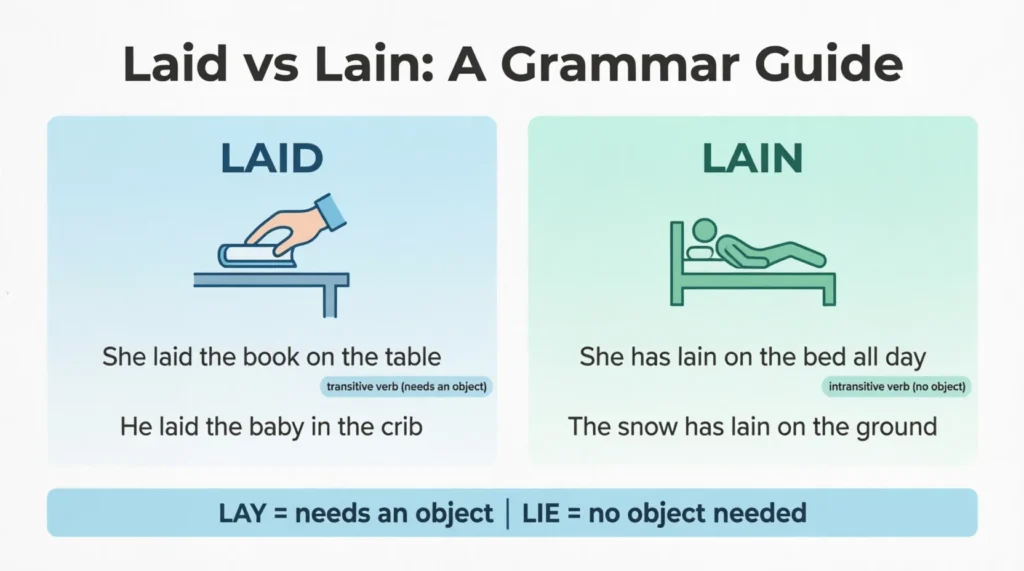
In short, laid and lain are different past participles that come from two different verbs. Laid comes from lay (to put something down), while lain comes from lie (to rest or recline). Keep reading to learn simple tricks, clear examples, and easy practice ideas that will help you remember the difference every time.
[IMAGE: Student comparing the words “laid” and “lain” on a notebook with grammar notes]
What Are laid vs lain? (And Why They Matter)
Have you ever written a sentence like, “The book has lain on the table,” then wondered if it should be “laid” instead? You are not alone. Many students stop in the middle of writing because these two words look similar but work very differently.
Laid vs lain is a grammar topic that helps you understand the difference between two verbs: lay and lie. Although the words sound alike, they have different meanings and follow different grammar patterns.
Knowing the difference matters because you will see these words in novels, school assignments, exams, and everyday writing. When you choose the correct word, your writing becomes clearer and more accurate.
Language arts researchers and literacy educators often point to verb forms like these as one of the most confusing parts of English. The good news is that once you understand the pattern, you can use these words with confidence.
Now let’s make the difference easy with plenty of examples.
The Best Examples of laid vs lain
The easiest way to remember these words is to see them used correctly in real sentences.
Emma laid her backpack on the chair before class.
The cat has lain by the fireplace all afternoon.
Dad laid the keys on the kitchen counter.
The blanket had lain untouched for weeks.
We laid the picnic blanket under the oak tree.
The old ship had lain beneath the sea for centuries.
Mia carefully laid the flowers on the table.
The dog had lain quietly while everyone talked.
The workers laid fresh bricks along the path.
The snow had lain on the mountains since winter began.
You laid your phone beside the computer yesterday.
The baby had lain peacefully in the crib.
They laid new books on every student’s desk.
The letter had lain unopened in the drawer.
Our jackets were laid neatly across the bench.
The traveler had lain awake all night.
She gently laid the sleeping kitten into its basket.
The leaves had lain on the ground until spring arrived.
The coach laid the game plan on the whiteboard.
The treasure had lain hidden for generations.
These examples work well because they clearly show the difference in meaning. Laid always involves putting something somewhere, while lain describes someone or something resting in a place. Seeing the verbs in realistic situations helps you remember them much more easily.
The next step is learning how you can use them correctly in your own writing.
How to Use laid vs lain in Your Writing
Ask yourself if there is an object. If you are putting something somewhere, use a form of lay. Example: “I laid the notebook on my desk.”
Check whether someone or something is simply resting. If nothing is being placed and the subject is resting, use a form of lie. Example: “The notebook has lain on the desk all week.”
Remember the verb families.
Lie → lay → lain
Lay → laid → laid
Read your sentence aloud. Hearing the sentence often helps you notice whether you are talking about placing something or simply resting.
Example in context:
“After Maya laid her jacket on the chair, it had lain there until the end of class.”
If you practice this question every time you write, you will soon recognize the correct choice without guessing.
laid vs lain in Poems and Stories
Creative writers use these words naturally because they describe actions and settings clearly. Choosing the correct verb helps readers picture the scene more easily.
Aisha wrote:
“The golden leaves had lain beneath the trees, waiting quietly for autumn winds.”
Carlos wrote:
“He laid a letter on the windowsill, hoping someone would find it before sunrise.”
Mei finished her story with:
“The old map had lain hidden inside the dusty chest until Noor finally discovered it.”
Poets and authors use these verbs to create vivid images and smooth rhythm. When you use the correct form, your readers focus on the story instead of getting distracted by grammar mistakes.
Now let’s look at the mistakes that almost everyone makes at first.
Common Mistakes Students Make With laid vs lain
Using laid when something is simply resting. This is very common. If nothing is being placed, lain is often the correct past participle.
Forgetting that lay needs an object. If you cannot answer “What was placed?” you should check whether you actually need a form of lie instead.
Mixing up the verb forms. Many students remember “lay” and “laid” but forget that “lain” belongs to the verb lie. Writing the two verb families side by side can help.
Assuming the words are interchangeable. They are related but not identical. Choosing the wrong one changes the grammar of your sentence.
Ignoring helping verbs. Words like has, have, and had are clues. For example, “has lain” and “has laid” belong to different verb families, so you should always check which meaning you want.
Everyone makes these mistakes while learning. With a little practice, you will spot them much more quickly.
Fun Activities to Practice laid vs lain
Create a sorting challenge. Grab a pencil and write ten sentences. Decide whether each sentence needs laid or lain, then explain why.
Play the object game. Look around your room. If you can identify an object being placed somewhere, write a sentence using laid.
Draw and describe. Draw two simple pictures. In one, someone is placing an object. In the other, someone is resting. Write a sentence for each picture.
Read a favorite book. Challenge yourself to find examples of lay, laid, lie, or lain. Notice how professional writers use them.
Make your own worksheet. Leave blanks in ten sentences and ask a friend or family member to fill in laid or lain correctly. Compare your answers afterward.
These activities help you practice in different ways, making the grammar easier to remember.
What NOT to Do With laid vs lain
Do not think laid and lain mean exactly the same thing. They come from different verbs and describe different actions.
Do not memorize only one verb family. Learning both sets together makes it much easier to choose correctly.
Do not ignore the object in your sentence. If something is being placed, you probably need a form of lay.
Do not assume modern English has removed the difference. Some people mix them up in conversation, but correct writing still follows the traditional grammar rules.
With these myths out of the way, you are ready to answer some common questions.
Frequently Asked Questions About laid vs lain
What is the difference between laid and lain?
Laid is the past tense and past participle of lay, which means to put something down. Lain is the past participle of lie, which means to rest or recline.
How do you remember laid vs lain?
A simple trick is to ask whether something is being placed. If the answer is yes, use laid. If someone or something is simply resting, lain is often the correct choice after has, have, or had.
Can you say “has laid” and “has lain”?
Yes, but they mean different things. “Has laid” means someone has placed something somewhere, while “has lain” means someone or something has rested somewhere.
Why is laid vs lain so confusing?
The confusion comes from the irregular verb lie, whose past tense is lay. Since lay is also a completely different verb, many students accidentally mix the two verb families together.
Is laid vs lain important for school writing?
Yes. Teachers often expect students to use these verb forms correctly in essays, grammar exercises, and exams. Creative writing teachers and language arts educators also encourage students to master these verbs because they make writing more accurate and polished.
Final Thoughts on laid vs lain
Learning laid vs lain may seem difficult at first, but the pattern becomes much easier once you know the difference between placing something and resting somewhere.
Remember the two verb families: lay → laid → laid and lie → lay → lain. Keeping them together in your notes can save you from common mistakes.
The more you read, write, and practice, the more natural these words will feel. Even experienced writers stop to check them sometimes, so you are in good company.
Keep practicing, stay curious, and remember that every sentence you write is another step toward becoming a stronger, more confident writer.
Sara Liu holds a Master’s degree in English Education from the University of Washington and has been an educator for over 15 years. She specializes in curriculum development for elementary and middle school students, with a particular focus on figurative language. Sara’s love for similes and metaphors blossomed when she discovered their power to spark imagination and convey emotion. At SimilePedia, Sara creates engaging worksheets and reference guides that help young learners grasp the nuances of figurative language. Her favorite part of writing content is developing resources that make complex concepts accessible to children. She is passionate about nurturing a love for words and creativity in her students, and her contributions are shaped by this commitment.