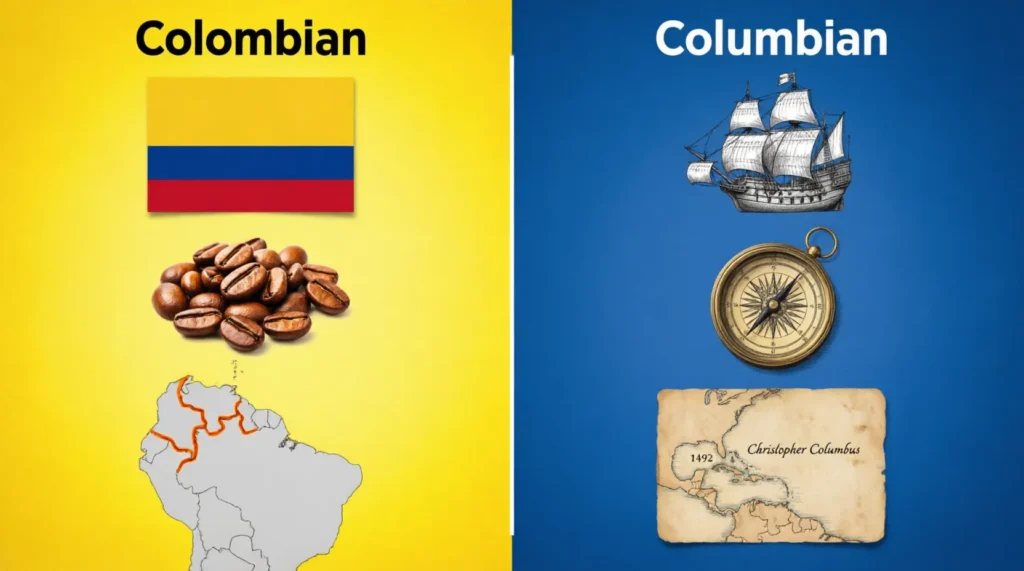
In short, columbian vs colombian is about understanding the important difference between two similar-looking words. One refers to people or things from Colombia, while the other is usually connected to Columbus or institutions named after him. Keep reading to learn the difference with easy examples and helpful memory tricks.
What Are the Columbian vs Colombian? (And Why They Matter)
Imagine you’re finishing a history report, and you proudly write, “My favorite Colombian explorer was Christopher Columbus.” Your teacher circles one word in red. It can feel confusing because the two words look almost identical.
The phrase columbian vs colombian helps you understand when to use each spelling correctly. Although they differ by only one letter, they have very different meanings.
Colombian refers to the country of Colombia, its people, culture, language, food, and anything connected to the nation in South America.
Columbian usually relates to Christopher Columbus, the historical term “Columbian,” or organizations and places named after Columbus, such as “Columbian Exchange” or “Columbian College.” Literacy educators often remind students that a single missing letter can completely change a word’s meaning.
Learning this difference helps you write more accurately in essays, school assignments, travel writing, and everyday conversations. Now let’s look at examples that make the distinction easy to remember.
[IMAGE: Comparison chart showing Colombian and Columbian with definitions]
The Best Examples of the Columbian vs Colombian
Here are clear examples showing when each word is correct.
She loves Colombian coffee from the mountains of Colombia.
Gabriel García Márquez was a famous Colombian writer.
My friend speaks with a Colombian accent.
We learned about Colombian culture in geography class.
The soccer team includes several Colombian players.
The restaurant serves delicious Colombian dishes.
The artist painted colorful Colombian landscapes.
Bogotá is the capital of Colombia, so its people are Colombian.
We watched a documentary about Colombian wildlife.
The festival celebrated Colombian traditions.
Examples using Columbian:
The class studied the Columbian Exchange.
Historians discussed the Columbian era.
She attends Columbian College.
The museum displayed Columbian artifacts related to Columbus.
The organization has a long Columbian tradition connected to its name.
The book explored the impact of the Columbian Exchange on world history.
The school newspaper mentioned the Columbian Society.
Researchers examined the effects of the Columbian voyages.
The lecture focused on Columbian history connected to Columbus.
The award was presented by a Columbian association.
These examples work because they connect each word to its correct meaning instead of relying on spelling alone. Language arts educators encourage students to notice the context first. If you’re talking about Colombia, use Colombian. If you’re talking about Columbus or something named after him, Columbian is often correct.
Now that you’ve seen the words in action, let’s learn how you can use them confidently in your own writing.
How to Use the Columbian vs Colombian in Your Writing
Think about the country first. If you mean the South American country of Colombia, always choose Colombian.
Ask yourself if Christopher Columbus is involved. If the topic is Columbus or a historical term like the “Columbian Exchange,” then Columbian is probably the correct choice.
Read your sentence aloud. Sometimes hearing your sentence helps you notice whether you’re talking about a country or a historical figure.
Double-check before submitting your work. Spell-checkers may not catch this mistake because both words are real.
Example:
“My family enjoyed authentic Colombian food while learning about the Columbian Exchange in history class.”
With a little practice, you’ll begin choosing the right word automatically.
Columbian vs Colombian in Poems and Stories
Creative writing becomes stronger when every word is accurate. Choosing the correct spelling also helps readers understand exactly what you mean.
Aisha wrote:
“The Colombian mountains touched the clouds, Coffee scented every gentle breeze.”
Mateo wrote:
“The teacher unfolded an old map, Pointing to the Columbian Exchange, Where history changed forever.”
Emma wrote:
“The Colombian dancers smiled with pride, Their music filled the evening sky.”
Creative writing teachers encourage students to use precise language because it creates stronger images and builds trust with readers. Even one letter can change the entire meaning of your story.
[IMAGE: Student writing Colombian and Columbian correctly in a notebook]
Common Mistakes Students Make With the Columbian vs Colombian
Using Columbian when talking about Colombia This is the most common mistake. Remember that people from Colombia are always Colombian.
Thinking both spellings mean the same thing They don’t. Although they look similar, they describe different ideas.
Misspelling Colombia as Columbia The country is Colombia, not Columbia. This spelling mistake often leads students to write the wrong adjective.
Forgetting the historical meaning of Columbian Words like “Columbian Exchange” have a specific historical meaning connected to Christopher Columbus.
Depending only on spell-check Since both words exist, your computer may not warn you. Always check the meaning yourself.
These mistakes are very common, and fixing them simply takes a little extra attention to context.
Fun Activities to Practice the Columbian vs Colombian
Sorting Challenge Grab a pencil and sort twenty example sentences into “Colombian” and “Columbian” categories.
History Detective Read a history article and highlight every correct use of Columbian.
Travel Brochure Create a colorful brochure about Colombia using the word Colombian at least five times correctly.
Partner Quiz Play with a friend by reading sentences aloud while your partner chooses the correct spelling.
Drawing and Writing Activity Draw two boxes. In one, sketch something from Colombia. In the other, draw something connected to the Columbian Exchange, then write two sentences about each.
These activities help you remember the difference through practice instead of memorization alone.
What NOT to Do With the Columbian vs Colombian
Don’t assume the words are interchangeable. They have different meanings and should never replace one another.
Don’t write “Columbian coffee.” Coffee from Colombia is always called Colombian coffee.
Don’t change “Columbian Exchange” to “Colombian Exchange.” This historical term has a fixed spelling connected to Columbus.
Don’t guess because the spellings look alike. Always ask yourself whether you’re referring to Colombia or Columbus before writing.
Frequently Asked Questions About Columbian vs Colombian
What is the difference between Columbian and Colombian?
Colombian refers to the country of Colombia or its people, culture, and products. Columbian usually relates to Christopher Columbus or names and institutions connected to him.
Is Colombian spelled with a “u” or an “o”?
When referring to the country, it is spelled Colombian with an “o.” The country itself is spelled Colombia, so the adjective follows the same spelling.
Why do people confuse Columbian and Colombian?
The words differ by only one letter, making them easy to mix up. Students often remember the spelling more easily after connecting Colombian with Colombia and Columbian with Columbus.
Is “Columbian coffee” correct?
No. Coffee from Colombia is called Colombian coffee because it comes from the country of Colombia.
What is the Columbian Exchange?
The Columbian Exchange is a historical term describing the widespread exchange of plants, animals, diseases, cultures, and ideas between the Americas and Europe after Christopher Columbus’s voyages. That’s why the historical term uses Columbian, not Colombian.
Final Thoughts on the Columbian vs Colombian
Learning the difference between columbian vs colombian may seem like a small detail, but it can make a big difference in your writing. One word connects to the country of Colombia, while the other usually connects to Christopher Columbus and historical terms.
As you’ve seen, paying attention to context is the easiest way to choose the correct spelling. Literacy researchers and language arts educators consistently encourage students to focus on meaning before memorizing spellings.
The more you read, write, and practice, the more natural this distinction will become. Before long, you’ll spot the correct word almost instantly.
Keep writing, stay curious, and remember that every small improvement makes you a stronger and more confident writer.
Sara Liu holds a Master’s degree in English Education from the University of Washington and has been an educator for over 15 years. She specializes in curriculum development for elementary and middle school students, with a particular focus on figurative language. Sara’s love for similes and metaphors blossomed when she discovered their power to spark imagination and convey emotion. At SimilePedia, Sara creates engaging worksheets and reference guides that help young learners grasp the nuances of figurative language. Her favorite part of writing content is developing resources that make complex concepts accessible to children. She is passionate about nurturing a love for words and creativity in her students, and her contributions are shaped by this commitment.