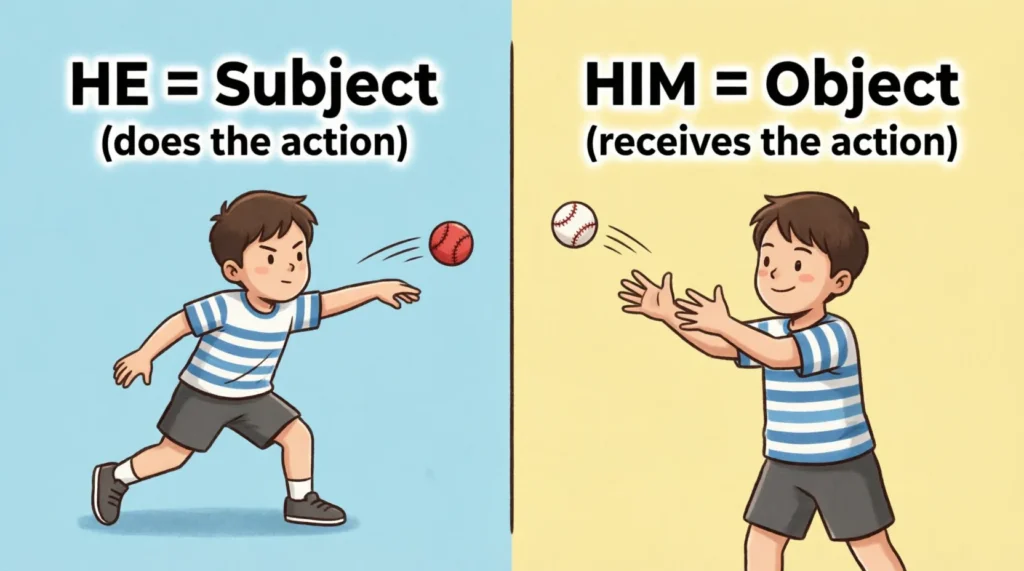
In short, he vs him is about knowing when to use each pronoun correctly in a sentence. He is used as the subject, while him is used as the object. Once you learn this simple rule, your speaking and writing will become much clearer, and you’ll spot mistakes with confidence.
What Are the he vs him Rules? (And Why They Matter)
Imagine you’re finishing a homework assignment when you stop and wonder, “Should I write he or him?” It happens to students of every age, and even adults sometimes pause to double-check.
The difference between he and him is actually simple. He is a subject pronoun, meaning it does the action. Him is an object pronoun, meaning it receives the action.
For example:
He plays soccer.
I saw him after school.
Knowing this difference helps you write stronger essays, answer grammar questions correctly, and communicate more clearly. Literacy educators often encourage students to master pronouns early because they appear in almost every piece of writing.
Once you understand this rule, you can recognize the correct choice almost automatically. Let’s look at plenty of examples to make it stick.
[IMAGE: Student comparing the words “he” and “him” in a grammar notebook]
The Best Examples of he vs him
Here are practical examples that show the difference clearly.
He loves reading before bedtime.
Sarah invited him to her birthday party.
He finished the science project first.
Everyone congratulated him after the competition.
He enjoys drawing cartoons.
I asked him for help with my homework.
He found the missing library book.
The teacher praised him for his effort.
He is waiting outside the classroom.
We surprised him with a thank-you card.
He solved the puzzle quickly.
My cousin called him yesterday.
He always shares his lunch.
The coach selected him for the team.
He remembered everyone’s name.
Our neighbors invited him over for dinner.
He practices the piano every evening.
I met him at the school library.
He answered the question correctly.
The audience applauded him at the end of the play.
Notice a pattern? Whenever the person is doing the action, you use he. Whenever the action happens to the person or follows a verb or preposition, you use him.
Language arts researchers explain that seeing many examples helps your brain recognize grammar patterns more naturally. The more you read and write, the easier these choices become.
How to Use he vs him in Your Writing
Learning the rule is easier when you follow a few simple steps.
Find who is doing the action. If that person is the subject, use he.
Find who receives the action. If someone else acts on that person, use him.
Remove extra words if the sentence seems confusing. The correct pronoun often becomes obvious.
Read your sentence aloud. If it sounds natural, you’ve probably chosen the right pronoun.
Example:
Correct: He helped Maya finish the project.
Correct: Maya thanked him for helping.
Whenever you write a story, report, or email, pause for a second and ask yourself, “Is this person doing the action or receiving it?” That quick question will help you choose correctly every time.
He vs Him in Poems and Stories
Authors naturally use both pronouns because they help readers understand who is acting and who is being described.
Aisha wrote:
“He chased the morning light, While the birds welcomed him with cheerful songs.”
Mateo told this story:
“He picked up the lost puppy. Everyone thanked him for being so kind.”
Priya wrote:
“He smiled at the stars above. The moon seemed to guide him home.”
Creative writing teachers encourage students to use pronouns carefully because they keep stories flowing smoothly without repeating names over and over again.
As you continue reading books, you’ll begin noticing how often skilled writers switch between he and him naturally.
Common Mistakes Students Make With he vs him
Using him as the subject. Many students accidentally write “Him went to school.” The correct sentence is “He went to school.”
Using he after a verb. You might hear “The teacher called he.” Instead, write “The teacher called him.”
Getting confused in longer sentences. Extra words can make grammar seem tricky. Try removing the extra phrases to find the correct pronoun.
Copying informal speech. People sometimes speak casually, but school writing follows standard grammar rules. That’s perfectly normal, and practice helps.
Forgetting that prepositions usually take him. After words like “to,” “for,” “with,” and “about,” you’ll usually need him, not he.
These mistakes are common, so don’t worry if you’ve made them before. Every correct sentence you write helps build stronger grammar habits.
Fun Activities to Practice he vs him
Grab a pencil and circle every he and him in a favorite story. Decide why each one is correct.
Challenge yourself to write ten sentences. Use he in five sentences and him in the other five.
Play a classroom game where one student starts a sentence, and another chooses whether he or him belongs in the blank.
Draw a comic strip with two characters. Write speech bubbles that correctly use both pronouns.
Create your own worksheet by changing every he to him, then correct all the mistakes.
Read a page from a novel aloud. Every time you hear he or him, pause briefly and explain why the writer chose that word.
Practicing in different ways helps you remember the rule much faster than simply memorizing it.
What NOT to Do With he vs him
Don’t choose a pronoun based only on what “sounds right.” Instead, identify the subject and object in the sentence.
Don’t assume longer sentences change the rule. Even complicated sentences follow the same grammar pattern.
Don’t use him before the main verb unless it truly functions as an object. “Him likes pizza” is incorrect because him isn’t the subject.
Don’t worry if you need to double-check. Even experienced writers pause sometimes. Careful editing makes your writing stronger.
Understanding these common myths makes it much easier to avoid mistakes in your own work.
Frequently Asked Questions About he vs him
What is the difference between he and him?
He is the subject pronoun used for someone doing the action. Him is the object pronoun used for someone receiving the action. This simple difference is the key to using each word correctly.
How do I know whether to use he or him?
Ask yourself who is performing the action. If the person is doing the action, use he. If the action happens to the person, use him.
Is “He and me” or “Him and me” correct?
It depends on the sentence. If the phrase is the subject, use “He and I.” If it’s the object, use “him and me.” Removing the other person from the sentence often helps you find the correct answer.
Why do students confuse he and him?
Both words refer to the same person, so it’s easy to mix them up. Longer sentences and everyday conversation can also make the difference harder to notice, but regular practice builds confidence.
Are he and him taught in elementary school?
Yes. Most students begin learning subject and object pronouns during elementary school and continue practicing them in middle school. Reviewing these rules helps improve grammar, writing, and reading comprehension.
Final Thoughts on he vs him
Learning he vs him is one of the easiest ways to improve your grammar. Once you understand that he does the action and him receives the action, many confusing sentences become much clearer.
Remember that every great writer started by learning simple grammar rules just like this one. You don’t need to memorize hundreds of exceptions—just practice identifying the subject and the object.
The more you read books, complete writing assignments, and notice pronouns in everyday language, the more natural the correct choice will feel. Language arts educators encourage frequent practice because small grammar skills create stronger writers over time.
Keep practicing, stay curious, and remember that every sentence you write is another chance to grow your confidence.
Liam is a language enthusiast and lead writer at Similepedia.com, where he focuses on creating clear, creative, and easy-to-use similes for everyday writing. He specializes in turning simple ideas into vivid comparisons that make sentences more engaging, expressive, and memorable.
Instead of overcomplicating language with technical jargon, Liam approaches similes as practical tools for better communication. He breaks down how comparisons work, when to use them, and how to make them sound natural — not forced or awkward.
He pays close attention to tone, context, and clarity, ensuring every simile fits smoothly into real sentences. From fun and playful comparisons to more descriptive and expressive ones, Liam helps readers improve how they write, speak, and express ideas.
At Similepedia.com, his mission is simple: make language more colorful and effective without making it complicated. He doesn’t just list similes — he helps readers understand how to use them confidently in real situations.