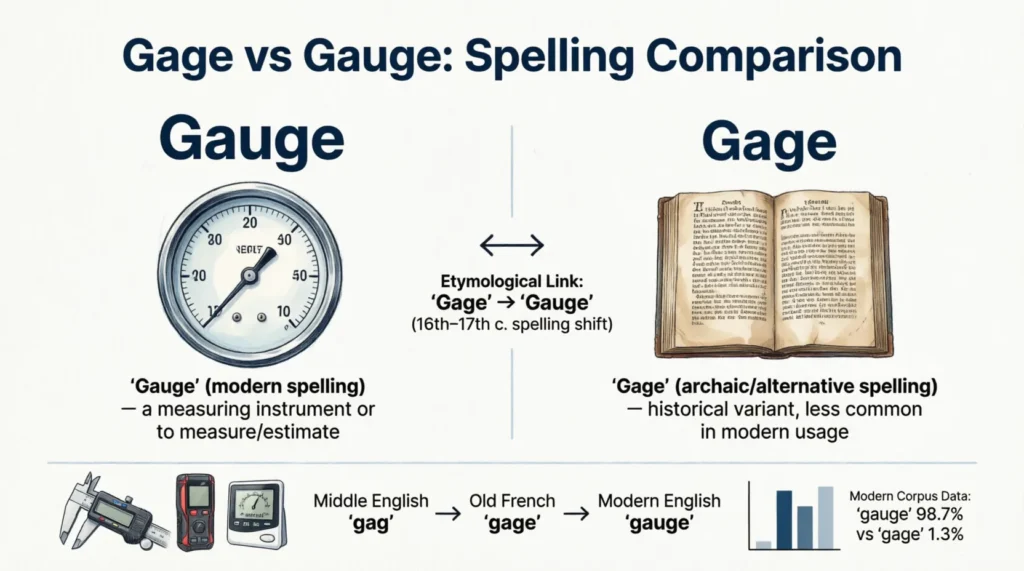
In short, gage vs gauge is about two words that look almost the same but are used in different ways. While gauge is the standard spelling in most situations, gage is a less common variant used in certain industries and historical contexts. Keep reading to learn when each word is correct and how you can avoid common mistakes.
[IMAGE: Student comparing the words “gage” and “gauge” in a notebook with example sentences]
What Are the gage vs gauge? (And Why They Matter)
Have you ever been writing an essay when spellcheck highlighted a word, and you wondered if you had used the wrong spelling? Maybe your teacher wrote “Use gauge instead” in the margin, leaving you confused about why both words seem to exist.
The topic of gage vs gauge is simply about understanding the difference between two similar spellings. In modern English, gauge is the standard spelling for almost every meaning, while gage survives mainly in technical industries and a few historical uses.
Knowing the difference matters because it helps your writing look polished and accurate. Whether you are answering exam questions, writing a science report, or reading technical manuals, choosing the correct spelling shows attention to detail.
Language arts educators and literacy researchers encourage students to learn commonly confused words because they improve reading comprehension, spelling confidence, and overall writing skills. Once you understand this pair, you will spot the correct word much more easily.
Before you start using these words confidently, it helps to see real examples.
The Best Examples of the gage vs gauge
Here are practical examples showing when each spelling is appropriate.
The fuel gauge showed that the car was almost empty.
Emma checked the temperature gauge before baking the cake.
The rain gauge measured three inches of rainfall overnight.
We used a pressure gauge to test the bicycle tire.
The teacher asked us to gauge the audience’s reaction.
You should gauge the distance before making the jump.
Liam tried to gauge how difficult the test would be.
The manager carefully gauged customer satisfaction.
Scientists use special tools to gauge wind speed.
Maya couldn’t gauge whether her joke was funny.
The carpenter used a thickness gauge to measure the wood.
The mechanic replaced the oil pressure gauge.
Doctors may gauge a patient’s progress over time.
The artist tried to gauge the perfect amount of light.
In most writing classes, gauge is always the correct spelling.
Some railway companies still use the spelling gage in technical names.
Certain engineering industries use gage for specific measuring tools.
Historical documents sometimes refer to a “gage” as a pledge or challenge.
Some manufacturing standards use gage for sheet metal thickness.
Outside of specialized fields, most readers expect to see gauge.
These examples work because they show real situations you might actually read or write about. They also highlight that context matters. Most of the time, your safest choice is gauge, while gage appears only in specialized or historical settings.
Now that you have seen the difference, let’s look at how you can use these words correctly in your own writing.
How to Use the gage vs gauge in Your Writing
Learn the everyday rule first. If you are writing school assignments, essays, stories, or emails, choose gauge unless you know a technical style guide requires gage.
Think about the meaning. If the word means “measure,” “estimate,” or a measuring instrument, gauge is almost always correct.
Watch for technical exceptions. Some engineering, manufacturing, and railway documents intentionally use gage because it is part of an industry standard.
Double-check your audience. If you are writing for school, your teacher will usually expect the standard spelling.
Example sentence:
“The weather gauge recorded strong winds during yesterday’s storm.”
As you practice, you will find that choosing the correct spelling becomes almost automatic.
gage vs gauge in Poems and Stories
Creative writers almost always use gauge because readers recognize it immediately. The word can describe both physical measurements and emotions.
Aisha wrote:
“I tried to gauge the quiet sky, Where hopeful dreams still learned to fly.”
Mateo whispered in his story:
“He couldn’t gauge the old man’s smile, so he waited before speaking.”
Priya ended her poem with:
“The tiny rain gauge filled with silver drops, reminding everyone that every storm eventually ends.”
Poets and authors often use gauge because it helps describe observation, uncertainty, or careful thinking. It creates vivid imagery while remaining easy for readers to understand.
Once you know how writers use these words, it becomes easier to avoid common errors.
Common Mistakes Students Make With the gage vs gauge
Using gage in every situation. This is very common. In modern English, gauge is the preferred spelling almost everywhere.
Thinking both spellings are always interchangeable. They are not. While they share a history, today’s readers expect different spellings depending on the context.
Assuming spellcheck is always wrong. Many writing programs correctly recommend gauge because it is the standard spelling.
Forgetting technical exceptions. Some industries intentionally use gage, especially in manufacturing and engineering. That does not mean it should replace gauge in school writing.
Mixing the spellings in the same document. If you are writing for general readers, stay consistent by using gauge throughout your work.
These mistakes are completely normal, especially when you first learn about commonly confused words. A little practice goes a long way.
Fun Activities to Practice the gage vs gauge
Grab a pencil and make two columns labeled “Gauge” and “Gage.” Sort example sentences into the correct column.
Challenge yourself to read a newspaper or science article and circle every time you see gauge used correctly.
Play a classroom guessing game where one student reads a sentence and everyone decides which spelling belongs in the blank.
Create a drawing of different measuring tools, such as a rain gauge, fuel gauge, and pressure gauge. Label each picture correctly.
Complete a worksheet where you replace incorrect spellings with the correct word. You will quickly notice patterns that make remembering easier.
These fun activities help you recognize the correct spelling without memorizing long grammar rules.
What NOT to Do With the gage vs gauge
Don’t assume gage is simply an old-fashioned spelling you can use anywhere. It still exists, but mainly in specialized industries and historical writing.
Don’t replace every instance of gauge with gage. In school assignments and most books, this will usually be considered incorrect.
Don’t ignore context. The audience and purpose of your writing help determine which spelling fits best.
Don’t believe every online example without checking. Some websites mix the spellings incorrectly, so always compare examples with reliable dictionaries or educational sources.
Understanding these myths makes the difference much easier to remember.
Frequently Asked Questions About the gage vs gauge
Which is correct: gage or gauge?
For almost all everyday writing, gauge is correct. Gage is mainly used in specialized industries, certain technical standards, or historical meanings.
Why do some companies spell it “gage”?
Some engineering and manufacturing organizations continue using gage because it follows long-established industry standards. This tradition has remained even though gauge is the common spelling elsewhere.
Is gage an incorrect spelling?
Not completely. It is a legitimate word with specific technical and historical uses, but it is not the standard spelling for everyday English.
How do you use gauge in a sentence?
You could write, “The fuel gauge showed the tank was nearly full.” You can also say, “I tried to gauge my friend’s reaction before telling the surprise.”
Should students use gage or gauge in school?
In almost every classroom assignment, you should use gauge. Unless your teacher is discussing engineering terminology or historical texts, it is the spelling readers expect.
Final Thoughts on the gage vs gauge
Learning the difference between gage and gauge is easier than it first appears. Once you know that gauge is the standard spelling for everyday writing, most of the confusion disappears.
You also discovered that gage is not completely wrong. Instead, it has specialized uses in manufacturing, engineering, railway terminology, and historical writing.
The more you read, write, and notice these words in context, the more naturally you will choose the correct spelling. Even experienced writers occasionally double-check commonly confused words.
Keep practicing, stay curious, and remember that every new word you master makes your writing stronger and more confident. Your next piece of writing can be even clearer than the last.
Liam Nguyen is a passionate educator and writer with a deep love for figurative language. He holds a master’s degree in Creative Writing and has spent eight years teaching at various educational settings, focusing on language enrichment programs for children from grades 2-6. His expertise in crafting metaphorical language and similes into captivating content stems from his belief that storytelling is the heartbeat of learning. Liam’s contributions to SimilePedia span from emotion-driven examples to color-inspired narrative tools. He is committed to fostering a creative environment where students can explore and find joy in their unique expressions.