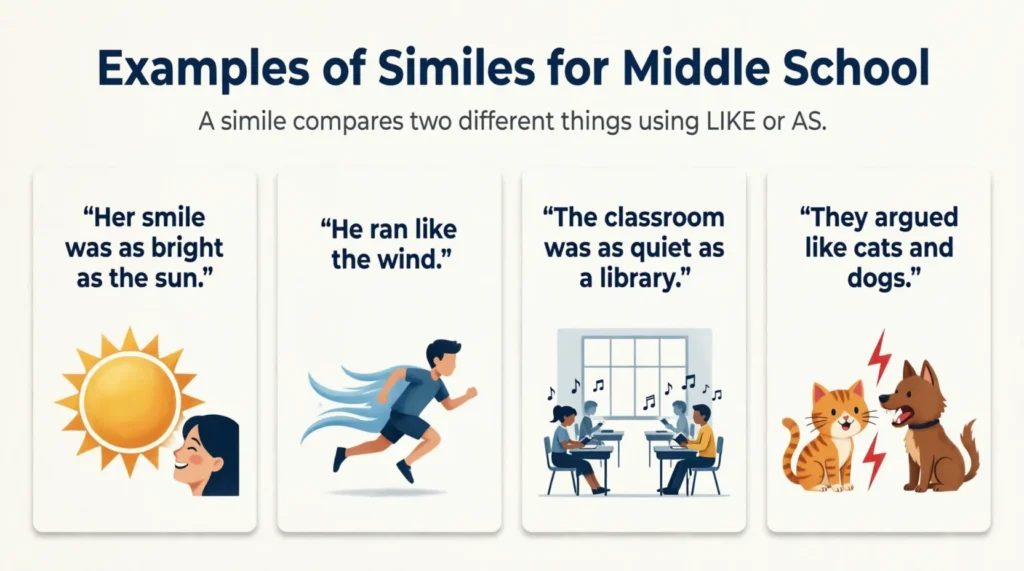
In short, examples of similes for middle school are simple comparisons that use “like” or “as” to help you describe people, feelings, objects, and events in a more vivid way. They make your writing more creative, colorful, and easier for readers to imagine. In this guide, you’ll discover clear examples and learn how to use them confidently in your own writing.
What Are Examples Of Similes For Middle School? (And Why They Matter)
Have you ever stared at a blank page, trying to describe something like “fast,” “cold,” or “scary,” but nothing exciting comes to mind? Maybe your teacher asked for a better description, and your sentence felt too plain. That’s exactly where examples of similes for middle school can help you shine.
A simile is a simple comparison between two different things using the words “like” or “as.” For example, “as busy as a bee” helps you imagine someone who never stops moving. It’s one of the easiest ways to make your writing more powerful and interesting.
Literacy educators often say that similes improve both reading comprehension and creative writing skills. When you use them, you help your reader see what you mean instead of just understanding it.
Learning examples of similes for middle school matters because you use them in essays, stories, poems, and even everyday conversations. The better you get at them, the more confident you become in expressing your ideas.
And once you understand how they work, you’ll start noticing them everywhere—in books, songs, and even movies. Let’s explore some of the best ones next.
The Best Examples Of Examples Of Similes For Middle School
Here are some clear, creative, and fun examples of similes for middle school that you can use in your writing. Each one helps you imagine something more clearly and makes your sentences more exciting.
As busy as a bee on a summer afternoon
As quiet as a mouse in a sleeping house
As fast as a cheetah chasing its prey
As cold as ice on a winter morning
As bright as the sun in a clear blue sky
As light as a feather floating in the air
As strong as an ox lifting heavy loads
As sweet as candy on a holiday treat table
As sharp as a knife cutting through paper
As slow as a turtle crossing a road
As smooth as silk sliding through your fingers
As loud as thunder during a heavy storm
As stubborn as a mule refusing to move
As free as a bird flying over mountains
As slippery as a fish in your hands
As dry as a desert without rain
As warm as fresh bread straight from the oven
As brave as a lion protecting its pride
As messy as a room after a long weekend
As calm as a lake on a windless day
These examples of similes for middle school work so well because they use familiar images. You can easily picture them in your mind, which helps your reader understand your message quickly and clearly.
How To Use Examples Of Similes For Middle School In Your Writing
Using similes is easier than you think. You just need to follow a few simple steps to make your writing more creative and engaging.
Think of the quality you want to describe Ask yourself what you want your reader to feel—speed, emotion, size, or mood.
Choose a strong comparison Pick something familiar that your reader can easily imagine, like animals, food, or nature.
Use “like” or “as” correctly This is what makes it a simile instead of a metaphor.
Test your sentence in context Read it out loud and see if it makes your writing more vivid.
For example, you could write: “You ran as fast as a cheetah during the school race.” This makes your sentence more exciting and helps your reader picture your speed.
When you practice examples of similes for middle school regularly, your writing naturally becomes more expressive and confident.
Examples Of Similes For Middle School In Poems And Stories
Writers and poets love using similes because they add emotion and rhythm to language. When you include them, your writing feels more alive and memorable.
Here are a few creative examples:
Mia’s poem:
“Your smile is as bright as the morning sun, warming every corner of my heart.”
Ahmed’s story:
The night was as dark as ink spilled across the sky, hiding every shadow.
Lina’s short verse:
“My thoughts are as fast as lightning, racing before I can catch them.”
Similes like these help you express feelings in a deeper way. They turn simple sentences into something that feels artistic and meaningful. That’s why examples of similes for middle school are often used in poetry and storytelling exercises.
Common Mistakes Students Make With Examples Of Similes For Middle School
It’s completely normal to make mistakes when learning similes. The good news is that you can fix them easily once you notice them.
Using unclear comparisons If your comparison is confusing, your reader won’t understand it. Always choose familiar objects.
Forgetting “like” or “as” Without these words, your simile becomes a metaphor instead.
Making comparisons too complicated Keep it simple so your reader can picture it quickly.
Using the same similes again and again Try to be creative instead of repeating common phrases like “as busy as a bee” too often.
Mixing unrelated ideas Your comparison should make sense. For example, comparing sadness to a color that doesn’t clearly represent emotion can confuse readers.
These mistakes are normal, and every writer improves with practice. The more you work with examples of similes for middle school, the easier it becomes to avoid them.
Fun Activities To Practice Examples Of Similes For Middle School
Try these fun activities to improve your simile skills and make learning more enjoyable:
Simile scavenger hunt Look around your classroom or home and describe five objects using similes. Challenge yourself to be creative.
Finish the sentence game Start with “as…” and complete it in different ways, like “as shiny as…” or “as noisy as…”
Story upgrade challenge Take a simple sentence like “The dog ran fast” and improve it using a simile.
Partner guessing game One person creates a simile, and the other guesses what is being described.
Drawing + writing combo Draw an object and write a simile next to it to describe it.
Simile journal Every day, write one new example of similes for middle school in your notebook.
These activities help you think creatively and make your writing stronger over time.
More examples of similes for middle school by Tone and Context
🌿 Natural & Descriptive
“As steady as a river carving through stone” — Captures persistence and determination, making it useful for describing someone who keeps working toward a goal.
“Like a leaf dancing in the autumn wind” — Suggests movement, freedom, or excitement in a vivid and natural way.
“As bright as morning sunlight on fresh snow” — Highlights clarity, happiness, or something that stands out clearly.
“Like a mountain standing against the storm” — Emphasizes strength and resilience during difficult situations.
“As calm as a pond at sunrise” — Works well when describing peaceful feelings, settings, or moments.
💛 Warm & Emotional
“Like a warm blanket on a chilly evening” — Expresses comfort, kindness, and emotional support.
“As welcoming as an old friend’s smile” — Conveys friendliness and a sense of belonging.
“Like a candle glowing in the darkness” — Represents hope, encouragement, or positivity during tough times.
“As comforting as hearing your favorite song” — Describes feelings of ease, happiness, and familiarity.
“Like a handwritten note from someone you miss” — Suggests affection, thoughtfulness, and emotional connection.
✨ Poetic & Romantic
“As graceful as moonlight drifting across a lake” — Creates a gentle, elegant image suitable for poems and creative writing.
“Like a star shining through the evening sky” — Highlights beauty, uniqueness, or inspiration.
“As soft as a whisper carried by the breeze” — Conveys tenderness and delicate emotion.
“Like a dream floating just beyond reach” — Suggests mystery, wonder, or longing.
“As beautiful as dawn painting the horizon” — Works well when describing something inspiring or breathtaking.
😄 Playful & Fun
“Like popcorn popping in a hot pan” — Describes excitement, energy, or lots of activity.
“As quick as a squirrel chasing a snack” — Highlights speed and playful movement.
“Like a puppy discovering a new toy” — Captures enthusiasm, curiosity, and joy.
“As bouncy as a ball on a playground” — Useful for describing energetic people or lively situations.
“Like confetti swirling through the air” — Suggests celebration, happiness, and fun.
These tone-grouped similes for examples of similes for middle school give you options for every kind of writing — whether you need something soft and poetic or bold and fun. Try picking one from each group and using them in a short paragraph to see how different the same keyword can feel.
Using examples of similes for middle school in Real Writing Contexts
In a Descriptive Essay
When writing a descriptive essay, students often need to make people, places, or events feel more vivid to the reader. A well-chosen simile can create a stronger image and make ordinary descriptions more memorable. Example: The old oak tree stood as steady as a river carving through stone, watching over the field year after year.
In a Poem
Similes can help establish mood and tone in poetry by creating vivid comparisons that spark emotion and imagination. They allow readers to picture a scene while feeling its atmosphere. Example: Her laughter floated like a leaf dancing in the autumn wind, while the sunset glowed as bright as morning sunlight on fresh snow.
In a Story or Creative Scene
In stories, similes can reveal a character’s feelings or make a setting feel more alive. They help readers connect with the scene through familiar images. Example: As Maya stepped onto the stage, her excitement burst through her like popcorn popping in a hot pan, and she could hardly stand still.
In a Social Media Caption or Message
Short similes work especially well in casual writing because they add personality without making the message too long. They can make a simple caption more fun and memorable. Example: Today was as bouncy as a ball on a playground—so much energy and so many good moments!
The more you practice placing similes for examples of similes for middle school into real sentences, the more natural your writing will sound — and the more your reader will feel exactly what you want them to feel.
What NOT To Do With Examples Of Similes For Middle School
Even good writers sometimes make mistakes. Here’s what you should avoid:
Don’t use overly complex comparisons If your reader can’t picture it quickly, your simile loses impact.
Don’t overuse similes in every sentence Too many comparisons can make your writing feel crowded.
Don’t copy the same similes repeatedly Original ideas make your writing more interesting.
Don’t ignore meaning Your simile should actually match what you’re trying to describe.
Avoiding these habits will help your writing feel clearer and more natural.
Frequently Asked Questions About Examples Of Similes For Middle School
What are examples of similes for middle school students?
Examples of similes for middle school students are simple comparisons like “as fast as a cheetah” or “as quiet as a mouse.” They help students describe ideas in a more vivid and creative way. These are often used in writing assignments and storytelling practice.
Why do teachers teach examples of similes for middle school?
Teachers use similes to help you improve your descriptive writing skills. They make your sentences more interesting and help readers visualize your ideas. This is an important part of language learning and creative expression.
How can I create my own examples of similes for middle school?
You can create your own similes by choosing a quality and comparing it to something familiar. For example, “as cold as ice” or “as soft as a cloud.” The key is to keep it simple and easy to imagine.
Are examples of similes for middle school hard to learn?
Not at all. Once you understand the pattern of “like” or “as,” you can easily create your own. With practice, you’ll start using them naturally in your writing.
Where can I use examples of similes for middle school in real writing?
You can use them in essays, poems, stories, and even homework assignments. They help make your writing more engaging and easier for readers to enjoy.
Final Thoughts On Examples Of Similes For Middle School
Learning examples of similes for middle school gives you a powerful tool to make your writing more creative and expressive. You can turn simple sentences into vivid images that your reader will remember.
The more you practice, the more natural it becomes to use similes in your writing. You don’t need to be a professional writer—just someone willing to experiment with words and ideas.
Keep trying new comparisons, stay curious, and trust your imagination. Your writing will grow stronger every time you use a simile with confidence.
Frequently Asked Questions
What are similes and why are they important for middle school students?▼
Similes are comparisons that use ‘like’ or ‘as’ to describe things vividly. They help students enhance their writing by making descriptions more creative and engaging, ultimately improving reading comprehension and writing skills.
Can you give examples of similes that middle school students can use?▼
Sure! Some examples include ‘as busy as a bee,’ ‘as cold as ice,’ and ‘as loud as thunder.’ These comparisons use familiar images that help readers visualize the qualities being described.
How can I incorporate similes into my writing effectively?▼
To use similes effectively, think about the quality you want to describe and choose a strong, relatable comparison. Make sure to use ‘like’ or ‘as’ correctly to form a simile, and read your sentence in context to ensure it flows well.
Why should middle school students learn to use similes?▼
Learning to use similes empowers students to express their ideas more confidently and vividly. It also helps them notice these figures of speech in various forms of media, enhancing their overall literacy skills.
Where can I find more examples of similes besides those listed in the article?▼
You can find more examples of similes in books, songs, and poetry. Observing how authors and songwriters use similes can inspire your own writing and expand your creative vocabulary.
Are similes only useful in creative writing, or can they be used in other types of writing?▼
Similes are versatile and can be used in essays, reports, and even everyday conversations. They add color to any type of writing by making descriptions more relatable and engaging.
How do similes differ from metaphors?▼
Similes explicitly use ‘like’ or ‘as’ to compare two different things, while metaphors make a direct comparison without those words. Understanding the difference can help you choose the right figure of speech for your writing.
Liam is a language enthusiast and lead writer at Similepedia.com, where he focuses on creating clear, creative, and easy-to-use similes for everyday writing. He specializes in turning simple ideas into vivid comparisons that make sentences more engaging, expressive, and memorable.
Instead of overcomplicating language with technical jargon, Liam approaches similes as practical tools for better communication. He breaks down how comparisons work, when to use them, and how to make them sound natural — not forced or awkward.
He pays close attention to tone, context, and clarity, ensuring every simile fits smoothly into real sentences. From fun and playful comparisons to more descriptive and expressive ones, Liam helps readers improve how they write, speak, and express ideas.
At Similepedia.com, his mission is simple: make language more colorful and effective without making it complicated. He doesn’t just list similes — he helps readers understand how to use them confidently in real situations.