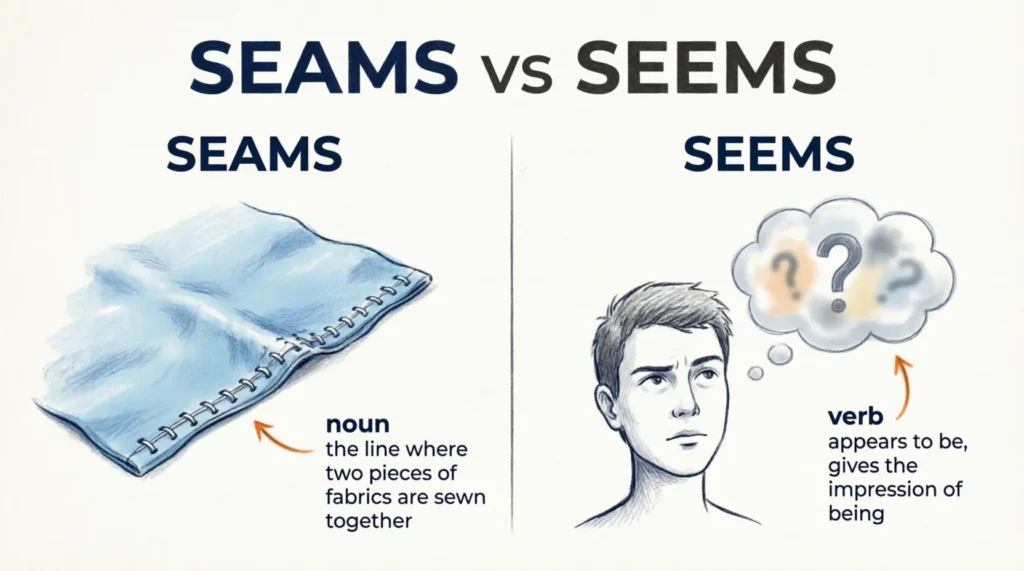
In short, seams and seems sound exactly alike, but they have very different meanings. Seams are the lines where pieces of fabric are joined together, while seems is a verb that means “appears” or “looks like.” Keep reading to learn simple explanations, memorable examples, and easy ways to remember the difference.
[IMAGE: A split illustration showing a shirt seam on one side and a student writing the word “seems” on the other]
What Are the seams vs seems? (And Why They Matter)
Have you ever looked at your homework and wondered whether to write “It seams easy” or “It seems easy”? You are not alone. Because these words sound the same, many students accidentally swap them.
Seams is a noun that usually refers to the stitched line where two pieces of fabric meet. Seems is a verb that means something appears or gives a certain impression.
Knowing the difference matters because using the wrong word can completely change the meaning of your sentence. Whether you are writing an essay, answering an exam question, or creating a story, choosing the correct word helps your writing sound clear and confident.
Language arts researchers and literacy educators encourage students to learn common homophones like these because they improve reading, spelling, and writing accuracy. Once you understand the meanings, you will spot the correct word much more easily.
Now that you know the basics, let’s explore plenty of examples you can remember.
The Best Examples of the seams vs seems
The dress has strong seams that keep it from tearing.
My backpack’s seams started coming apart after years of use.
The jacket needs new seams along the sleeves.
You can see the seams inside the handmade pillow.
The soccer ball’s seams are stitched very carefully.
The old book has cracked seams in its binding.
The quilt’s colorful seams show excellent craftsmanship.
The jeans have double seams for extra strength.
The toy ripped because one of its seams split open.
The costume’s seams were almost invisible.
It seems like it might rain this afternoon.
Maya seems excited about the science fair.
This puzzle seems easier than yesterday’s challenge.
Your answer seems correct to me.
The movie seems longer than I remembered.
He seems nervous before the performance.
The classroom seems quieter today.
This recipe seems simple enough to try.
Everything seems ready for the school play.
It seems impossible until you practice.
These examples work well because they clearly show that seams is connected with clothing, fabric, or stitched objects, while seems expresses appearance or opinion. Paying attention to the context creates a strong mental picture, making each word easier to remember.
[IMAGE: A comparison chart labeled “Seams = stitching” and “Seems = appears”]
How to Use the seams vs seems in Your Writing
When you write, you can avoid this common mistake by following a few simple steps.
Ask yourself whether you are talking about fabric or stitching. If the answer is yes, choose seams.
If you mean “appears” or “looks like,” write seems instead.
Read your sentence aloud and replace the word with “appears.” If the sentence still makes sense, seems is the correct choice.
Picture a shirt whenever you see seams. Visual clues often help your brain remember spelling patterns.
Example:
“The old jacket has torn seams, but it seems easy to repair.”
As you practice, you will start recognizing the correct word without even thinking about it.
Seams vs Seems in Poems and Stories
Creative writers often use seems to describe feelings or mystery, while seams appears in stories involving clothing, costumes, or handmade objects.
Aisha wrote:
“The sky seems calm tonight, Yet secrets dance behind the stars.”
Mateo described his adventure:
“The superhero cape had loose seams, But it still made him feel brave enough to fly.”
Priya’s story included:
“The old teddy bear’s seams were worn with love. It seems every hug had left a happy memory behind.”
Poets and authors choose these words carefully because they help readers picture scenes, understand emotions, and create vivid imagery. As you read more stories, you will notice how naturally each word fits its own purpose.
Common Mistakes Students Make With the seams vs seems
Writing “It seams funny.” This is probably the most common mistake. Since “appears” fits here, the correct word is seems.
Using seems when talking about clothing. If you are describing a shirt, pillow, or backpack, you almost always need seams, not seems.
Depending only on pronunciation. These words sound identical, so listening alone cannot help you choose the correct spelling.
Forgetting to check the sentence’s meaning. Before you finish your writing, ask yourself what the sentence is actually describing.
Rushing through proofreading. Even excellent writers confuse homophones sometimes. Reading your work one more time usually catches these small mistakes.
The good news is that these mistakes are completely normal, and you can fix them with regular practice.
Fun Activities to Practice the seams vs seems
Grab a pencil and write ten sentences. Challenge yourself to use seams in five sentences and seems in the other five.
Play a partner game where one person reads a sentence aloud while the other decides which spelling belongs in the blank.
Create a two-column worksheet. Label one side “Fabric” and the other “Appears,” then sort example sentences into the correct column.
Draw a shirt, backpack, and pillow. Label the seams, then write three new sentences using seems correctly.
Read a short story or chapter from your favorite book. Circle every time you find seems, and see if you can find any examples of seams in descriptions.
These activities make learning enjoyable while helping you build confidence with each new sentence.
What NOT to Do With the seams vs seems
Do not assume that words sounding alike have the same meaning. Seams and seems are homophones, but they belong in different situations.
Do not memorize spelling without understanding meaning. Knowing what each word represents makes choosing the correct spelling much easier.
Do not guess during a test. Pause for a second and ask yourself whether the sentence is about stitching or appearance.
Do not believe that spell-check catches every mistake. Since both words are spelled correctly, your computer may not notice if you picked the wrong one.
Frequently Asked Questions About the seams vs seems
What is the difference between seams and seems?
Seams refers to the stitched lines where pieces of fabric are joined together. Seems means something appears or looks a certain way. Although they sound the same, they have completely different meanings.
How do you remember seams vs seems?
A simple trick is to remember that seams contains “seam,” which relates to sewing and clothing. If you can replace the word with “appears,” then you should use seems.
How do you use seams and seems in a sentence?
Here is a correct example: “The backpack’s seams are strong, and it seems ready for another school year.” Each word has its own job in the sentence.
Why do students confuse seams and seems?
Students often confuse them because they are homophones, meaning they sound exactly alike. Literacy educators recommend learning the meanings first instead of relying only on pronunciation.
Are seams and seems taught in middle school?
Yes. Many teachers introduce homophones throughout elementary and middle school because they improve spelling, vocabulary, and reading comprehension. Learning them early makes future writing much easier.
Final Thoughts on the seams vs seems
Learning the difference between seams and seems may feel challenging at first, but it becomes much easier once you connect each word to its meaning. Remember that seams belong to sewing, clothing, and stitched objects, while seems describes how something appears.
The more you read, write, and proofread your work, the faster you will recognize which spelling belongs in each sentence. Even experienced writers occasionally pause to double-check homophones.
Creative writing teachers and language arts educators often remind students that strong writing is built from small, accurate choices. Mastering pairs like these helps your ideas shine more clearly.
Keep practicing, stay curious, and remember that every sentence you write is another chance to grow as a confident writer.
Liam Nguyen is a passionate educator and writer with a deep love for figurative language. He holds a master’s degree in Creative Writing and has spent eight years teaching at various educational settings, focusing on language enrichment programs for children from grades 2-6. His expertise in crafting metaphorical language and similes into captivating content stems from his belief that storytelling is the heartbeat of learning. Liam’s contributions to SimilePedia span from emotion-driven examples to color-inspired narrative tools. He is committed to fostering a creative environment where students can explore and find joy in their unique expressions.