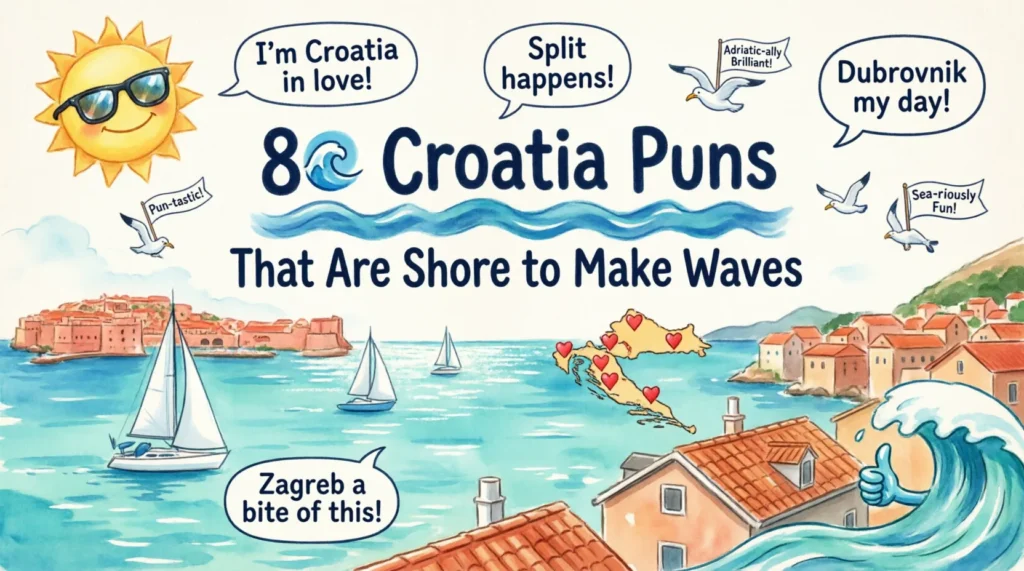
Ready to sea-ze the day with 80 Croatia puns and jokes? This collection is packed with witty lines for Instagram captions, travel photo dumps, postcards, beach texts, and vacation scrapbooks. Scroll through and start copying your favorite Adriatic-approved wordplay.
The Best Croatia Puns (Start Here)
Croatia stole a pizza my heart.
I’m having a shore thing with Croatia.
Dubrovnik once, regret nothing.
Croatia really yacht my attention.
Split happens — especially on vacation.
This trip was un-Brač-lievable.
Croatia is my current sea-nario.
Adriatic-ing up every second of this trip.
Travel Caption One-Liners
These Croatia puns are perfect for vacation selfies, beach shots, and sunset reels from the Adriatic coast. They’re short, punchy, and built for captions that deserve more than a plain “wish you were here.”
Croatia? More like Crow-YAY-tia.
Sea you later — I’m staying in Croatia.
Serving coastal granddaughter energy in Dubrovnik.
I came for the views and stayed for the seafood.
Split decisions led me to Croatia.
Current mood: Adriatic and dramatic.
Beach, please — I’m in Croatia.
This island getaway has me Hvar-ever changed.
Croatia is giving major dock-star vibes.
Lost at sea? Nah, just emotionally attached to the coastline.
Sailing through Croatia one wave at a time.
No bad tides in sight.
Funny Croatia Jokes
Need a few laugh-out-loud Croatia jokes for your travel group chat or postcard? These Q&A-style jokes bring the sunshine, the sailing chaos, and the tourist energy.
Q: Why did the tourist fall in love with Croatia? A: It was coast at first sight.
Q: Why don’t people rush in Dubrovnik? A: They prefer taking the scenic route.
Q: Why was the Croatian beach so confident? A: It had plenty of shore support.
Q: Why did the sailor move to Croatia? A: He wanted a reel change of pace.
Q: Why was the island vacation so emotional? A: Too many pier pressure moments.
Q: Why did the tourist bring sunglasses to Split? A: The city was too bright to handle.
Q: Why did everyone love the Croatian ferry? A: It always carried the conversation.
Q: Why was the seafood dinner unforgettable? A: It was o-fish-ally amazing.
Q: Why did the traveler extend their Croatia trip? A: They couldn’t bay goodbye.
Q: Why did the beach towel feel important? A: It had a lot resting on it.
Q: Why do tourists smile so much in Croatia? A: The views are cliff-hangingly beautiful.
Q: Why did the yacht get invited to every party? A: It knew how to make waves.
Flirty Croatia Puns
These Croatia lines are made for vacation crushes, couples’ captions, and romantic seaside selfies. A little cheesy? Sure. But that’s part of the charm.
You had me at “Let’s book Croatia.”
I’m totally shore about you.
You’re the only souvenir I need from Croatia.
We’re making quite the splash together.
I’d cross every island just to sea you.
You make my heart dock faster.
I’m Adriatic-ed to your smile.
You’re my favorite travel destination.
Our chemistry is stronger than Croatian coffee.
I cannoli think about our beach date.
You’re yacht what I expected — you’re better.
Love washed ashore the moment we landed.
Postcard & Souvenir Lines
Writing a postcard or picking out souvenirs? These witty Croatia sayings fit perfectly on travel journals, tote bags, magnets, and beachy notes home.
Wish you were pier.
Croatia really raised the bar-ge.
Meet me where the water sparkles.
Sunsets hit different on the Adriatic.
Croatia has me feeling fintastic.
Collecting memories one island at a time.
Straight outta Dubrovnik.
Croatia is always a good tide-a.
Home is where the beach snacks are.
Caught feelings and maybe too much sun.
Take only pictures, leave only sandy footprints.
Croatia: the reel deal.
Social Media Croatia Captions
These puns are built for TikTok clips, Instagram dumps, and vacation carousel posts. Short enough to fit a caption, clever enough to earn the comments.
Croatia has me feeling boat-iful.
Just coasting through life.
Vacation mode: fully anchored.
Serving Adriatic attitude.
Croatia understood the assignment.
This trip deserves its own highlight reel.
Sun, sea, and zero emails.
Mentally still island hopping.
Proof that paradise exists.
Out of office and into the ocean.
Croatia really coast me a lot of sunscreen.
Not me considering moving here after four days.
Kid-Friendly Croatia Puns
These clean and playful Croatia jokes are great for family trips, school travel projects, or kids who love silly vacation humor.
Croatia is shore fun for everyone!
I’m having a whale of a time in Croatia.
The beach day totally rocked.
Croatia is sand-sational.
Keep palm and travel on.
This vacation is going swimmingly.
I shell always remember Croatia.
No crabby moods allowed at the beach.
Croatia is turtle-y awesome.
I’m flipping out over these island views.
Every snack tastes butter by the sea.
Croatia is my happy plaice.
More similes for ugly by Tone and Context
🌿 Natural & Descriptive “As ugly as a tree scarred by lightning” — This captures roughness and damage and works well in descriptive essays or nature writing. “Like a wilted leaf forgotten in the rain” — This creates an image of neglect and is useful for vivid descriptions. “As ugly as a muddy pond after a storm” — This highlights messiness and suits outdoor scenes. “Like cracked earth in a dry season” — This suggests harshness and wear, making details more striking. “As ugly as tangled roots sticking out of the ground” — This emphasizes awkward shapes and works in creative descriptions.
💛 Warm & Emotional “Like an old sweater with holes but full of memories” — This reminds readers that something imperfect can still hold meaning. “As ugly as a broken toy that a child still treasures” — This captures affection despite flaws and fits personal stories. “Like a crooked picture hanging in Grandma’s house” — This shows that imperfections can feel familiar and comforting. “As ugly as a rain-soaked diary with faded pages” — This creates a gentle, emotional mood in reflective writing. “Like a patchwork blanket sewn from scraps” — This highlights uniqueness and warmth despite an uneven appearance.
✨ Poetic & Romantic “As ugly as shadows dancing on shattered glass” — This gives a dramatic and artistic feeling that works in poems. “Like a moon hidden behind storm clouds” — This suggests hidden beauty beneath an unpleasant appearance. “As ugly as winter branches under a gray sky” — This creates a quiet and melancholy tone. “Like forgotten ruins covered in ivy” — This blends sadness with mystery and suits lyrical writing. “As ugly as a candle melting in silence” — This evokes emotion and works well in songs or poems.
😄 Playful & Fun “As ugly as socks with sandals at a fancy party” — This creates humor and works in casual conversations. “Like a sandwich dropped upside down on the floor” — This adds a silly image perfect for jokes. “As ugly as a doodle drawn with your eyes closed” — This playful comparison fits social media posts and funny stories. “Like a potato wearing sunglasses indoors” — This gives a goofy image that makes readers smile. “As ugly as a cake that collapsed before the candles were lit” — This captures funny disappointment in lighthearted writing.
These tone-grouped similes for similes for ugly give you options for every kind of writing — whether you need something soft and poetic or bold and fun. Try picking one from each group and using them in a short paragraph to see how different the same keyword can feel.
Using similes for ugly in Real Writing Contexts
In a Descriptive Essay Students may need to describe an unpleasant object, place, or scene in detail. A simile makes the image easier for readers to picture and understand. For example, The abandoned shed looked as ugly as a muddy pond after a storm, with broken boards hanging from its sides.
In a Poem Similes for ugly can create sadness, mystery, or even dramatic beauty in poetry. They help set the mood and make emotions stronger. Like forgotten ruins covered in ivy, the memories faded quietly beneath the evening sky.
In a Story or Creative Scene Writers can use similes for ugly to show what a character notices or how they react to something unpleasant. This adds life to a scene and helps readers feel present. When Mia opened the old attic trunk, she wrinkled her nose because the contents looked as ugly as tangled roots sticking out of the ground.
In a Social Media Caption or Message Short, funny similes work well in casual writing and make captions more entertaining. They add personality and humor without sounding too serious. This haircut is as ugly as a doodle drawn with your eyes closed 😂.
The more you practice placing similes for similes for ugly into real sentences, the more natural your writing will sound — and the more your reader will feel exactly what you want them to feel.
How to Use These Croatia Puns
Croatia jokes and witty travel lines work almost anywhere you want to add personality to your vacation memories. Use them as Instagram captions for beach photos, island-hopping videos, or dreamy Dubrovnik sunset shots. Funny Croatia sayings also fit perfectly in travel journals, postcards, scrapbook pages, and custom photo books after your trip.
If you’re traveling with friends, these puns make hilarious group chat messages, matching T-shirt slogans, or even boat party invitations. Couples can use flirty Croatia humor for anniversary trips, honeymoon captions, or romantic seaside selfies. Many of these lines also work well for TikTok text overlays and travel vlog titles because they’re quick, playful, and easy to remember.
You can even use witty Croatia lines for themed parties, farewell cards, or office vacation emails before heading to the Adriatic coast. The best travel humor feels personal, lighthearted, and easy to share — exactly like these puns.
Frequently Asked Questions
Q: What is a good pun about Croatia? A: One of the most popular Croatia puns is “Croatia stole a pizza my heart.” It mixes travel humor with the country’s coastal food culture and works great for captions or postcards.
Q: What are funny Croatia one-liners? A: Funny Croatia one-liners include “Split happens” and “I’m Adriatic and dramatic.” Short travel jokes tend to work best because they’re easy to remember and fit perfectly on social media.
Q: Are Croatia puns good for Instagram captions? A: Yes — Croatia puns are ideal for Instagram captions, especially for beach photos, yacht trips, old-town pictures, and island-hopping content. Travel captions with humor usually get more engagement because they feel personal and fun.
Q: What makes a Croatia pun funny? A: The best Croatia humor combines travel experiences with coastal wordplay, local landmarks, sailing culture, and vacation emotions. Clever references to Split, Dubrovnik, beaches, ferries, and the Adriatic Sea make the jokes feel more authentic.
Q: What do you call a Croatia travel joke? A: Most people simply call them Croatia puns, travel jokes, or vacation one-liners. If they focus on beaches and sailing, they’re often described as coastal humor or Adriatic jokes.
{
“@context”: “https://schema.org”,
“@type”: “FAQPage”,
“mainEntity”: [
{
“@type”: “Question”,
“name”: “What are some of the best Croatia puns for Instagram captions?”,
“acceptedAnswer”: {
“@type”: “Answer”,
“text”: “Some great Croatia puns for Instagram captions include ‘Croatia stole a pizza my heart’ and ‘Split happens — especially on vacation.’ These puns are perfect for adding a humorous touch to your travel photos.”
}
},
{
“@type”: “Question”,
“name”: “Can you provide examples of funny jokes related to Croatia?”,
“acceptedAnswer”: {
“@type”: “Answer”,
“text”: “Absolutely! Here are a few: ‘Why did the tourist fall in love with Croatia? It was coast at first sight.’ Another one is, ‘Why did the sailor move to Croatia? He wanted a reel change of pace.’ These jokes capture the light-hearted spirit of traveling in Croatia.”
}
},
{
“@type”: “Question”,
“name”: “Are there any flirty puns to use while traveling in Croatia?”,
“acceptedAnswer”: {
“@type”: “Answer”,
“text”: “Yes! Flirty puns like ‘You had me at “Let’s book Croatia”’ and ‘I’d cross every island just to sea you’ are perfect for vacation crushes. These playful lines can enhance romantic moments during your trip.”
}
},
{
“@type”: “Question”,
“name”: “What types of puns are featured in the article?”,
“acceptedAnswer”: {
“@type”: “Answer”,
“text”: “The article features a variety of puns including general Croatia puns, travel caption one-liners, funny jokes, flirty puns, and postcard sayings. Each section is designed to fit different contexts, whether for social media or personal messages.”
}
},
{
“@type”: “Question”,
“name”: “How can I use these Croatia puns in my travel scrapbook?”,
“acceptedAnswer”: {
“@type”: “Answer”,
“text”: “You can incorporate these puns into captions for your photos or as witty commentary on your travel experiences. For example, use ‘Croatia has me feeling fintastic’ alongside pictures from the beach to capture the essence of your trip.”
}
},
{
“@type”: “Question”,
“name”: “What makes Croatia puns unique compared to other travel puns?”,
“acceptedAnswer”: {
“@type”: “Answer”,
“text”: “Croatia puns often play on the stunning coastal scenery and cultural references specific to the Adriatic region. They combine humor with the experience of traveling in Croatia, making them particularly relatable and enjoyable for visitors.”
}
},
{
“@type”: “Question”,
“name”: “Are there specific puns that relate to Croatian cities or landmarks?”,
“acceptedAnswer”: {
“@type”: “Answer”,
“text”: “Yes, several puns are tailored to specific locations, like ‘Dubrovnik once, regret nothing’ and ‘Serving coastal granddaughter energy in Dubrovnik.’ These puns highlight the charm of individual places and enhance your travel storytelling.”
}
}
]
}.ch-faq-block{margin:2em 0}.ch-faq-block h3{font-size:1.3em;font-weight:700;margin:0 0 14px}.ch-faq-item{border:1px solid #e5e7eb;border-radius:10px;margin-bottom:8px;overflow:hidden}.ch-faq-item summary{list-style:none;display:flex;justify-content:space-between;align-items:center;gap:12px;padding:14px 18px;background:#f9fafb;cursor:pointer;font-weight:600;-webkit-user-select:none;user-select:none}.ch-faq-item summary::-webkit-details-marker{display:none}.ch-faq-item summary::marker{display:none}.ch-faq-item summary:hover{background:#f3f4f6}.ch-faq-arrow{font-size:11px;flex-shrink:0;color:#6b7280;transition:transform .2s ease}.ch-faq-item[open] .ch-faq-arrow{transform:rotate(180deg)}.ch-faq-answer{padding:14px 18px;border-top:1px solid #e5e7eb;margin:0}.ch-faq-answer p{margin:0}
Frequently Asked Questions
What are some of the best Croatia puns for Instagram captions?▼
Some great Croatia puns for Instagram captions include ‘Croatia stole a pizza my heart’ and ‘Split happens — especially on vacation.’ These puns are perfect for adding a humorous touch to your travel photos.
Can you provide examples of funny jokes related to Croatia?▼
Absolutely! Here are a few: ‘Why did the tourist fall in love with Croatia? It was coast at first sight.’ Another one is, ‘Why did the sailor move to Croatia? He wanted a reel change of pace.’ These jokes capture the light-hearted spirit of traveling in Croatia.
Are there any flirty puns to use while traveling in Croatia?▼
Yes! Flirty puns like ‘You had me at “Let’s book Croatia”’ and ‘I’d cross every island just to sea you’ are perfect for vacation crushes. These playful lines can enhance romantic moments during your trip.
What types of puns are featured in the article?▼
The article features a variety of puns including general Croatia puns, travel caption one-liners, funny jokes, flirty puns, and postcard sayings. Each section is designed to fit different contexts, whether for social media or personal messages.
How can I use these Croatia puns in my travel scrapbook?▼
You can incorporate these puns into captions for your photos or as witty commentary on your travel experiences. For example, use ‘Croatia has me feeling fintastic’ alongside pictures from the beach to capture the essence of your trip.
What makes Croatia puns unique compared to other travel puns?▼
Croatia puns often play on the stunning coastal scenery and cultural references specific to the Adriatic region. They combine humor with the experience of traveling in Croatia, making them particularly relatable and enjoyable for visitors.
Are there specific puns that relate to Croatian cities or landmarks?▼
Yes, several puns are tailored to specific locations, like ‘Dubrovnik once, regret nothing’ and ‘Serving coastal granddaughter energy in Dubrovnik.’ These puns highlight the charm of individual places and enhance your travel storytelling.
Liam Nguyen is a passionate educator and writer with a deep love for figurative language. He holds a master’s degree in Creative Writing and has spent eight years teaching at various educational settings, focusing on language enrichment programs for children from grades 2-6. His expertise in crafting metaphorical language and similes into captivating content stems from his belief that storytelling is the heartbeat of learning. Liam’s contributions to SimilePedia span from emotion-driven examples to color-inspired narrative tools. He is committed to fostering a creative environment where students can explore and find joy in their unique expressions.