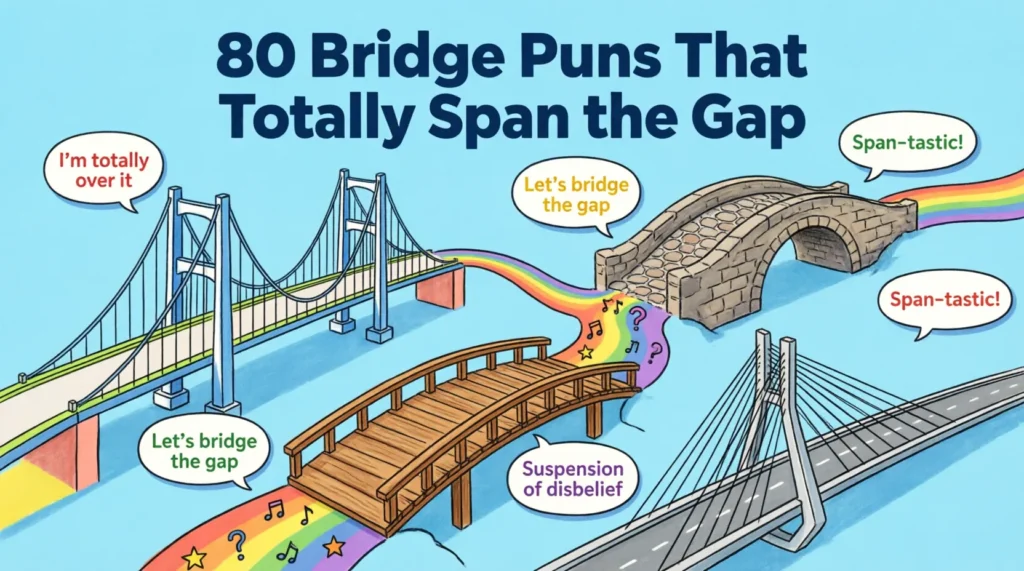
These 80 bridge puns and jokes are built for Instagram captions, road trip posts, greeting cards, classroom laughs, and construction-themed party signs. From clever one-liners to goofy Q&A jokes, there’s a pun here for every crossing. Scroll down, grab your favorites, and start connecting the laughs.
The Best Bridge Puns (Start Here)
I’m just here to bridge the conversation.
That joke really crossed the line.
You make my heart suspension-worthy.
I’m trying not to burn bridges, but you’re testing me.
This friendship has strong support beams.
Life’s better when you meet people halfway across the bridge.
Our connection is structurally sound.
Bridge humor always spans generations.
Short Bridge One-Liners
These quick bridge puns are perfect for texts, captions, signs, or tossing into conversation when you need a fast laugh with solid support.
I’m over this bridge drama already.
That idea really has legs… and railings.
I like relationships with strong foundations.
Cross that bridge with confidence.
This situation feels a little suspension-ful.
I’m trying to stay grounded, but this bridge keeps lifting me up.
Bridge builders always know how to connect.
I’ve reached my toll-erance limit.
Keep calm and bridge the gap.
That bridge joke really carried the conversation.
Some friendships are basically human suspension bridges.
I’m emotionally under construction.
Funny Bridge Jokes
These bridge jokes use classic Q&A humor that works great for kids, classrooms, road trip laughs, and anyone who appreciates a sturdy punchline.
Q: Why did the bridge break up with the highway? A: It needed more support.
Q: Why are bridges terrible at secrets? A: They always let things slip through.
Q: Why did the suspension bridge get promoted? A: It handled pressure beautifully.
Q: Why did the bridge go to therapy? A: It had too many emotional crossings.
Q: Why don’t bridges argue often? A: They prefer to meet in the middle.
Q: What’s a bridge’s favorite music? A: Heavy metal support tracks.
Q: Why did the tiny bridge feel confident? A: It knew it could span big opportunities.
Q: What did the bridge say after a compliment? A: Stop, you’re making me blush concrete.
Q: Why did the bridge fail comedy school? A: Its timing kept collapsing.
Q: Why was the bridge always invited to parties? A: It connected everyone.
Q: What did the bridge order at dinner? A: Suspension rolls.
Q: Why did the bridge avoid gossip? A: It didn’t want to burn connections.
Bridge Instagram Captions
These witty bridge lines are made for skyline shots, road trip selfies, scenic crossings, and city-view posts that need a little extra structure.
Bridging my way into the weekend.
Current mood: crossing into better days.
Strong views and stronger bridges.
Caught feelings halfway across.
Just out here making connections.
Meet me where the skyline meets the bridge.
Built for the journey, not just the crossing.
One step closer to somewhere amazing.
Bridge vibes only.
Crossing into my scenic era.
This view deserves a standing ovation… and maybe a toll.
Bridging the gap between wanderlust and reality.
More similes for although by Tone and Context
🌿 Natural & Descriptive “Like a river changing course after a storm” — This captures a gentle shift or contrast and works well in essays and nature writing.
“As steady as a mountain, although clouds gathered above” — This shows strength despite difficulties and adds vivid imagery.
“Like sunlight breaking through morning fog” — It highlights hope appearing despite obstacles and suits descriptive scenes.
“As calm as a lake, although the wind brushed its surface” — This simile suggests quiet balance in changing situations.
“Like leaves clinging to branches in late autumn” — It captures persistence and works well in reflective writing.
💛 Warm & Emotional “Like a smile that stays even after tears” — This expresses comfort and resilience in personal stories.
“As gentle as a hug, although worries filled the room” — It creates a caring tone for heartfelt writing.
“Like a candle glowing during a power outage” — This simile symbolizes hope when things become difficult.
“As faithful as an old friend, although years had passed” — It shows loyalty and warmth in memories and letters.
“Like a warm blanket on a rainy evening” — This captures comfort and reassurance in emotional writing.
✨ Poetic & Romantic “Like moonlight dancing across quiet waves” — This creates a dreamy mood for poems and lyrics.
“As graceful as a swan, although the water rippled below” — It highlights beauty despite hidden struggles.
“Like roses blooming after spring rain” — This simile represents love and renewal in poetic lines.
“As bright as stars above a silent field” — It gives romantic writing a peaceful and magical tone.
“Like a melody lingering after the music ends” — This conveys lasting emotions and memories.
😄 Playful & Fun “Like a cat pretending not to care about treats” — This adds humor and works well in casual writing.
“As cheerful as popcorn popping in a microwave” — It creates an energetic and funny image.
“Like a puppy chasing its own tail” — This simile captures playful excitement and silliness.
“As busy as a squirrel collecting snacks before winter” — It adds a lively touch to everyday situations.
“Like confetti flying at a surprise party” — This brings a fun and colorful feeling to messages and captions.
These tone-grouped similes for although give you options for every kind of writing — whether you need something soft and poetic or bold and fun. Try picking one from each group and using them in a short paragraph to see how different the same keyword can feel.
Using the keyword in Real Writing Contexts
In a Descriptive Essay
Students may use similes for although when describing contrasts or changes in a scene. A simile can make those differences easier for readers to picture. For example, The old house stood like a lighthouse in the fog, although years of rain had faded its paint.
In a Poem
Similes for although can help create mood and add emotion to poetic lines. They make contrasts feel more vivid and memorable. Like moonlight shining through clouds, although the night was cold, hope still whispered softly.
In a Story or Creative Scene
In stories, similes for although can reveal a character’s feelings or show how a setting changes. They help readers imagine emotions more clearly. Maya smiled like sunshine after a storm, although her hands still trembled as she stepped onto the stage.
In a Social Media Caption or Message
Short similes for although can make casual messages more expressive and fun. They work well when sharing feelings or memorable moments. Today’s mood: like a rainbow after rain, although the week started rough!
The more you practice placing similes for although into real sentences, the more natural your writing will sound — and the more your reader will feel exactly what you want them to feel.
Romantic & Flirty Bridge Puns
These playful bridge puns are great for cute texts, Valentine’s cards, flirty captions, or cheesy pickup lines with a strong emotional framework.
You’ve bridged the gap to my heart.
I’d cross any bridge just to see you.
Our chemistry is structurally impressive.
You support me better than reinforced steel.
You make my heart skip a suspension cable.
I think we’ve built something beautiful together.
You’re the missing link in my love life.
I’m falling for you bridge by bridge.
Our love story has excellent infrastructure.
I’d never burn a bridge with you.
You keep me connected when life gets shaky.
You had me at “meet me halfway.”
Construction & Engineering Bridge Humor
These bridge puns lean into blueprints, engineering culture, construction chaos, and all the stress that comes with keeping things standing.
Trust me, I have a concrete plan.
Bridge engineers really know how to support each other.
I’m held together by coffee and steel cables.
Blueprints are just confidence with measurements.
This project has been a long road to crossing.
My patience is currently under construction.
Engineers don’t panic — they reinforce.
That bridge design deserves a standing ovation.
Construction crews always rise to the occasion.
Some people build bridges. I build deadlines.
Every great bridge starts with someone saying, “Hear me out.”
Load-bearing humor is my specialty.
Clean & Kid-Friendly Bridge Puns
These family-friendly bridge jokes are easy to use in school projects, classroom signs, kids’ captions, and silly conversations without collapsing into awkward territory.
Bridges always know how to lift spirits.
I’m crossing my fingers and my bridge.
A good bridge never leaves anyone stranded.
Bridges make every trip more connected.
I’m trying to stay positive — one crossing at a time.
That bridge is working overtime!
Be kind and build bridges.
This joke really spans all ages.
Bridges are basically giant teamwork projects.
Nothing brings people together like a good crossing.
I’ve got a bridge-sized imagination.
Keep building strong connections everywhere you go.
Bridge Puns for Every Situation
Love & Relationship Bridge Puns
You bridge every gap in my heart.
Our relationship is built on a strong bridge of trust.
I crossed paths with you and never looked back.
You’re the bridge that connects all my best days.
Love without you would leave me stranded on the other side.
We always find a bridge over troubled waters together.
You’re the missing span in my life’s bridge.
My feelings for you keep building bridge by bridge.
You make every distance between us feel shorter.
Let’s keep strengthening this bridge called love.
Work & Office Bridge Puns
Let’s bridge the gap between ideas and results.
This project needs someone who can connect the dots and the bridges.
Our team is the bridge between planning and success.
I didn’t burn bridges—I upgraded them.
Let’s meet in the middle and bridge the difference.
Every deadline feels easier when the team builds bridges together.
Good communication is the strongest office bridge.
I’m just here trying to span all these responsibilities.
We bridged the problem before it became a roadblock.
That idea really connected both sides of the discussion.
Friendship Bridge Puns
A good friend is a bridge you can always count on.
Our friendship spans every challenge.
You always help bridge the gap on bad days.
Friends like you make every crossing easier.
We’ve built years of friendship one bridge at a time.
No matter the distance, our friendship stays connected.
You’re the bridge between my problems and my laughter.
Some friendships are short roads; ours is a landmark bridge.
You never leave me hanging over the edge.
Thanks for always helping me get to the other side.
Travel & Adventure Bridge Puns
I’m just crossing bridges and collecting memories.
Every bridge has a story waiting on the other side.
Adventure begins where the bridge meets the horizon.
I travel for the views and stay for the bridges.
This trip really helped me bridge the gap between work and fun.
Some people chase roads—I chase bridges.
A bridge is proof that every journey can move forward.
Crossing this bridge felt like stepping into a new chapter.
My travel plans are fully connected this year.
Life’s best adventures usually start with crossing a bridge.
How to Use These Bridge Puns
Bridge humor works surprisingly well in everyday situations because it naturally fits themes like connection, travel, teamwork, and overcoming obstacles. These funny bridge sayings are perfect for Instagram captions on road trips, skyline photos, or scenic walking trails. A clever crossing joke can instantly make a travel post feel more memorable and shareable.
You can also use witty bridge lines in greeting cards, engineering presentations, classroom projects, or even construction company marketing. Teachers often use clean bridge jokes to keep students engaged during lessons about architecture, science, or teamwork. They also work well as icebreakers during events and team-building activities.
For social media, short bridge one-liners pair well with city photos, friendship posts, and relationship captions because the “connection” theme feels relatable without trying too hard. Even flirty bridge humor can add a playful touch to texts or Valentine’s notes. The best part is that bridge jokes can swing between wholesome, clever, and goofy depending on the moment.
How to Use Bridge Puns (With Examples)
Send These to Cheer Someone Up
Use these when a friend needs encouragement or motivation.
You’re closer to the finish line than you think—just keep crossing that bridge.
Every challenge is just another bridge to success.
Don’t worry, you’ll span this obstacle in no time.
The other side of this bridge looks pretty bright.
You’ve already built half the bridge—keep going.
Tough times don’t last, but strong bridges do.
You’ve got what it takes to bridge the distance to your goal.
One step at a time gets you across any bridge.
Keep moving forward—the bridge isn’t going to cross itself.
You’re stronger than the gaps standing in your way.
Use in Group Chats
Perfect for reacting to conversations and keeping things light.
I’m just here to bridge the communication gap.
This chat has officially connected both sides of the argument.
Let’s not burn bridges before lunch.
Someone build a bridge to the point already.
This conversation has more twists than a suspension bridge.
I’m crossing into this chat with confidence.
That joke really carried us to the other side.
Looks like we’re all on the same bridge now.
This discussion is holding together better than expected.
Let’s bridge our differences and pick a restaurant.
Use as Travel Photo Captions
Great for bridge selfies, sightseeing posts, and adventure snapshots.
Just bridging the gap between dreams and destinations.
Caught between two sides and loving the view.
Taking life one bridge crossing at a time.
Found myself in the middle of something beautiful.
Proof that the best views come from the bridge.
Crossed a bridge and gained a memory.
This bridge really connected me to the moment.
Standing where journeys and views meet.
Another bridge, another story to tell.
Making connections one crossing at a time.
Frequently Asked Questions
Q: What is a good pun about bridges? A: A good bridge pun usually plays on ideas like crossing, connection, support, or suspension. Simple lines like “Let’s bridge the gap” or “Our friendship is structurally sound” work because they’re easy to understand and naturally funny.
Q: What are funny bridge one-liners? A: Funny bridge one-liners include short jokes like “I’ve reached my toll-erance limit” or “Bridge humor always spans generations.” The best ones are quick, clever, and easy to use in captions or conversations.
Q: Are bridge puns good for Instagram captions? A: Yes, bridge puns work especially well for travel photos, skyline shots, hiking posts, and scenic city pictures. They add personality to your caption without sounding forced or overly complicated.
Q: What makes a bridge pun funny? A: The humor usually comes from double meanings tied to support, crossing paths, building connections, or “burning bridges.” Clever wordplay mixed with relatable situations makes the joke feel natural.
Q: What do you call a bridge joke? A: Most people simply call them bridge puns, bridge jokes, or crossing humor. Engineering fans sometimes call them structural jokes because they play off construction and design themes.
{
“@context”: “https://schema.org”,
“@type”: “FAQPage”,
“mainEntity”: [
{
“@type”: “Question”,
“name”: “What types of bridge puns are included in the article?”,
“acceptedAnswer”: {
“@type”: “Answer”,
“text”: “The article features a variety of bridge puns, including clever one-liners, funny Q&A jokes, and romantic flirty puns. These puns are perfect for social media captions, greeting cards, and even classroom jokes.”
}
},
{
“@type”: “Question”,
“name”: “Can I use these bridge puns for social media posts?”,
“acceptedAnswer”: {
“@type”: “Answer”,
“text”: “Absolutely! The article offers a section specifically for bridge Instagram captions, making them ideal for skyline shots, road trip selfies, or scenic crossings. You can easily incorporate these witty lines into your posts to add some humor.”
}
},
{
“@type”: “Question”,
“name”: “Are there any bridge jokes suitable for kids?”,
“acceptedAnswer”: {
“@type”: “Answer”,
“text”: “Yes, the article includes a collection of funny bridge jokes that utilize classic Q&A humor, making them perfect for kids and classrooms. These jokes are designed to be lighthearted and engaging for all ages.”
}
},
{
“@type”: “Question”,
“name”: “How can I use bridge puns for romantic messages?”,
“acceptedAnswer”: {
“@type”: “Answer”,
“text”: “The article provides a section dedicated to romantic and flirty bridge puns, which are great for cute texts or Valentine’s cards. These playful lines can help express your feelings in a fun and creative way.”
}
},
{
“@type”: “Question”,
“name”: “Do the puns vary in style and tone?”,
“acceptedAnswer”: {
“@type”: “Answer”,
“text”: “Yes, the article includes a diverse range of bridge puns, from humorous one-liners to more heartfelt romantic expressions. This variety ensures that there is a pun for every type of occasion, whether lighthearted or sentimental.”
}
},
{
“@type”: “Question”,
“name”: “Are there any specific bridge puns that stand out in the article?”,
“acceptedAnswer”: {
“@type”: “Answer”,
“text”: “Some standout puns include ‘You’ve bridged the gap to my heart’ and ‘I’m trying not to burn bridges, but you’re testing me.’ These puns capture the playful essence of bridge humor while also resonating with emotional themes.”
}
},
{
“@type”: “Question”,
“name”: “How can I use these puns for classroom activities?”,
“acceptedAnswer”: {
“@type”: “Answer”,
“text”: “The article suggests that many of the bridge jokes and puns can be used for classroom laughs, making them perfect for icebreakers or creative writing prompts. Teachers can incorporate these puns into activities to encourage students to think humorously and creatively.”
}
}
]
}
.ch-faq-block{margin:2em 0}.ch-faq-block h3{font-size:1.3em;font-weight:700;margin:0 0 14px}.ch-faq-item{border:1px solid #e5e7eb;border-radius:10px;margin-bottom:8px;overflow:hidden}.ch-faq-item summary{list-style:none;display:flex;justify-content:space-between;align-items:center;gap:12px;padding:14px 18px;background:#f9fafb;cursor:pointer;font-weight:600;-webkit-user-select:none;user-select:none}.ch-faq-item summary::-webkit-details-marker{display:none}.ch-faq-item summary::marker{display:none}.ch-faq-item summary:hover{background:#f3f4f6}.ch-faq-arrow{font-size:11px;flex-shrink:0;color:#6b7280;transition:transform .2s ease}.ch-faq-item[open] .ch-faq-arrow{transform:rotate(180deg)}.ch-faq-answer{padding:14px 18px;border-top:1px solid #e5e7eb;margin:0}.ch-faq-answer p{margin:0}
Frequently Asked Questions
What types of bridge puns are included in the article?▼
The article features a variety of bridge puns, including clever one-liners, funny Q&A jokes, and romantic flirty puns. These puns are perfect for social media captions, greeting cards, and even classroom jokes.
Can I use these bridge puns for social media posts?▼
Absolutely! The article offers a section specifically for bridge Instagram captions, making them ideal for skyline shots, road trip selfies, or scenic crossings. You can easily incorporate these witty lines into your posts to add some humor.
Are there any bridge jokes suitable for kids?▼
Yes, the article includes a collection of funny bridge jokes that utilize classic Q&A humor, making them perfect for kids and classrooms. These jokes are designed to be lighthearted and engaging for all ages.
How can I use bridge puns for romantic messages?▼
The article provides a section dedicated to romantic and flirty bridge puns, which are great for cute texts or Valentine’s cards. These playful lines can help express your feelings in a fun and creative way.
Do the puns vary in style and tone?▼
Yes, the article includes a diverse range of bridge puns, from humorous one-liners to more heartfelt romantic expressions. This variety ensures that there is a pun for every type of occasion, whether lighthearted or sentimental.
Are there any specific bridge puns that stand out in the article?▼
Some standout puns include ‘You’ve bridged the gap to my heart’ and ‘I’m trying not to burn bridges, but you’re testing me.’ These puns capture the playful essence of bridge humor while also resonating with emotional themes.
How can I use these puns for classroom activities?▼
The article suggests that many of the bridge jokes and puns can be used for classroom laughs, making them perfect for icebreakers or creative writing prompts. Teachers can incorporate these puns into activities to encourage students to think humorously and creatively.
Liam is a language enthusiast and lead writer at Similepedia.com, where he focuses on creating clear, creative, and easy-to-use similes for everyday writing. He specializes in turning simple ideas into vivid comparisons that make sentences more engaging, expressive, and memorable.
Instead of overcomplicating language with technical jargon, Liam approaches similes as practical tools for better communication. He breaks down how comparisons work, when to use them, and how to make them sound natural — not forced or awkward.
He pays close attention to tone, context, and clarity, ensuring every simile fits smoothly into real sentences. From fun and playful comparisons to more descriptive and expressive ones, Liam helps readers improve how they write, speak, and express ideas.
At Similepedia.com, his mission is simple: make language more colorful and effective without making it complicated. He doesn’t just list similes — he helps readers understand how to use them confidently in real situations.