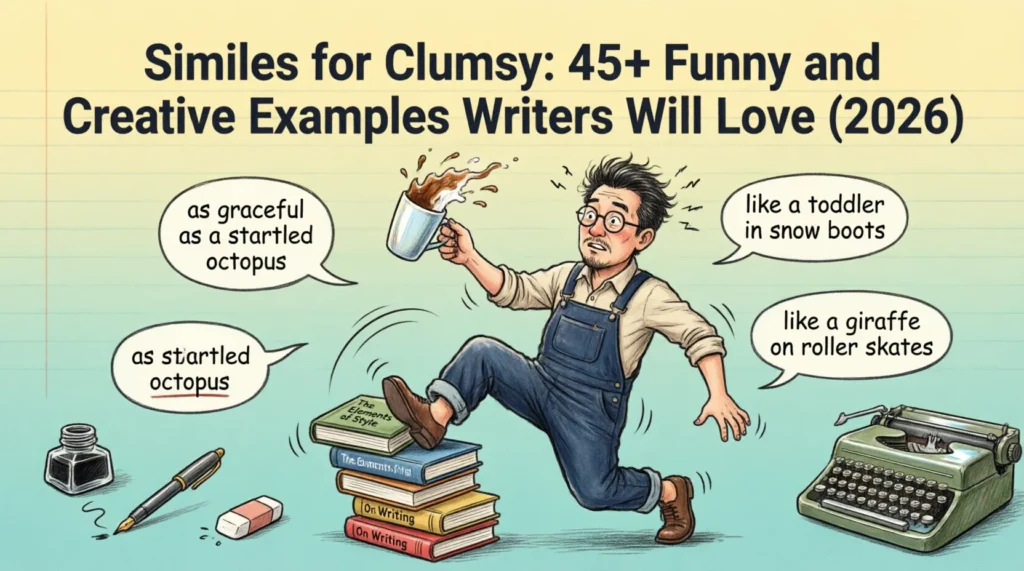
In short, similes for clumsy are comparisons that help you describe awkward, accident-prone, or uncoordinated actions in a vivid way. You’ll find funny, relatable, and creative examples in this guide, along with tips for using them naturally in stories, poems, and school assignments. Keep reading to discover similes that can make your writing more colorful and memorable.
What Are Similes for Clumsy? (And Why They Matter)
Picture this: you’re writing a story about a character who trips over their own backpack in front of the whole class. You know they’re clumsy, but “very clumsy” sounds boring. That’s where similes help.
Similes for clumsy compare awkward movement to something else using words like “as” or “like.” They help readers clearly imagine the action instead of just reading a plain description.
For example, saying “He moved like a penguin on roller skates” instantly creates a funny mental picture. Your reader can almost see the wobbling and slipping.
Language arts educators often encourage students to use similes because they improve storytelling, descriptive writing, and reading comprehension. Literacy researchers also note that figurative language helps readers connect emotionally with characters and scenes.
Once you start noticing similes in books, songs, and movies, you’ll realize writers use them everywhere. And the best part? You can learn to create your own.
The Best Examples of Similes for Clumsy
[IMAGE: Student dropping books while classmates laugh kindly]
She stumbled like a baby deer learning to walk.
He danced like a robot with loose batteries.
She moved like a penguin on roller skates.
He tripped over his feet like tangled shoelaces.
She crashed into the table like a runaway shopping cart.
He walked like he was balancing on marbles.
She spun around like a top about to fall over.
He handled the plates like a squirrel juggling acorns.
She bumped into chairs like a pinball bouncing around an arcade machine.
He ran like a puppy chasing its own tail.
She climbed the stairs like a giraffe on stilts.
He skated like a fish flopping on dry land.
She carried the drinks like a tower ready to collapse.
He fell like a domino tipping the rest behind it.
She tiptoed like an elephant trying to sneak through a library.
He moved through the crowd like a bowling ball in a hallway.
She waved her arms like a scarecrow in a windstorm.
He caught the ball like he was wearing oven mitts.
She slipped across the floor like soap in a bathtub.
He jumped like a kangaroo with tangled legs.
She stumbled into the classroom like a gust of wind pushed her.
He moved like a bicycle with a crooked wheel.
She tried to balance like a flamingo standing in a storm.
He dropped his books like a magician messing up a trick.
She turned around like a spinning chair out of control.
He walked across the ice like a cat wearing socks.
She reached for the glass like her arms had a mind of their own.
He climbed the fence like a ladder made of jelly.
She carried the cake like she was crossing a tightrope.
He dodged the ball like someone avoiding invisible puddles.
She moved across the dance floor like popcorn popping in a pan.
He stumbled down the hallway like a sleepy zombie.
She tried to catch the frisbee like a bird with wet wings.
He sat down like the chair surprised him.
She ran like untied shoelaces were chasing her.
He balanced the boxes like stacked cards in the wind.
She slipped into the room like a cartoon character on a banana peel.
He climbed the rocks like boots filled with sand.
She reached for the microphone like it was moving away from her.
He walked through the kitchen like a bull in a china shop.
She twirled like a kite caught in messy wind.
He bumped into people like a bumper car at a carnival.
She crossed the gym floor like a duck on slippery ice.
He carried the groceries like juggling flaming torches.
She hurried down the sidewalk like someone learning to use roller skates.
These examples work well because they create strong imagery. Instead of simply telling readers someone is awkward, they show the movement in a funny or vivid way.
Creative writing teachers often encourage students to choose similes that match the mood of the story. Some similes feel playful and silly, while others sound dramatic or exaggerated.
More Similes for Clumsy by Tone and Context
🌿 Natural & Descriptive “As clumsy as a young fawn learning to run” — Captures awkward movements and inexperience, making it useful in descriptive writing. “Like a branch swaying wildly in a strong wind” — Suggests unsteady motion and a lack of control. “As clumsy as a pebble tumbling down a hillside” — Highlights constant bumps, slips, and unexpected movements. “Like a duck waddling across a muddy path” — Creates a vivid image of awkward but determined movement. “As clumsy as a sapling bent by every breeze” — Emphasizes instability and difficulty staying balanced.
💛 Warm & Emotional “Like a nervous friend carrying a birthday cake” — Shows clumsiness caused by excitement or pressure. “As clumsy as a child reaching for a first hug” — Suggests sweet, harmless awkwardness. “Like someone dancing before they know the steps” — Captures uncertainty mixed with enthusiasm. “As clumsy as a puppy eager to greet its owner” — Conveys energetic, lovable awkwardness. “Like trembling hands holding a special gift” — Reflects emotional nerves that lead to mistakes.
✨ Poetic & Romantic “As clumsy as a falling petal caught in the wind” — Creates a gentle and graceful image of awkward movement. “Like a drifting cloud changing direction without warning” — Suggests wandering and uncertain motion. “As clumsy as moonlight spilling across uneven stones” — Adds a dreamy and artistic feeling. “Like a star slipping behind a passing curtain of clouds” — Evokes delicate and unexpected movement. “As clumsy as a song searching for its melody” — Expresses uncertainty in a poetic way.
😄 Playful & Fun “Like a robot with the wrong instructions” — Perfect for humorous descriptions of awkward actions. “As clumsy as a penguin on roller skates” — Creates a funny image of struggling to stay balanced. “Like a backpack stuffed with too many surprises” — Suggests bumping into things and moving awkwardly. “As clumsy as a juggler on the first day of practice” — Highlights repeated mistakes in a lighthearted way. “Like a video game character stuck on the wrong controls” — A fun, modern comparison students can relate to.
These tone-grouped similes for clumsy give you options for every kind of writing — whether you need something soft and poetic or bold and fun. Try picking one from each group and using them in a short paragraph to see how different the same topic can feel.
More Similes for Clumsy: 45+ Funny and Creative Examples Writers Will Love (2026) by Tone and Context
“As clumsy as a young fawn learning to walk” — Captures someone who is unsteady but still learning, making it perfect for gentle descriptions.
“Like a branch bending in a strong wind” — Suggests awkward, uncontrolled movement during challenging situations.
“As clumsy as a pebble skipping the wrong way” — Shows unexpected and uneven motion that doesn’t go as planned.
“Like a duck waddling across slippery stones” — Highlights funny, uncertain steps while keeping the image lighthearted.
“As clumsy as vines tangled after a storm” — Works well for describing messy actions or confused movement in vivid writing.
💛 Warm & Emotional (for personal stories, letters, heartfelt writing)
“Like a puppy discovering its oversized paws” — Emphasizes adorable awkwardness instead of embarrassment.
“As clumsy as a child reaching for a first hug” — Shows innocent, lovable mistakes filled with kindness.
“Like someone carrying too many dreams at once” — Suggests that clumsiness can come from excitement or being overwhelmed.
“As clumsy as tired hands after a long day” — Fits stories where exhaustion causes small accidents.
“Like a friend laughing after tripping” — Reflects resilience and the ability to laugh at yourself.
✨ Poetic & Romantic (for poems, song lyrics, love writing)
“As clumsy as moonlight dancing on rippling water” — Creates a graceful yet unpredictable image for poetic writing.
“Like a drifting feather caught between breezes” — Suggests gentle, uncertain movement with a dreamy tone.
“As clumsy as a heartbeat racing before a confession” — Perfect for describing nervous excitement in romantic scenes.
“Like scattered petals carried by the wind” — Adds soft imagery when describing awkward but beautiful moments.
“As clumsy as stars hiding behind passing clouds” — Brings a gentle sense of hesitation to poems and reflective writing.
😄 Playful & Fun (for casual use, social media captions, humor)
“Like a robot running on low batteries” — Funny for describing slow, awkward movement.
“As clumsy as someone dancing in oversized boots” — Great for humorous stories or playful conversations.
“Like popcorn bouncing out of the bowl” — Describes energetic, unpredictable motion with a smile.
“As clumsy as a shopping cart with one wobbly wheel” — A relatable comparison for everyday mishaps.
“Like a penguin trying to skateboard” — A silly image that works perfectly in jokes, captions, and lighthearted writing.
These tone-grouped similes for Similes for Clumsy: 45+ Funny and Creative Examples Writers Will Love (2026) give you options for every kind of writing — whether you need something soft and poetic or bold and fun. Try picking one from each group and using them in a short paragraph to see how different the same keyword can feel.
Using Similes for Clumsy: 45+ Funny and Creative Examples Writers Will Love (2026) in Real Writing Contexts
In a Descriptive Essay
When describing a person’s movements or actions in an essay, a simile helps readers picture the scene more clearly. Instead of simply saying someone was clumsy, compare them to something familiar to make the description memorable. For example: “My little brother was as clumsy as a young fawn learning to walk as he carried the stack of books across the classroom.”
In a Poem
Similes for clumsy can create a playful, gentle, or emotional mood depending on the comparison you choose. They help turn ordinary movement into meaningful imagery. For example: “You moved like a drifting feather caught between breezes, searching for balance beneath the evening sky.”
In a Story or Creative Scene
In stories, similes can reveal a character’s personality, nervousness, or excitement without directly explaining it. They make action scenes feel more vivid and entertaining. For example: “As Mia hurried onto the stage, she was as clumsy as someone dancing in oversized boots, nearly dropping the microphone before bursting into laughter.”
In a Social Media Caption or Message
Short similes add humor and personality to captions, texts, or posts. A clever comparison makes everyday accidents feel relatable and fun. For example: “Today’s mood: like a robot running on low batteries—I dropped my phone, spilled my drink, and somehow still made it through the day! 😂”
The more you practice placing Similes for Clumsy: 45+ Funny and Creative Examples Writers Will Love (2026) into real sentences, the more natural your writing will sound — and the more your reader will feel exactly what you want them to feel.
Using Clumsy in Real Writing Contexts
In a Descriptive Essay
When writing about a person, animal, or moment, a simile can make clumsy actions easier for readers to picture. Instead of simply saying someone moved awkwardly, compare their movement to something familiar.
Example: The young deer was as clumsy as a young fawn learning to run, stumbling over roots as it crossed the forest floor.
In a Poem
Similes for clumsy can help create a gentle, humorous, or thoughtful mood in poetry. They add imagery that helps readers feel the scene more clearly.
Example: She moved like a drifting cloud changing direction without warning, wandering softly through the afternoon breeze.
In a Story or Creative Scene
In stories, similes can reveal a character’s personality or emotions through their actions. A clumsy comparison can make a scene more vivid and memorable.
Example: Rushing into the classroom, Ethan was as clumsy as a juggler on the first day of practice, dropping his books before he even reached his desk.
In a Social Media Caption or Message
Short similes work well in casual writing because they quickly create a funny image. They can make everyday moments more entertaining and relatable.
Example: Today I was as clumsy as a penguin on roller skates—dropped my water bottle twice before lunch!
The more you practice placing similes for clumsy into real sentences, the more natural your writing will sound — and the more your reader will feel exactly what you want them to feel.
How to Use Similes for Clumsy in Your Writing
Now that you’ve seen many examples, you might wonder how to use similes for clumsy naturally in your own work. The key is choosing comparisons that fit your scene and character.
Think about the type of clumsy action.
Is your character tripping, dropping things, bumping into objects, or dancing awkwardly? Different situations need different similes.
Example: “Mina carried the tray like a tower ready to collapse.”
Use familiar images.
Readers understand similes faster when the comparison feels relatable. Animals, sports, school objects, and everyday activities work really well.
Match the tone of your writing.
Funny stories can use silly similes, while emotional stories may need softer descriptions. You don’t want a serious scene to sound accidentally goofy.
Don’t overuse similes.
Using one or two strong similes is usually better than filling every sentence with them. Too many comparisons can make your writing feel crowded.
If you practice adding similes little by little, your descriptions will start sounding more natural and creative.
Similes for Clumsy in Poems and Stories
[IMAGE: Student writing poetry in a notebook]
Writers often use similes for clumsy to make scenes feel funny, relatable, or emotional. In poems and stories, these comparisons can reveal a character’s personality without directly explaining it.
Here are a few short examples.
“Ali rushed across the stage like a kite tangled in tree branches, arms flapping wildly while the audience giggled softly.”
“Sofia carried her science project like a tower made of crackers. One shaky step later, the volcano exploded early.”
“Jayden danced at the school party like a broomstick caught in a thunderstorm, but somehow everyone cheered anyway.”
Poets and authors use figurative language because it creates rhythm, imagery, and emotion. A good simile helps readers picture the action clearly while also feeling connected to the character.
You may even notice that clumsy characters often become the most lovable people in stories because their mistakes feel real and human.
Common Mistakes Students Make With Similes for Clumsy
Learning figurative language takes practice, so mistakes are completely normal. Here are some common problems students run into when using similes for clumsy.
Using comparisons that don’t make sense
Sometimes students pick random objects that don’t connect to awkward movement. If readers can’t picture the comparison, the simile loses power.
Making the simile too long
A simile should usually be quick and clear. Long explanations can interrupt the flow of your writing.
Repeating the same simile again and again
Using “like a bull in a china shop” five times in one story can feel repetitive. Try mixing in fresh images.
Forgetting the mood of the scene
A super funny simile may not fit a sad or serious moment. Think about the feeling you want readers to have.
Confusing similes with metaphors
A simile uses “like” or “as.” If those words disappear, you may actually be writing a metaphor instead.
Creative writing teachers often remind students that even professional authors revise their figurative language many times before it sounds right.
Fun Activities to Practice Similes for Clumsy
Practicing figurative language becomes much easier when you turn it into a game or creative challenge. Here are some fun ways you can improve your skills.
Clumsy Character Challenge
Grab a pencil and invent a hilariously clumsy character. Write five similes describing how they walk, dance, eat, or play sports.
Draw and Describe
Draw a funny scene of someone slipping, tripping, or dropping something. Then write three similes that match your drawing.
Simile Matching Game
Write clumsy actions on one side of paper strips and funny comparison ideas on another. Mix and match them to create new similes.
Story Rewrite Activity
Take a boring sentence like “Tom was clumsy” and rewrite it three different ways using similes. Challenge yourself to make each version more vivid.
Read-Aloud Hunt
While reading a novel or poem, look for similes that describe movement or awkward behavior. You’ll start noticing how authors build imagery.
Group Acting Game
In a classroom or with friends, act out different clumsy movements while others invent similes to describe them. This activity usually creates lots of laughter and creativity.
These activities help you build confidence while making language arts feel more playful and less stressful.
What NOT to Do With Similes for Clumsy
Even good writers can develop habits that weaken their figurative language. Here are a few myths and mistakes to avoid.
Don’t use the first simile you think of every time
Popular similes are okay sometimes, but original comparisons usually make your writing more memorable.
Don’t force a simile into every sentence
Too many similes can overwhelm readers. Give your descriptions room to breathe.
Don’t make clumsy characters feel mean or cruelly mocked
Funny similes should entertain readers, not embarrass characters in a hurtful way.
Don’t choose confusing comparisons
If your reader has to stop and figure out what the simile means, it may need simplifying.
Once you learn balance and clarity, your similes will feel much stronger and more natural.
Frequently Asked Questions About Similes for Clumsy
What is a simile for clumsy?
A simile for clumsy compares awkward movement to something else using “like” or “as.” For example, “He walked like a penguin on roller skates” creates a vivid image of wobbling and slipping.
How do you use similes for clumsy in a sentence?
You can add them while describing actions in stories or essays. For example: “Lena carried the paint buckets like stacked blocks ready to tumble.” The simile helps readers imagine the scene more clearly.
What is the difference between a simile and a metaphor for clumsy?
A simile uses “like” or “as,” while a metaphor directly says one thing is another. “He moved like a broken robot” is a simile, while “He was a broken robot on the dance floor” is a metaphor.
Why do writers use similes for clumsy characters?
Writers use them to create humor, emotion, and strong mental pictures. Clumsy similes can make characters feel relatable and memorable to readers.
Are similes for clumsy good for middle school writing?
Yes, they’re excellent for middle school writing because they improve creativity and descriptive detail. Language arts educators often encourage students to practice similes in narratives and poetry.
Final Thoughts on Similes for Clumsy
Learning how to use similes for clumsy can make your writing much more vivid and entertaining. Instead of simply telling readers someone is awkward, you help them actually picture the movement.
You explored funny, creative, and relatable examples that work well in stories, poems, and classroom assignments. You also learned how to avoid common mistakes and practice your figurative language skills in fun ways.
Remember, you don’t need to write perfect similes right away. Even experienced writers experiment with different comparisons before finding one that feels just right.
The more you practice noticing movement, emotion, and imagery around you, the easier it becomes to create memorable similes that bring your writing to life.
Frequently Asked Questions
What are similes for clumsy and how can they enhance my writing?▼
Similes for clumsy are comparisons that vividly illustrate awkward or uncoordinated actions, making your descriptions more engaging. Using phrases like ‘he moved like a penguin on roller skates’ helps readers visualize the action and adds humor to your writing.
Can you provide examples of similes for clumsy?▼
Certainly! Some examples include ‘she stumbled like a baby deer learning to walk’ and ‘he danced like a robot with loose batteries.’ These comparisons not only entertain but also create a clear mental image of the character’s clumsiness.
Why are similes important in storytelling and descriptive writing?▼
Similes improve storytelling by adding depth and creativity to descriptions, helping readers connect emotionally with characters. Language arts educators often encourage their use because they enhance descriptive writing and reading comprehension.
How can I create my own similes for clumsy characters?▼
To create your own similes, think of common clumsy actions and compare them to something relatable or humorous. For instance, you could say ‘she moved like a turtle trying to run a marathon’ to evoke a funny image.
What role do similes play in connecting with readers emotionally?▼
Similes help readers visualize actions and emotions, making characters more relatable and their experiences more impactful. By using figurative language, you can evoke laughter, sympathy, or other feelings, enhancing the emotional connection.
How can I incorporate similes for clumsy into school assignments?▼
Incorporate similes by using them in descriptive essays, creative writing, or poetry. They can add humor and vivid imagery, making your writing stand out and engaging your audience.
Where can I find more examples of similes in literature and media?▼
You can find similes in books, songs, and movies, as they are a common literary device. Pay attention to dialogue and descriptions in your favorite works to see how other writers effectively use similes.
Sara Liu holds a Master’s degree in English Education from the University of Washington and has been an educator for over 15 years. She specializes in curriculum development for elementary and middle school students, with a particular focus on figurative language. Sara’s love for similes and metaphors blossomed when she discovered their power to spark imagination and convey emotion. At SimilePedia, Sara creates engaging worksheets and reference guides that help young learners grasp the nuances of figurative language. Her favorite part of writing content is developing resources that make complex concepts accessible to children. She is passionate about nurturing a love for words and creativity in her students, and her contributions are shaped by this commitment.