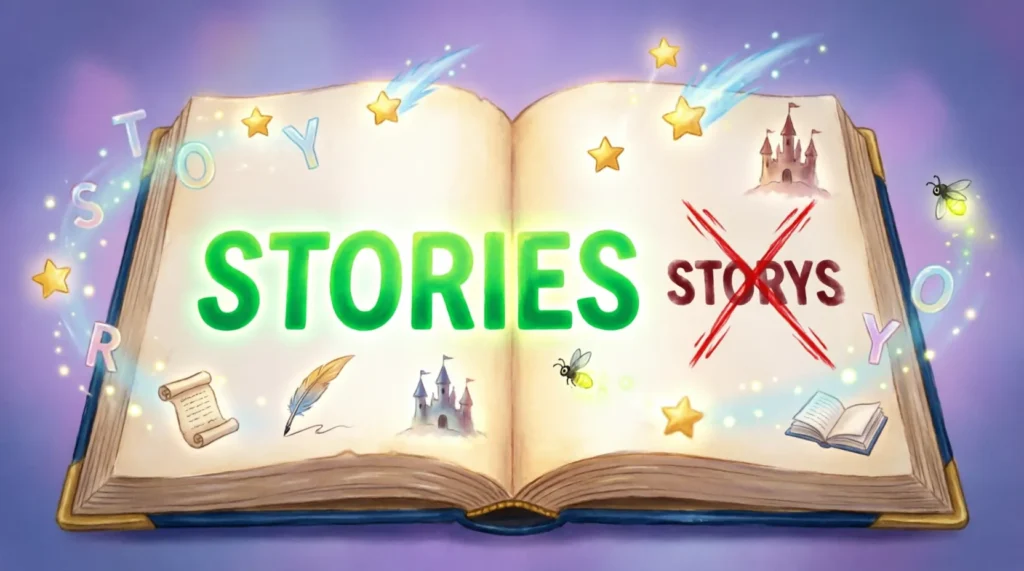
In short, storys vs stories is about learning which spelling is correct. The correct plural of story is stories, while storys is a spelling mistake. Keep reading to discover why this happens, how to remember it, and how to use the correct form with confidence.
[IMAGE: Student looking at the words “storys” and “stories” with the correct spelling highlighted]
What Are the storys vs stories? (And Why They Matter)
Have you ever finished writing a homework assignment, looked back at your work, and wondered whether you should write storys or stories? You are not alone. Many students pause at this exact spelling question.
The phrase storys vs stories compares an incorrect spelling with the correct one. The word stories is the proper plural of story, while storys is not considered correct in standard English.
Learning this spelling rule matters because you will use the word stories in book reports, essays, reading journals, creative writing, and everyday conversations. Correct spelling also helps your writing look polished and professional.
Literacy educators and language arts researchers explain that understanding common spelling patterns makes reading and writing easier. Once you learn this simple rule, you will spot the correct spelling almost automatically.
Now that you know the difference, let’s look at examples you can use in real life.
The Best Examples of the storys vs stories
Here are examples that show the correct use of stories and explain why storys should be avoided.
I read three exciting stories before bed.
My teacher asked us to write two adventure stories.
Grandma loves telling funny stories about her childhood.
The library has hundreds of mystery stories.
We shared scary stories around the campfire.
Maya enjoys writing fantasy stories in her notebook.
Our class published its own collection of stories.
Liam reads animal stories every weekend.
The magazine printed several inspiring success stories.
We listened to traditional folk stories from different cultures.
The children illustrated their favorite stories.
My brother invents superhero stories for his friends.
The teacher encouraged us to improve our stories with dialogue.
Historical stories help us understand the past.
Digital stories can include pictures, music, and narration.
The contest accepted original stories from students.
I enjoy short stories because they are quick to read.
These stories teach important life lessons.
The author writes unforgettable stories for young readers.
Never write “storys” because the correct spelling is stories.
These examples work well because they show the word in everyday situations that you might actually encounter. They also reinforce the spelling pattern through repetition, making it easier for your brain to remember the correct form.
The next step is learning the simple spelling rule behind the change.
How to Use the storys vs stories in Your Writing
Remember the spelling rule. When a noun ends with a consonant followed by y, change the y to i and add -es to make it plural.
Check the last letter before the y. Since story ends with the consonant r, the correct plural becomes stories.
Proofread your work before submitting it. A quick spelling check can help you catch mistakes like storys.
Practice using the correct form in sentences until it feels natural.
Example:
“My classmates wrote imaginative stories about exploring a mysterious island.”
As you keep writing, this spelling rule will become second nature.
storys vs stories in Poems and Stories
Creative writing gives you many chances to use the word stories correctly.
Aisha smiled as she whispered, “These stories sparkle like stars, lighting every page with wonder.”
Carlos opened an old notebook. Inside were stories that made every rainy afternoon feel like an exciting adventure.
Mei filled her journal with stories about magical forests where every tree could sing.
Poets and authors choose familiar words like stories because they connect readers with emotions, imagination, and memorable experiences. When you spell the word correctly, your writing becomes easier to read and more enjoyable.
Before moving on, let’s look at a few mistakes that many students make.
Common Mistakes Students Make With the storys vs stories
Writing “storys” instead of “stories.” This is the most common mistake. Remember to replace the y with ies.
Adding only an “s.” Some students think every noun simply adds s, but words ending in a consonant plus y follow a different rule.
Forgetting the spelling rule during fast writing. This happens often during tests or timed assignments. Slow down for a quick spelling check.
Confusing words ending in a vowel plus “y.” Words like toy become toys, not toies. Since story ends with a consonant before the y, it becomes stories instead.
Copying incorrect spellings found online. Not every website is accurate. Trust dictionaries, classroom materials, and reliable educational resources.
Everyone makes spelling mistakes sometimes. The good news is that this one is easy to fix once you know the rule.
Fun Activities to Practice the storys vs stories
Grab a pencil and make a list of ten words ending in y. Change each one into its correct plural.
Challenge yourself to write five original stories using different genres, such as mystery, fantasy, or comedy.
Play a spelling sorting game with a friend. Place words into two groups: words ending in a consonant plus y and words ending in a vowel plus y.
Draw a comic strip with three panels and write short stories underneath each picture.
Read a children’s book and highlight every time you see the word stories. This reading challenge helps reinforce correct spelling naturally.
These activities help you remember the rule while making learning enjoyable.
What NOT to Do With the storys vs stories
Do not assume every plural only needs an s. English has spelling patterns, and this is one of the most common ones.
Do not write “storys.” It is not the accepted plural form in standard English.
Do not memorize the word without learning the rule. Understanding why the spelling changes helps you spell many other words correctly.
Do not think this rule applies to every word ending in y. Words ending with a vowel before y, such as key or toy, simply add s.
Understanding these myths makes the rule much easier to remember.
Frequently Asked Questions About the storys vs stories
Is storys or stories correct?
The correct spelling is stories. The word storys is a spelling mistake and should not be used in school assignments, professional writing, or everyday English.
Why does story become stories?
The word story ends with a consonant followed by y. English spelling rules tell us to change the y to i and add -es, creating stories.
Can I ever use the spelling storys?
No. In standard English, storys is considered incorrect. You should always use stories when referring to more than one story.
How can I remember the difference between storys vs stories?
A simple trick is to remember: “Consonant + y becomes ies.” Every time you write story, check the letter before the y. Since it is r, the plural becomes stories.
Are there other words that follow the same rule?
Yes. Words like baby → babies, city → cities, lady → ladies, and family → families all follow the same spelling pattern. Practicing these words will help you remember the rule for stories, too.
Final Thoughts on the storys vs stories
Learning the difference between storys vs stories is one of those small grammar lessons that makes a big difference in your writing. Once you understand the spelling rule, you will know exactly which form to use.
You discovered that stories is the correct plural of story, while storys is incorrect. You also learned the spelling rule, saw plenty of examples, practiced common mistakes, and explored fun activities.
Creative writing teachers and literacy educators encourage students to learn spelling patterns instead of memorizing individual words. When you understand the rule, you can apply it to many other words with confidence.
Keep practicing, keep reading, and keep writing. Every sentence you write helps you become a stronger and more confident English writer.
Liam Nguyen is a passionate educator and writer with a deep love for figurative language. He holds a master’s degree in Creative Writing and has spent eight years teaching at various educational settings, focusing on language enrichment programs for children from grades 2-6. His expertise in crafting metaphorical language and similes into captivating content stems from his belief that storytelling is the heartbeat of learning. Liam’s contributions to SimilePedia span from emotion-driven examples to color-inspired narrative tools. He is committed to fostering a creative environment where students can explore and find joy in their unique expressions.