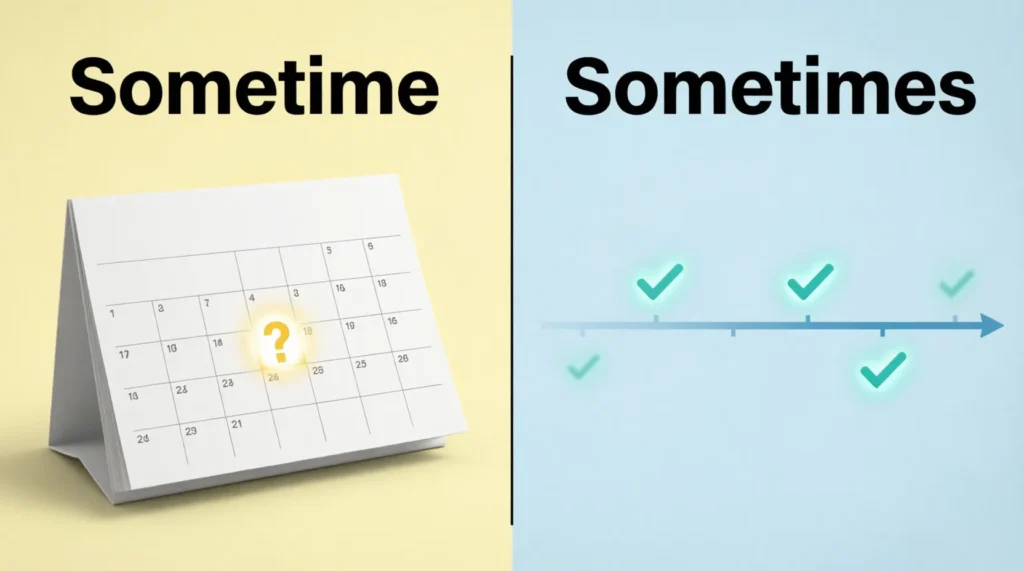
In short, sometime vs sometimes is about knowing the difference between a word that means “at an unspecified time” and a word that means “occasionally.” Once you understand this simple difference, your writing will sound clearer and more confident. Keep reading for easy explanations, examples, and practice tips.
What Are the sometime vs sometimes? (And Why They Matter)
Imagine you’re writing an essay, and your teacher circles the sentence, “I sometimes want to visit my grandma next weekend.” You know something is wrong, but you’re not sure why. If this has happened to you, you’re definitely not alone.
The phrase sometime vs sometimes helps you understand two English words that look almost the same but have different meanings. Learning the difference makes your sentences more accurate and natural.
Sometime means “at an unspecified time.” Sometimes means “occasionally” or “from time to time.” That one extra “s” completely changes the meaning.
Language arts researchers and literacy educators often point out that confusing commonly mixed-up words is one of the most frequent writing mistakes students make. Once you master this pair, you’ll feel more confident in essays, stories, emails, and everyday conversations.
The easiest way to remember the difference is by seeing plenty of real examples.
[IMAGE: Student comparing the words “sometime” and “sometimes” on a notebook]
The Best Examples of the sometime vs sometimes
Here are examples that clearly show how each word is used correctly.
We should meet sometime next week.
Can you call me sometime this afternoon?
I’d love to visit Japan sometime in the future.
Let’s watch that movie sometime this weekend.
We’ll finish the project sometime tomorrow.
I sometimes read before going to bed.
My brother sometimes forgets his homework.
We sometimes eat breakfast outside.
Emma sometimes laughs at her own jokes.
The weather sometimes changes without warning.
I sometimes listen to music while studying.
Our class sometimes works in small groups.
You sometimes need patience when learning grammar.
Birds sometimes return to the same nest.
Malik sometimes writes poems after school.
We should go hiking sometime during the summer.
Let’s talk sometime after dinner.
I sometimes make spelling mistakes, and that’s okay.
Sofia sometimes practices piano twice a day.
We’ll celebrate sometime after the exams are over.
These examples work because they clearly match the meaning of each word. When you picture the situation, you can easily tell whether it refers to a single unknown time or something that happens occasionally. Strong examples like these help you build confidence every time you write.
Now that you’ve seen the difference, let’s learn how you can use these words correctly in your own writing.
How to Use the sometime vs sometimes in Your Writing
Ask yourself whether you mean one unknown time or many occasions. If you mean one future or past time, use sometime. If you mean “occasionally,” use sometimes.
Replace the word with another phrase to test it. If “one day” makes sense, choose sometime. If “occasionally” fits better, choose sometimes.
Read your sentence aloud. Hearing it often helps you notice whether the meaning sounds natural.
Check your writing before turning it in. Many students accidentally type one word when they really mean the other.
Example:
“I sometimes play soccer after school, but let’s practice sometime this Saturday.”
With a little practice, you will begin choosing the correct word without even thinking about it.
Sometime vs Sometimes in Poems and Stories
Creative writers use these words for different reasons. Sometime often creates mystery about when something will happen, while sometimes shows repeated habits or emotions.
Maya wrote:
“We’ll meet sometime beneath the stars, When dreams become tomorrow’s light.”
Aarav wrote:
“Sometimes the rain sings softly, Sometimes the wind joins the song.”
Lina’s story began:
“Sometimes Noah felt nervous before speaking in class. But sometime after the school play, he discovered a new confidence.”
Creative writing teachers encourage students to choose words carefully because even tiny differences can change the mood, rhythm, and meaning of a story or poem.
As you practice, you’ll also learn what mistakes to avoid.
Common Mistakes Students Make With the sometime vs sometimes
Using sometimes when talking about one future event. Instead of saying, “Let’s meet sometimes tomorrow,” write, “Let’s meet sometime tomorrow.”
Using sometime for a repeated habit. If something happens again and again, you almost always need sometimes.
Assuming the words are interchangeable. They may look alike, but they express completely different ideas.
Forgetting to check the sentence meaning. Reading your sentence slowly often reveals whether you mean “one day” or “occasionally.”
Memorizing the spelling without understanding the meaning. It is much easier to remember the correct word when you understand what each one actually means.
Making these mistakes is completely normal. Every correction helps you become a stronger writer.
Fun Activities to Practice the sometime vs sometimes
Grab a pencil and create two columns labeled “Sometime” and “Sometimes.” Write ten sentences and place each one in the correct column.
Challenge yourself to read a short story and highlight every example of either word. Explain why each one was chosen.
Play a classroom sorting game where your teacher reads sentences aloud and you decide which word belongs.
Create a comic strip where one character plans something sometime while another character sometimes forgets important things.
Complete a worksheet by filling in missing words with either sometime or sometimes. Then compare your answers with a partner.
Keep a daily journal for one week. Try using both words correctly in different sentences every day.
The more you practice in different ways, the easier this grammar pair becomes.
What NOT to Do With the sometime vs sometimes
Don’t think the extra “s” is just a spelling difference. It changes the meaning from one unspecified time to repeated occasions.
Don’t guess without reading the whole sentence. The surrounding words usually tell you which choice is correct.
Don’t memorize only definitions. Learn through examples so you can recognize the correct meaning naturally.
Don’t replace every uncertain sentence without checking the context. Ask yourself whether you’re talking about one event or a repeated habit before choosing.
Once you avoid these common habits, your grammar will become much more accurate.
Frequently Asked Questions About the sometime vs sometimes
What is the difference between sometime and sometimes?
Sometime means “at an unspecified time,” while sometimes means “occasionally.” The first usually refers to one unknown time, and the second describes something that happens more than once.
How do you use sometime in a sentence?
You use sometime when you don’t know the exact time. For example: “Let’s have lunch sometime next week.” It refers to one future occasion.
How do you use sometimes in a sentence?
Use sometimes to describe something that happens occasionally. For example: “I sometimes ride my bike to school.” It shows that the action is repeated, but not all the time.
Is sometime the same as someday?
Not exactly. Sometime usually means an unspecified time, while someday often refers to an unknown time in the future. In many situations they are similar, but they are not always interchangeable.
Why do students confuse sometime and sometimes?
The words look almost identical, so it’s easy to mix them up. The best way to remember the difference is to focus on the meaning instead of the spelling.
Final Thoughts on the sometime vs sometimes
Learning sometime vs sometimes may seem like a small grammar lesson, but it makes a big difference in your writing. Once you know that one word refers to an unspecified time and the other means “occasionally,” choosing the correct one becomes much easier.
Remember the simple trick: if you can replace the word with “one day,” use sometime. If you can replace it with “occasionally,” use sometimes.
The more you read, write, and practice, the faster you’ll recognize the correct choice. Even experienced writers double-check tricky word pairs from time to time.
Keep practicing, stay curious, and remember that every sentence you write is another step toward becoming a more confident English writer.
Sara Liu holds a Master’s degree in English Education from the University of Washington and has been an educator for over 15 years. She specializes in curriculum development for elementary and middle school students, with a particular focus on figurative language. Sara’s love for similes and metaphors blossomed when she discovered their power to spark imagination and convey emotion. At SimilePedia, Sara creates engaging worksheets and reference guides that help young learners grasp the nuances of figurative language. Her favorite part of writing content is developing resources that make complex concepts accessible to children. She is passionate about nurturing a love for words and creativity in her students, and her contributions are shaped by this commitment.