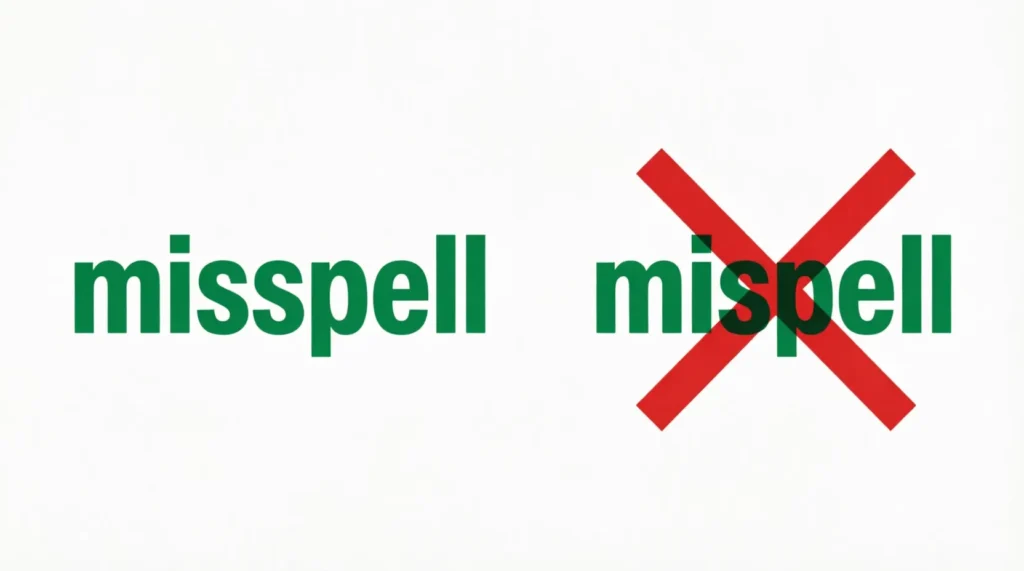
In short, misspell is the correct English word, while mispell is a common misspelling. If you’ve ever wondered which version belongs in your writing, this guide will help you understand the difference, remember the correct spelling, and use it with confidence.
[IMAGE: Student comparing the words “misspell” and “mispell” in a notebook]
What Are the misspell vs mispell? (And Why They Matter)
Have you ever typed a word, looked at it twice, and still wondered if it was correct? Many students and even experienced writers pause when they see misspell and mispell, unsure which one is right.
The phrase misspell vs mispell compares the correct spelling, misspell, with the incorrect spelling, mispell. The confusion happens because English spelling rules are not always obvious.
Knowing the difference matters because accurate spelling makes your writing easier to read and understand. Whether you are writing an essay, sending an email, or taking a spelling test, using the correct form helps you communicate clearly.
Literacy educators and language arts researchers often remind students that recognizing common spelling mistakes builds stronger reading and writing habits. Once you understand this one, you are much less likely to make the same mistake again.
Now that you know the basic difference, let’s look at clear examples that make the rule easy to remember.
The Best Examples of the misspell vs mispell
Correct: I always misspell the word “necessary.”
Incorrect: I always mispell the word “necessary.”
Correct: Don’t misspell your teacher’s name.
Incorrect: Please don’t mispell this vocabulary word.
Correct: Many children misspell difficult words at first.
Correct: Even adults sometimes misspell long scientific terms.
Incorrect: She didn’t realize she had written mispell.
Correct: The spell checker noticed I misspelled the address.
Correct: Try not to misspell important words in your report.
Correct: You can improve if you practice words you often misspell.
Incorrect: My notebook says mispell, but that’s not correct.
Correct: Writers sometimes misspell unfamiliar names.
Correct: Read your work carefully so you don’t misspell keywords.
Correct: It is easy to misspell words with double letters.
Correct: Teachers encourage students to fix every word they misspell.
Incorrect: The dictionary does not list mispell as a correct spelling.
Correct: I accidentally misspelled “beautiful” yesterday.
Correct: You won’t misspell this word once you know the rule.
These examples work because they show the word in real situations you might see at school or at home. They also highlight the visual difference between the correct spelling and the common mistake, making it easier for your brain to remember.
How to Use the misspell vs mispell in Your Writing
Remember that misspell has two “s” letters together. The prefix mis- joins the word spell, so both “s” letters stay.
Before you submit your work, read it slowly and look for words that seem unusual. If you see mispell, replace it with misspell.
Use a dictionary or spell checker when you feel unsure. These tools can help you catch mistakes before someone else reads your writing.
Practice writing the correct word several times until it feels natural.
Example sentence:
“I used to misspell the word ‘accommodate,’ but now I remember the correct spelling.”
As you practice, the correct version will quickly become automatic.
misspell vs mispell in Poems and Stories
Creative writing often includes characters who make mistakes as part of learning. That makes misspell vs mispell a useful topic even in stories and poems.
Aisha smiled and laughed, “I used to misspell every hard word, but every page helped me grow.”
Miguel closed his notebook. “This time I didn’t misspell my spelling words,” he whispered proudly.
Priya read her poem aloud. Every corrected word gave her confidence, and she no longer worried about simple spelling mistakes.
Creative writing teachers encourage students to include realistic learning moments because they help readers connect with characters and celebrate progress.
Common Mistakes Students Make With the misspell vs mispell
Writing mispell because it looks shorter. This is very common. The correct spelling keeps both “s” letters from mis- and spell.
Forgetting where the double letters belong. English has many words with double letters, so this confusion is normal. Practice helps you remember.
Trusting memory instead of checking. If you are unsure, take a few seconds to look up the word in a dictionary or spell checker.
Assuming both spellings are accepted. Only misspell is considered correct in standard English. Mispell is simply a spelling error.
Repeating the mistake because of typing too quickly. Slow down when proofreading. A careful final read often catches errors you missed the first time.
Once you know these common mistakes, you can avoid them more easily in your own writing.
Fun Activities to Practice the misspell vs mispell
Grab a pencil and make a two-column chart. Write correct spellings on one side and common misspellings on the other.
Challenge yourself to find five words with double letters, then write each one in a complete sentence.
Play a spelling game with a friend. One person reads words aloud while the other writes them correctly.
Create a colorful poster that explains why misspell has two “s” letters. Hang it near your study space.
Complete a proofreading worksheet by correcting words like mispell, beleive, and definately. You will sharpen your editing skills at the same time.
Read a short story and circle any words you think are difficult to spell. Check them afterward with a dictionary.
These activities make spelling practice feel less like homework and more like a fun challenge.
What NOT to Do With the misspell vs mispell
Don’t assume shorter words are always correct. Removing one “s” changes the correct spelling into a mistake.
Don’t memorize only by sound. Both words sound almost the same, so you need to remember how the word looks.
Don’t ignore spell-check suggestions. They often catch mistakes that your eyes skip over.
Don’t believe that mispell is an accepted alternative. It is not an alternative spelling in standard English. The correct form is always misspell.
Now that you know what to avoid, let’s answer a few questions students often ask.
Frequently Asked Questions About misspell vs mispell
Is misspell or mispell correct?
Misspell is the correct spelling. Mispell is a common mistake caused by leaving out one of the “s” letters.
Why do people write “mispell” instead of “misspell”?
Many people accidentally remove one “s” because the word looks simpler. Since English contains many double-letter words, this kind of mistake happens often.
How can I remember the correct spelling of misspell?
Think of the word as mis + spell. When you join them together, both “s” letters remain, giving you misspell.
Can spell check find “mispell”?
Most modern spell-check programs recognize mispell as incorrect and suggest misspell instead. It is still a good habit to proofread your work yourself.
Is misspell suitable for school writing?
Yes. Misspell is the standard spelling used in books, dictionaries, classrooms, and formal writing. Using the correct spelling helps your writing look polished and professional.
Final Thoughts on the misspell vs mispell
Understanding misspell vs mispell is easier than it first seems. Once you know that misspell is correct and mispell is simply a common mistake, you already have the most important part mastered.
You also learned why the word keeps both “s” letters, saw plenty of real examples, and explored practical ways to remember the correct spelling. These simple strategies can help you avoid the mistake in essays, homework, emails, and creative writing.
Remember that every writer makes spelling mistakes from time to time. The difference is that strong writers check, learn, and improve with practice.
Keep reading, keep writing, and keep practicing—you’ve got this, and every correctly spelled word makes your writing even stronger.
Liam Nguyen is a passionate educator and writer with a deep love for figurative language. He holds a master’s degree in Creative Writing and has spent eight years teaching at various educational settings, focusing on language enrichment programs for children from grades 2-6. His expertise in crafting metaphorical language and similes into captivating content stems from his belief that storytelling is the heartbeat of learning. Liam’s contributions to SimilePedia span from emotion-driven examples to color-inspired narrative tools. He is committed to fostering a creative environment where students can explore and find joy in their unique expressions.