In short, sites vs sights is about learning the difference between two words that sound the same but have different meanings. Once you understand when to use each one, your writing will become clearer, more accurate, and more confident. Keep reading for simple explanations, examples, and fun ways to remember them.
[IMAGE: Student comparing the words “site” and “sight” with simple illustrations]
What Are the sites vs sights? (And Why They Matter)
Have you ever stared at your homework wondering whether to write “historic sites” or “historic sights”? You’re not alone. Many students mix up these words because they sound exactly the same.
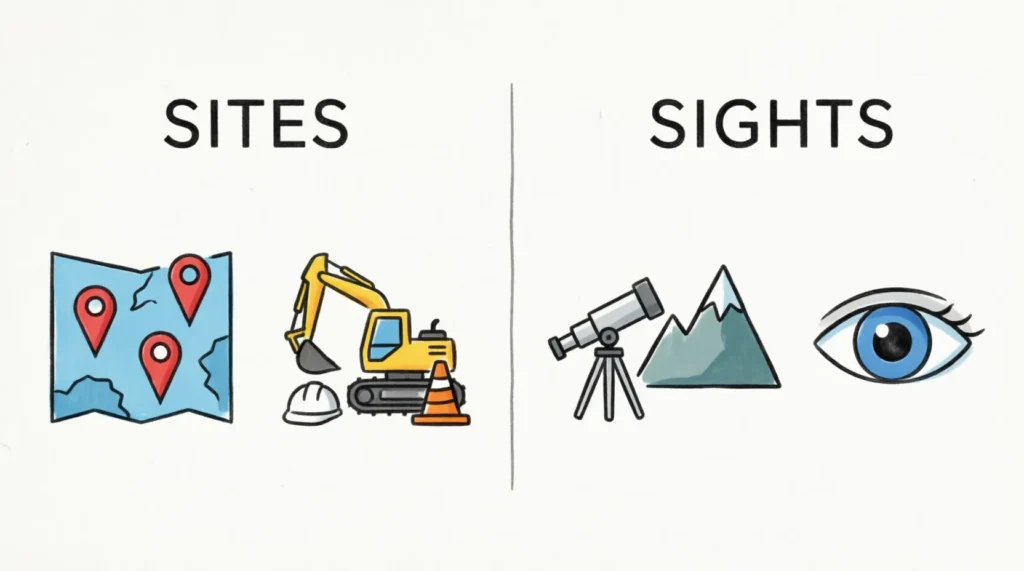
Sites vs sights compares two homophones—words that sound alike but have different meanings. A site is a place or location, while a sight is something you see or your ability to see.
Knowing the difference helps you write stronger essays, understand books more easily, and avoid common spelling mistakes on quizzes and exams. Whether you are describing a vacation or writing a research report, choosing the correct word makes your meaning clear.
Language arts researchers and literacy educators encourage students to learn commonly confused words through examples instead of memorizing long lists. Once you see these words in context, you will remember them much more easily.
Now that you know the basic difference, let’s look at plenty of examples you can use right away.
The Best Examples of the sites vs sights
We visited several historic sites during our class trip.
The Grand Canyon is one of the most breathtaking sights in the United States.
Construction workers arrived at the building site early in the morning.
The mountain sights amazed every traveler.
Archaeologists carefully studied the ancient site.
The city’s famous sights attracted thousands of tourists.
Please meet me at the project site after school.
The colorful autumn sights made Maya smile.
Scientists protected the fossil site from damage.
The beautiful sights along the beach were unforgettable.
The camping site had clean water and plenty of trees.
Tourists took pictures of all the famous sights.
Our teacher showed us the excavation site in a documentary.
The night-time sights of the city sparkled with lights.
The accident site was closed while police investigated.
The museum guide pointed out the most popular sights in the gallery.
The school selected a new site for the science garden.
The colorful festival offered wonderful sights and sounds.
Engineers inspected the construction site every morning.
The castle was one of the most memorable sights on our vacation.
These examples work because they place each word in a real situation that you can easily imagine. Notice that site almost always refers to a location, while sight relates to seeing or something worth looking at. Paying attention to the context helps you choose the correct spelling every time.
[IMAGE: Split illustration showing a construction site on one side and beautiful sightseeing landmarks on the other]
How to Use the sites vs sights in Your Writing
Ask yourself if you are talking about a place. If the answer is yes, you probably need site.
Think about whether you are describing something you can see or your vision. If so, sight is usually the correct choice.
Read your sentence aloud. Even though the words sound the same, thinking about the meaning helps you pick the right spelling.
Use a memory trick: site contains the word “it,” reminding you of a specific place, while sight contains “eye” sounds because it relates to seeing.
Example sentence:
“My family visited several historic sites, and the mountain sights were unforgettable.”
With a little practice, you will start choosing the correct word without even thinking about it.
Sites vs sights in Poems and Stories
Creative writing becomes stronger when you choose the right word. Using site instead of sight, or the other way around, can completely change the meaning of your story.
“Amina climbed the hill with delight, The sunrise was a glorious sight.”
“Carlos explored the ancient site, Wondering who had lived there long ago.”
“Lina sketched every beautiful sight she found, While Noah marked each historical site on the map.”
Poets and authors carefully choose these words because they create precise images for readers. Creative writing teachers often remind students that accurate word choice helps readers picture every scene more clearly.
As you become familiar with these examples, spotting mistakes becomes much easier.
Common Mistakes Students Make With the sites vs sights
Using “site” when talking about something you see. If you mean a beautiful view or attraction, use sight, not site.
Writing “sights” when referring to a location. Historic places, construction areas, and campsites are all sites.
Assuming the words are interchangeable. They sound alike, but their meanings are completely different. Always think about what your sentence is describing.
Forgetting that “sightseeing” comes from “sight.” People go sightseeing to see interesting things, not to visit “site-seeing.”
Ignoring context while proofreading. Reading your work one more time helps you catch these easy-to-miss homophone errors.
Everyone makes these mistakes at first. The good news is that you can fix them quickly by focusing on meaning instead of pronunciation.
Now let’s make learning even more enjoyable with a few hands-on activities.
Fun Activities to Practice the sites vs sights
Create two columns on a sheet of paper labeled “Site” and “Sight.” Challenge yourself to sort twenty words or sentences into the correct column.
Grab a pencil and write five sentences using site correctly and five using sight correctly. Then ask a friend or family member to check your work.
Play a classroom game where one student reads a sentence aloud and everyone else holds up a card showing either “site” or “sight.”
Draw two simple pictures. One should show a construction site, and the other should show a beautiful sight. Write two descriptive sentences under each drawing.
Read a travel article or story and highlight every example of site and sight. Discuss why each spelling was chosen.
Create your own worksheet by mixing correct and incorrect sentences. Then challenge yourself or a classmate to find and fix every mistake.
Practicing in different ways helps you remember the difference long after the lesson ends.
What NOT to Do With the sites vs sights
Don’t choose a word based only on how it sounds. These homophones require you to think about meaning.
Don’t assume every tourist attraction is automatically a site. Sometimes you are describing the attraction itself as a wonderful sight.
Don’t skip proofreading. Even experienced writers accidentally confuse these words from time to time.
Don’t memorize definitions without using them in sentences. Real examples help you remember much better than isolated vocabulary lists.
Understanding these common myths makes learning the correct usage much easier.
Frequently Asked Questions About the sites vs sights
What is the difference between site and sight?
A site is a place or location, such as a construction site or archaeological site. A sight is something you see or your ability to see, like a beautiful sunset or your eyesight.
How do you remember sites vs sights?
A simple trick is to connect site with a location and sight with seeing. Every time you write one of these words, ask yourself whether you are talking about a place or something visible.
Can “sites” mean websites?
Yes. A website is often shortened to “site.” For example, people might say, “I visited three educational sites to research my project.”
What is a sentence using both site and sight?
Here’s one example: “We explored the ancient site, and the view from the hill was an unforgettable sight.” Using both words together is a great way to practice.
Why do students confuse sites vs sights?
Students confuse these words because they are homophones—they sound exactly alike. Literacy researchers recommend learning them through meaningful examples, which makes the difference much easier to remember.
Final Thoughts on the sites vs sights
Learning sites vs sights may seem tricky at first, but the difference becomes clear once you focus on meaning instead of sound. Remember that a site is a place, while a sight is something you see.
You have explored clear definitions, practical examples, common mistakes, writing tips, and fun activities. These strategies can help you use both words correctly in essays, stories, travel writing, and everyday conversations.
Language arts educators know that mastering commonly confused words takes practice, not perfection. Every sentence you write gives you another chance to improve.
Keep reading, keep writing, and keep asking questions. Your vocabulary will continue to grow, and your writing will become stronger with every page you create.
Liam Nguyen is a passionate educator and writer with a deep love for figurative language. He holds a master’s degree in Creative Writing and has spent eight years teaching at various educational settings, focusing on language enrichment programs for children from grades 2-6. His expertise in crafting metaphorical language and similes into captivating content stems from his belief that storytelling is the heartbeat of learning. Liam’s contributions to SimilePedia span from emotion-driven examples to color-inspired narrative tools. He is committed to fostering a creative environment where students can explore and find joy in their unique expressions.