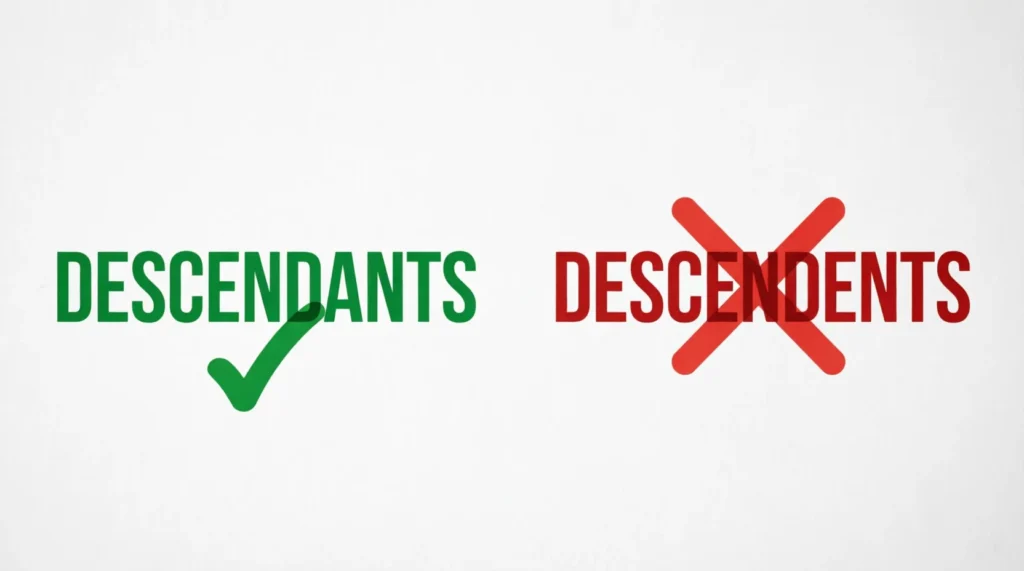
In short, descendants is the correct spelling when you mean people who come from an ancestor. Descendents is usually considered a misspelling, although some dictionaries list it as a rare variant. Keep reading to learn the difference, remember the correct spelling, and avoid this common writing mistake.
[IMAGE: Student comparing the words “descendents” and “descendants” with a green check mark beside “descendants”]
What Are descendents vs descendants? (And Why They Matter)
Have you ever stared at your homework, typed a word into your document, and wondered, “Is this spelling actually right?” You’re not alone. Many students pause when they see descendents and descendants because the words look almost identical.
The topic of descendents vs descendants is really about choosing the correct spelling. In modern English, descendants is the standard spelling for people who are related to someone from an earlier generation, such as children, grandchildren, or later family members.
Knowing the correct spelling matters because you may see this word in history books, family tree projects, biographies, literature, and exams. Using the right form also helps your writing appear clear and polished.
Language arts researchers and literacy educators encourage students to pay attention to commonly confused words because accurate spelling improves both reading comprehension and written communication. Once you understand this difference, you will notice it everywhere you read.
Now that you know what the topic means, let’s look at examples that show the correct word in real sentences.
The Best Examples of descendents vs descendants
Here are examples showing how descendants should be used in everyday writing:
The king’s descendants ruled the kingdom for hundreds of years.
Scientists studied the descendants of the first settlers.
Maria proudly shared stories about her grandparents and their descendants.
Many descendants still live in the same village today.
The museum honored the descendants of local heroes.
His descendants continue the family business.
Researchers interviewed the descendants of early explorers.
The family’s descendants gathered for a large reunion.
The chief’s descendants preserved many cultural traditions.
Our teacher explained that we are all someone’s descendants.
The castle belongs to the descendants of the original owner.
Written records helped identify the descendants of the famous inventor.
Several descendants attended the anniversary celebration.
The tribe welcomed the descendants of its founders.
Future descendants may discover these letters one day.
The author dedicated the book to her descendants.
Historians traced the descendants through old census records.
The descendants proudly carried on family customs.
Archaeologists worked with the descendants of the ancient community.
The family’s descendants now live across the world.
Notice that every sentence uses descendants, not descendents. The word fits naturally whenever you are talking about people who come from earlier family members.
Good examples are clear, meaningful, and easy to picture. They also help you connect the word to real-life situations like family history, genealogy, history class, and storytelling.
Next, let’s make sure you know exactly how to use the correct spelling in your own writing.
How to Use descendents vs descendants in Your Writing
Remember that descendants is the standard spelling you should use in school assignments, essays, and reports. If you are unsure, choose this spelling.
Think about family relationships. If you are talking about children, grandchildren, or later generations, descendants is almost always the correct word.
Proofread your writing. If you accidentally typed descendents, check whether your teacher or style guide expects the standard spelling descendants.
Read your sentence aloud. Ask yourself, “Am I talking about people who came after an ancestor?” If the answer is yes, descendants is the word you want.
Example sentence:
“Emily discovered that she was one of the descendants of a famous artist.”
As you practice, the correct spelling will soon become automatic.
descendents vs descendants in Poems and Stories
Creative writers often use family history to build emotion and connection. When you write stories or poems, descendants helps readers understand how generations are linked.
Poem Example
Amina smiled beneath the ancient tree, Where descendants gathered happily. Old stories traveled through the air, A family treasure all could share.
Story Example
Kai opened an old wooden box filled with faded photographs. He realized he was looking at the faces of his great-grandparents and the many descendants who followed them.
Story Example
Sofia listened as her grandmother described their family’s journey across the ocean. She hoped future descendants would continue telling the same inspiring story.
Creative writing teachers encourage students to use family connections because they add emotion, history, and meaning. You can make your own stories stronger by choosing accurate words that help readers understand relationships.
Before you finish your next assignment, it also helps to know the mistakes many students make.
Common Mistakes Students Make With descendents vs descendants
Using “descendents” in formal writing This is the most common mistake. Although it has appeared as a rare spelling, schools, dictionaries, and style guides generally recommend descendants.
Confusing descendants with ancestors These words are opposites. Ancestors came before you, while descendants come after them.
Thinking both spellings are equally common They are not. You will see descendants far more often in books, articles, and academic writing.
Using the word for unrelated people Descendants must have a family connection to an earlier ancestor. Friends, neighbors, and classmates are not descendants unless they share that relationship.
Skipping the proofreading step A quick spelling check can help you catch this mistake before turning in your work. Everyone makes spelling errors sometimes, and this one is easy to fix.
Now let’s make learning even more enjoyable with a few simple activities.
Fun Activities to Practice descendents vs descendants
Family Tree Challenge Grab a pencil and draw a simple family tree. Label each generation so you can clearly identify the descendants.
Word Detective Read a history article or biography and highlight every time you find the word descendants. See how authors naturally use it.
Sentence Swap Write five sentences using descendants correctly. Then ask a friend or family member to check your work.
History Match Game Create cards with famous historical figures on one side and their descendants on the other. Match them as quickly as you can.
Editing Practice Challenge yourself by correcting sentences that mistakenly use descendents. This activity helps your eyes recognize the correct spelling more quickly.
These activities only take a few minutes, but they can make a big difference in your confidence.
What NOT to Do With descendents vs descendants
Don’t assume every version you see online is correct. Some websites contain spelling mistakes. Trust reliable dictionaries and educational resources.
Don’t confuse descendants with ancestors. Remember that ancestors come before you, while descendants come after you.
Don’t believe “descendents” is the preferred spelling. The accepted spelling in modern English is descendants.
Don’t memorize the word without using it. You will remember the spelling much better if you write your own sentences and read them aloud.
By avoiding these habits, your writing will become clearer and more accurate.
Frequently Asked Questions About descendents vs descendants
Is descendents or descendants correct?
Descendants is the correct and standard spelling in modern English. While descendents has appeared as a rare alternative spelling, it is not the preferred form for school or professional writing.
What does descendants mean?
Descendants are people who come from an earlier ancestor. They include children, grandchildren, great-grandchildren, and later generations of the same family.
Why do people spell descendants as descendents?
The words sound very similar, so many people accidentally replace the “a” with an “e.” It is a common spelling mistake that proofreading can easily fix.
How can I remember the correct spelling of descendants?
Think of the word ancestor. Descendants are connected to ancestors, so remembering family generations can help you recall the correct spelling with the letter “a.”
Can I use descendents in school assignments?
It is much safer to use descendants. Teachers, exams, dictionaries, and style guides expect this spelling, so it is the best choice for your writing.
Final Thoughts on descendents vs descendants
At first glance, descendents and descendants seem almost identical. That is exactly why so many students mix them up.
The good news is that the answer is simple. In modern English, descendants is the standard spelling you should use whenever you are writing about people who come from earlier generations.
As you continue reading books, writing essays, and completing assignments, you will see this word again and again. The more you practice, the more natural the correct spelling will feel.
Every strong writer learns by noticing small details like this. Keep practicing, keep asking questions, and remember that every sentence you write is another step toward becoming a more confident writer.
Jamal Rodriguez is a poet and author who has been writing professionally for over a decade. With a Bachelor’s degree in Creative Writing, Jamal’s expertise lies in the use of vivid imagery and emotional depth in poetic language. Fascinated by the limitless possibilities of similes and metaphors, he joined SimilePedia to share his knowledge with budding writers. Jamal focuses on creating content for creative writers and poets, helping them understand the emotional resonance that figurative language can evoke. Through his work, he aims to inspire others to explore their own creative boundaries and embrace the beauty of language as an art form. His contributions include a range of exercises that stimulate imagination across all grade levels.